
AI Chatbot Development Cost in 2026: Real Prices and Timelines
- August 7, 2026 12:00 AM
- By Kendall Chris
- 0 Comments
- 9
- AI & Technology
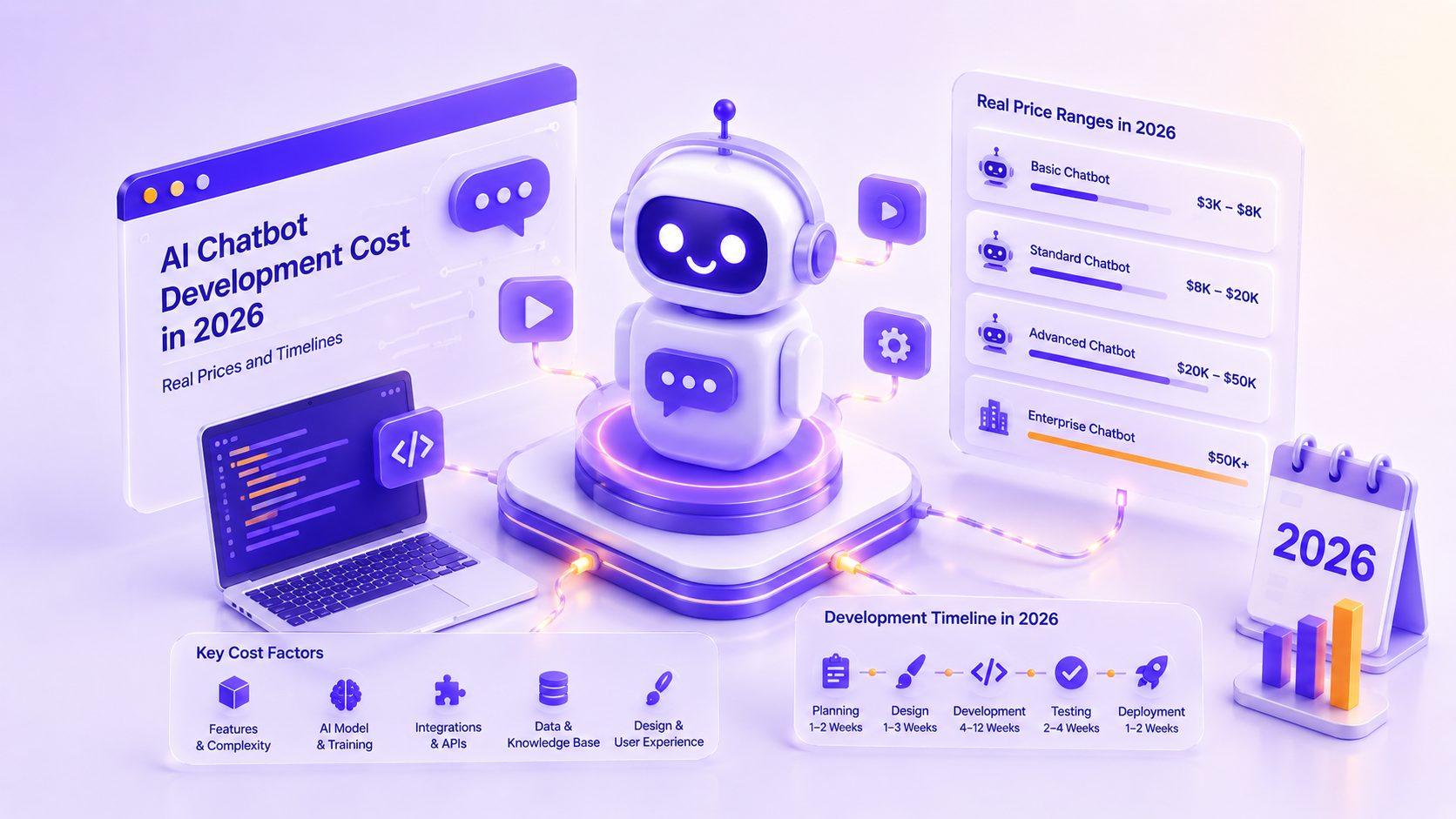
AI Chatbot Development Cost at a Glance
At a very high level there are four "tiers of chatbots" in existence today, and the gap is less to do with whether they look good (as these are all pretty basic) and more to do with what type of algorithm was deployed in order to let them speak! The ranges below apply to professionally constructed products, not including ongoing hosting and support, which we address below.
| Chatbot Type | Typical Build Cost | What It Does | Best For |
| Rule-based / scripted | $5,000 to $15,000 | Follows fixed decision trees and keyword matching; no real understanding | Simple FAQs, lead capture, menu-style flows |
| LLM-powered | $20,000 to $60,000 | Understands natural language, answers from a knowledge base, holds context | Customer support, internal help, product Q&A |
| Custom-trained / RAG | $50,000 to $120,000 | Retrieves from your own data, tuned to your domain and tone | Support at scale, technical or regulated domains |
| Agentic / enterprise | $120,000+ | Takes actions across systems, not just answers: bookings, orders, tickets | Complex operations, high-volume automation |
The most frequent error buyer(s) made was setting the price of the tier which they desire and looking at the price of the tier which they need. A question answering bot is not equal to an action-executing bot and section to follow is detailing how much the price jumped that high.
What Determines the Cost of an AI Chatbot?
Four of these factors have almost the entire effort in setting the price. Know the 4-driving price, spend on what counts and eliminate what does not work.
Chatbot type (scripted vs LLM-powered vs agentic)
This is the biggest lever of them all. A scripted bot follows a flowchart that you create, so it's cheap, predictable and has constraints, if the user asks something that wasn't on the script, it breaks. An LLM driven bot understands natural language and can deal with questions not specifically trained for in your flowchart; this is where the 'usefulness' takes a huge leap and also a huge jump up in cost. An agentic bot takes it one step further; it doesn't just answer, it takes an action – make the appointment, open a ticket, update the database entry. Each step up this ladder entails a huge rise in engineering, testing, and precautions, as a bot that can 'do' things can do things wrongly, and making sure it doesn't do the latter is actual work. Confused where a chatbot ends and an AI agent begins, then that's covered as part of the FAQs at the end of this guide.
Model and API costs (per-token economics)
The LLMs of today don’t cost a fixed price. Instead, you pay per token, and tokens are approximately 75 percent of a word. So, you pay for the tokens you put into the LLM (your prompt, and any instructions or context you give it) - the input - and you also pay for the output that you get - the LLM’s response - and output typically costs 3-4x as much as input. The price varies significantly by LLM. As of today, for instance, a smaller model like GPT-4o mini costs $0.00000015 per input token (or $0.15 per million) and $0.0000006 per output token ($0.60 per million). Heavier models cost a lot more, making your LLM choice a real budget item rather than a mere technical choice. You can and should look up the current GPT and Claude API pricing and model differences. The key takeaway of these pricing decisions for bot designers is to avoid reaching to a high-end (expensive) LLM unnecessarily, and use a lower-end (cheaper) model when appropriate.
Integrations (CRM, helpdesk, internal data)
A chatbot that runs in isolation is cheap and not very powerful. It begins to have value when you link it to the systems running in your business today: CRM for looking up a customer, helpdesk for creating/inquiring about a ticket, order fulfillment for a factual status. Each of these integrations has added development time, maintenance overhead, and the additional failure point of needing to manage yet another service. This is often where the cost of the project starts to creep up. 'Connect it to our systems' is a cheap statement but a real engineering task for each system.
Training data and knowledge-based preparation
An LLM-bot is only as good as what it can access. Preparing that knowledge - your documents - cleaning them, organizing them, relating them in a way so the bot gets the right answer, is a legitimate part of the job that customers routinely don’t realize. Inaccurate, contradictory, or outdated source content leads to confident but wrong answers from the bot, so all that preparation isn’t optional admin, it’s the difference between a tool that adds value and one that creates liabilities. Your more specialized your area, the more important it becomes.
Build vs Buy: Custom Chatbot or Off-the-Shelf Platform?
If it’s your first ‘real’ decision, it will likely be whether to develop or develop a robot, or if configuring out of the box works. There’s no such thing as a universally good / bad answer to this – it largely comes down to exactly what you want your bot to do and how much want yourself in charge of the process to achieve that end.
| Factor | Off-the-Shelf Platform | Custom Build |
| Upfront cost | Low; subscription-based | Higher; project-based |
| Time to launch | Days to weeks | Weeks to months |
| Flexibility | Limited to platform features | Fully tailored to your needs |
| Integrations | Prebuilt connectors only | Any system you need |
| Ongoing cost | Monthly per-seat or per-usage fees | Model and hosting costs, plus maintenance |
| Data control | Lives on the vendor's terms | You decide where data sits |
| Best for | Standard use cases, fast starts | Specific workflows, scale, differentiation |
The honest advice: unless you're already in a complex/specialized use case, a customer-support bot fielding common questions, for example - a platform off-the-shelf will get you live quickly and inexpensively-and is likely a wise first step. The second you need deep integration with your internal systems, a private/proprietary knowledge base, complete control over your data and responses, and/or the scale at which per-seat pricing no longer makes economic sense, a custom build is already cheaper, more capable. Plenty of companies wisely choose a platform for validation and then opt for custom once they understand precisely what they want.
Realistic Timelines: How Long Does Chatbot Development Take?
Timelines reflect these tiers well. A simple, rules-based, or “off the shelf” bot you can have live in one to three weeks – since a huge proportion of the work is content & configuration. A more capable bot you “plug in” (with, say, a knowledge base and two integrations): 4 to 10 weeks; for that time, you’re dealing with data prep, integrations, conversations design, and testing the bot to be sure of its behavior. And if you’re custom-training models, or building multi-step agents: 3-6 months+, to tune knowledge retrieval, set up a secure web of interactions across multiple systems, and layer in protections around taking actions.
Most users attempt to skip over the testing phase, and that's the phase where there's the biggest payoff from patience. A bot doesn't fail like traditional software fails. Chatbots can be confidently and catastrophically wrong, or misinterpret your intent and run-down irrelevant rabbit trails. But spotting those problems requires the context and flow of real conversations – all with the range of type stuff real users throw at your bot. Send a bot out the door without testing and the most common trip you'll trip up over is looking like a fool in front of a customer.
Ongoing Costs After Launch
Chatbot is not a purchase that’s on time payment, and that the costs associated is where there is usually a surprise to a budget. The following are two relevant and applicable classifications.
API / token consumption
Tokens used are consumed with each LLM-powered bot conversation, and you pay for those tokens. The monthly bill will correlate directly with the volume. Many users over a long conversation duration translates into many tokens, and thus a high bill. Low volume internal bots may be on the order of tens dollars per month; high volume bots that cater to the customer service queue (thousands of interactions per day) are orders of magnitude higher monthly costs. This is why model selection and prompt efficiency are budget considerations and not merely technical concerns and why attaching massive context to each bot request may result in a cost multiple times that of a well-tuned bot.
Monitoring, retraining, and content updates
You have to maintenance them - bots get worse if you don’t “Feed it, exercise it. Products and policies evolve, and the kinds of questions people have will drift - so you have to monitoring the conversations for breakdowns, adding to the bot’s knowledge base as data gets outdated or knowledge is added, and tweaking its behavior based on actual usage and user input. This must come as an ongoing operational cost, not as an item on a “go live” budget. And rest assured, you don’t win with a bot; you have to work to maintain its helpfulness, whereas not doing so leads to an invisibly failing product which everyone assumes went “dark” when we go live.
What Actually Works: Lessons from Real Deployments
Eventually few patterns hold across any industry and will remain more valuable than any price list. That insight helps explain another problem worth a company paying attention to. While we observed nearly all companies are using some form of artificial intelligence (AI), only a small fraction is getting much real value out of it-suggesting the challenges companies have realizing value from the technology relate to the execution, and not the technology itself. Here, three characteristics of effective-and profitable-chatbots. One is that scope discipline beats ambition. Successful bots know how to do one thing well before they attempt to do ten. For instance, a bot that is adept at the company’s top twenty most frequent support queries build more trust than one that tries to do everything and does everything half as well. Build small to demonstrate the concept and scale once it proves itself. The two is the data content really is the product. Model obsession causes teams to look for the optimal model to buy, but the quality of replies depends more on the quality of source information in terms of cleanliness and organization and its availability to respond quickly than it does on the model's version and tier. The more attention you give to the quality and structure of the source of knowledge, the more return on your bot. The third, by the way is a graceful handoff to a human. The best bots are designed with an acknowledgment of their limitations. A bot knows what it doesn't know. By design, they seamlessly hand off the conversations rather than trying to guess-in which case the conversation gets garbled. "Let me get someone who can help with that" goes farther with an annoyed customer than getting the wrong-or fabricated -information. Building that pathway to a live agent up front offers some of the highest returns of the entire build.
Common Mistakes That Inflate Chatbot Budgets
In fact, the bulk of budget overruns are due to only a few specific kinds of mistakes. The most expensive is deciding on an agentic bot when an LLM-based one would have done; you pay for the functionality of taking actions you will never use. Neglecting knowledge base preparation is also a common one since feeding a bot with noisy data generates wrong answers that are harder (and therefore more costly) to fix than if the work was done correctly initially. Cost overruns due to integration are a very reliable occurrence since "connect it to our systems" actually translates to the non-trivial work required on a per system basis. Finally, not considering on-going costs during the budgeting process leads to an unwelcome bill for token spend and maintenance instead of a predictable line item. Avoiding these four problems would contribute more to a chatbot budget than any haggling on build cost.
Final Thoughts
In 2026, a chatbot AI will set you back anywhere from a couple of thousand for a basic scripted bot to $150,000+ for a custom agentic system and the specific level of investment required hinges solely on what you need the bot to do. Clarify the objective first and then select the tier matching this objective rather than the level suggesting the most capability, then build ongoing model and maintenance costs into the budget from the outset. A well scoped chatbot that performs one task well is worth considerably more than one that attempts to manage multiple tasks poorly.
If you are weighing a chatbot build and want an honest read on which tier fits your use case and what it will really cost to run, our team is happy to talk it through.
Frequently Asked Questions

AEO vs SEO vs GEO: What's the Difference in 2026?
- July 21, 2026
- By Kendall Chris
0 COMMENTS
Leave A Reply
Your email address will not be published. Required fields are marked *
Cancel reply