Enterprise systems that fit how your business actually runs
What sits under enterprise solutions
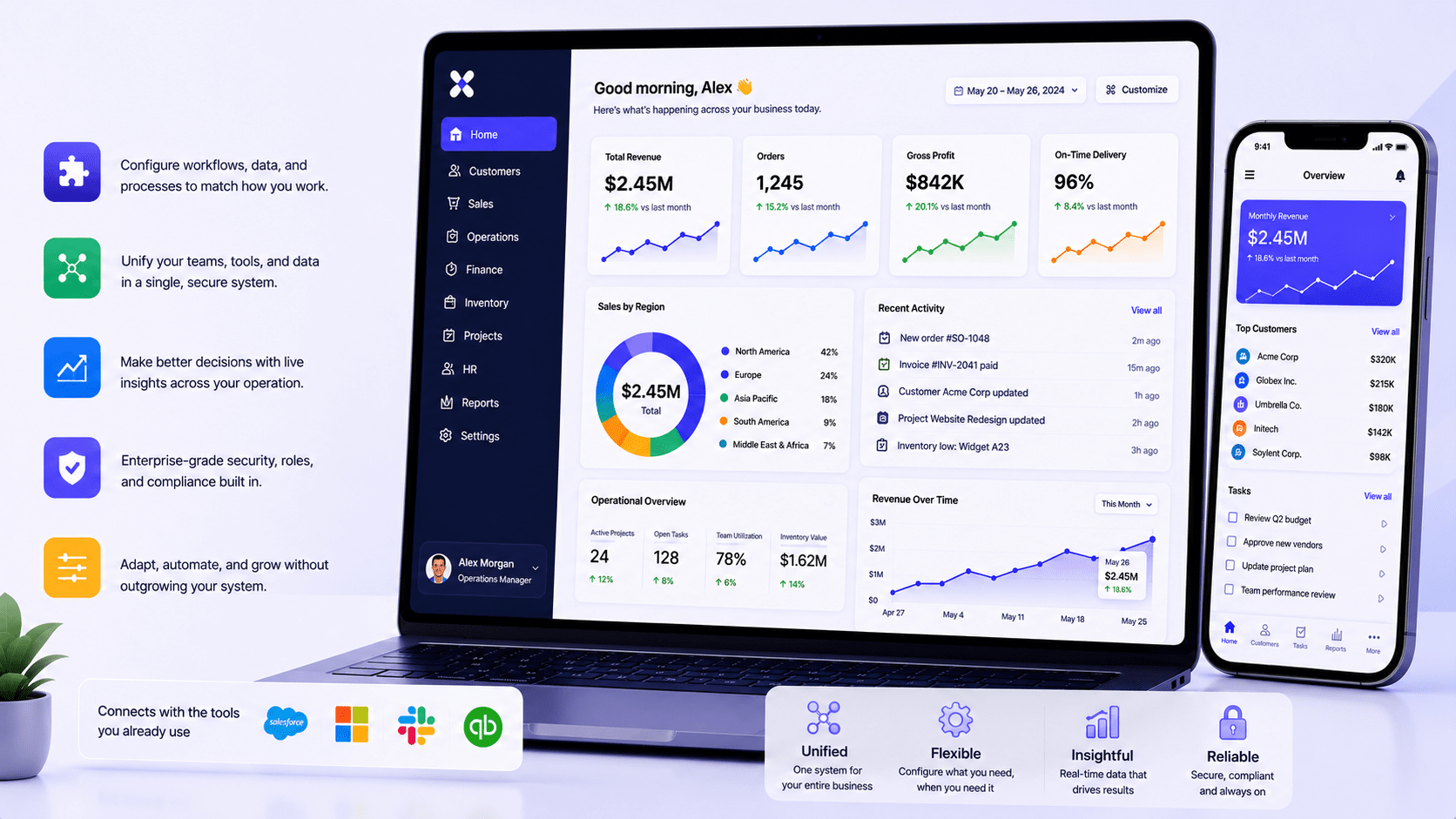
ERP to bring core operations into one connected system, and CRM to manage customer relationships and sales properly. Custom or platform based.
Who this is for
Businesses running on spreadsheets past the point they should be, where the workbook everyone depends on has become a risk nobody wants to name.
Companies with disconnected systems, where the same information is entered into several places and none of them fully agree.
Growing operations where the manual coordination that worked at a smaller scale now consumes real management time every week.
Businesses with existing ERP or CRM that is not working, whether badly implemented, never properly adopted, or outgrown.
Organisations facing a compliance or audit requirement that their current record-keeping cannot satisfy.
The decision, the risks, and the real cost
Custom or platform, why these projects fail, and the five-year total that actually matters.
Custom or platform? The decision that matters most
This is the choice that determines your costs and your flexibility for the next decade, so it deserves proper thought rather than a vendor's preference.
Implementing an established platform makes sense when a mature product already covers most of what you need. You get proven software faster, a large pool of people who know it, ongoing development funded by the vendor, and a lower initial cost. In exchange you accept the platform's way of doing things, ongoing licence fees that scale with users, and limits on how far it can bend to your process.
Building custom makes sense when your processes are genuinely distinctive and bending your business to fit packaged software would cost more than it saves, when licence costs at your scale become punishing, or when the system is a competitive advantage rather than administrative overhead. You get software shaped exactly around how you work, and you own it outright. In exchange you carry the full build cost and the responsibility for its future.
Most businesses that think they need custom actually need a well-configured platform. A minority genuinely need custom and are badly served by being forced into a product. Our assessment stage exists to tell you which you are, and we will say so plainly even when the answer is the smaller engagement.
Why these projects fail, and how we avoid it
Enterprise software has a poor reputation for good reason. Projects overrun, budgets inflate, and systems get delivered that nobody uses. The causes are consistent and almost never technical.
Scope that was never properly understood. The project starts before anyone has mapped how the business actually works. We spend real time on this first, including talking to the people doing the job rather than only the people describing it.
Data that was worse than anyone admitted. Migration reveals years of duplicates, gaps and inconsistencies. We audit data early, because discovering it late is what turns a timeline into a crisis.
No one brought the users along. A system imposed on people who were not consulted gets worked around. We involve the people who will use it, and we train properly rather than sending a manual.
Everything at once. Big-bang launches concentrate all the risk into one day. Where the situation allows, we phase delivery so value arrives early and problems surface while they are still small.
What enterprise projects cost, honestly
Industry ranges, and this is a category where ranges are genuinely wide.
Implementing a platform for a small to medium business typically starts in the mid five figures once configuration, data migration, integration and training are included, and rises considerably with complexity and user count. On top you pay ongoing licence fees per user, which over five years often exceed the implementation cost and should be modelled from the start.
Custom builds start in the low tens of thousands for focused systems and rise substantially for full operational platforms. There are no licence fees, but you carry hosting and maintenance.
The comparison that matters is not the first invoice but the five-year total, including licences, and the cost of the manual work the system replaces. We build that comparison with you during assessment, using your real numbers, before you commit to a direction.
How we work
-
01
Assessment firstHow your business actually operates, what your systems do and fail to do, the state of your data, and a realistic outcome.
-
02
RecommendationPlatform or custom, with the reasoning and a five-year cost comparison.
-
03
Design and planningAgreed with you and with the people who will use the system.
-
04
Build or configureIn phases where sensible, so value arrives early.
-
05
Data migrationTested and verified rather than assumed.
-
06
Training and launchThen the settling-in period, and ongoing support as the business changes.
Why Raydiant Webs
We do both, so our advice is not a sales strategy. A firm that only implements one platform will always conclude you need that platform. We have no such incentive.
Real integration depth. Enterprise work is mostly integration, and our team has built systems across Java, .NET, Python and PHP, including Oracle-backed platforms. Connecting your new system to what you already run is the part that most often goes wrong, and it is the part we are strongest on.
We build the rest too. Web, mobile and desktop applications that connect to your enterprise system come from the same team, so the whole thing is designed coherently rather than negotiated between vendors. And if you are a fifteen-person business being sold a solution designed for four hundred, we will tell you.
Enterprise solutions FAQ
It depends on how distinctive your processes are, your scale, and the five-year cost including licences. Most businesses are better served by a well-configured platform. Some genuinely need custom. Our assessment tells you which, before you commit.
For ERP, Odoo and SAP among others. For CRM, Salesforce and HubSpot among others. We also build custom systems where that is the better answer.
Months rather than weeks, with the range depending heavily on scope, data condition and how many systems must be integrated. Phased delivery means you get working parts earlier rather than waiting for everything.
It is audited early, cleaned, migrated in stages and verified against the source. Data is the most underestimated part of these projects and we treat it accordingly.
That depends on whether they were involved and trained, which is why we treat adoption as part of the project rather than something that happens afterwards. A system nobody uses is a failed project regardless of how well it works.
Often, yes. Poor configuration, missing integrations and low adoption are usually fixable without replacing the system, and that is a far cheaper answer than starting again.
For custom builds, completely: code, documentation and infrastructure access. For platform implementations you own your configuration, data and any custom development, within the platform's own licensing.
Talk about enterprise solutions
Tell us where the friction is and we will assess honestly whether a platform or a custom build fits, and what each would really cost.
- We build custom AND implement platforms, so no bias
- A five-year cost comparison, not just the first invoice
- Integration depth where these projects usually fail
Outgrowing your current systems?
Tell us where the friction is and we will assess honestly whether a platform or a custom build fits, and what each would really cost.