AEO vs SEO vs GEO: What's the Difference in 2026?
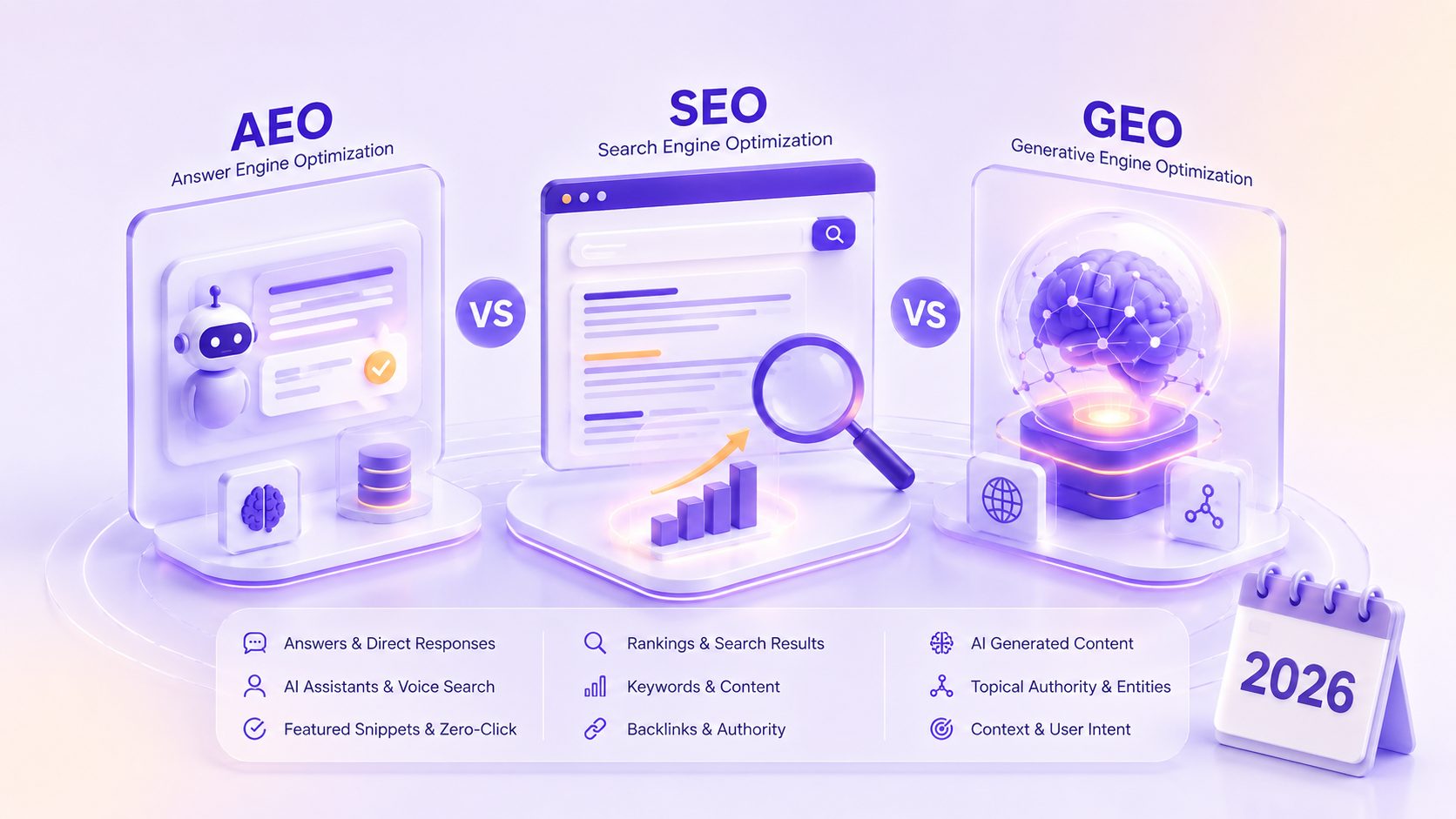
Here’s the short answer. SEO will land your page on a search results page. AEO will have your content pulled into a direct answer-whether that's in Google's AI Overviews or on a voice assistant. GEO will have your brand name dropped or referenced as AI tools, like ChatGPT and Perplexity, formulate answers.
They aren't competing disciplines; they're three layers of the same visibility problem. Whether you should invest your marketing dollars in one or all three comes down to one question: Where do your customers ask their questions? In 2026, the answer for most companies is somewhere in between. We’ll break down each of these practices in easy-to-understand terms, outline where they overlap and where they diverge, and present a decision tree to help you determine where to focus first.
Quick Answer: AEO vs SEO vs GEO in One Table
If you only remember one thing from this article, make it this table.
|
Factors |
SEO |
AEO |
GEO |
|
Optimizes for |
Search engine rankings |
Direct answer features |
AI-generated responses |
|
Where you win |
Results pages, local pack |
AI Overviews, snippets, voice |
ChatGPT, Perplexity, Gemini, Copilot |
|
Success metric |
Positions, clicks, traffic |
Answer presence, snippet wins |
Citations, brand mentions |
|
Core work |
Content, links, technical health |
Answer-first structure, schema, FAQs |
Entity signals, earned media, quotable facts |
|
Maturity |
Established, competitive |
Growing, still open |
New, wide open |
Pay attention to what the rows have in common. All columns begin from the same raw materials: clean, factual, well-organized content. They diverge in how each of the systems uses the data, which is where the actual work becomes bifurcated.
What Is SEO and What Does It Still Do Best?
That's the kind of SEO you already know – your content, technical strength, and authority metrics, and how to make your pages rise when someone looks for things on Google or Bing. Keywords, speed, internal links, back links, local listings, you name it. After 20 years, that all still rings true.
And yet, in spite of all the “RIP SEO” articles, it is going nowhere.
As of 2025, Google processes more than 5 trillion searches per year – that number eclipses the entire universe of AI technologies combined. When someone is searching for "emergency plumber Dublin 2," or "ergonomic office chair buy," a ranked listing, or even a Google map entry, still grabs that intent better than any technology ever could. SEO’s genius lies in its ability to compound – and what compounds is the traffic and the leads. Your pages once optimized and link building continue to generate business for you over years with minimal input.
What you will learn in time is that organic traffic will ultimately be the cheapest and the most sustainable source you ever own.
A perfect example would be an expertly crafted cost guide targeting a commercial search query which can potentially deliver a number of high quality inquiries on a monthly basis for 2-3 years – whereas a PPC campaign targeting the same search query will only work as long as there is budget attached. Because of that durability we consistently recommend our clients never abandon their SEO efforts regardless of how much their target customers use AI and intelligent search technologies. SEO is still the ultimate foundational element for all your marketing efforts – AI applications and virtual assistants predominantly depend on accessible content, rapid load speeds, and established trustworthiness, and all that is delivered through strong SEO.
SEO can be viewed as the structural foundation of your building; however, few people ever enter the building any more – they now acquire their required solutions at the front door.
What Is AEO (Answer Engine Optimization)?
Answer engine optimization is essentially the art of optimizing content such that machines can pull it up directly into an answer. Machines in this instance are things like Google’s AI Overviews, snippets, the People Also Ask box, and the single, read aloud response of a voice assistant. The reason there’s such an urgency to AEO is one single statistic: according to Similarweb, zero-click searches on Google rose from 56% to 69% in the year after AI Overviews launched (Similarweb).
Backlinks are not dead, nor are keywords, but much of the value of a search query has shifted from position one to the answer box immediately above it.
AEO is the process of capturing that value. In practice, AEO means getting the answer in the first sentence or two, writing headings in a human-like way (as humans would write questions) and a "true" FAQ section at the bottom of the page, marking everything with schema so machines know what they are reading, and generally rewarding clarity over cleverness. It's often amazing the difference the two can make; an article which, after three introductory paragraphs of scene-setting, does not appear in a search answer is often re-written to put the direct answer in the first two sentences and the scene-setting below it, only for it to show up in snippets and Overviews weeks later with no changes to content or links. We went through the full discipline in a guide to what answer engine optimization is, along with a 30-day starter plan, so we'll just keep it to the basics here: AEO is essentially SEO's finishing layer-taking your ranking content and making it quotable.
What Is GEO (Generative Engine Optimization)?
Generative Engine Optimization is working a very different machine, one in which large language models generate answers for us - your favorite version being the underlying logic that drives ChatGPT, Gemini, Claude, Perplexity and Copilot. When somebody asks one of these tools “which software agencies in Ireland are worth talking to?” that result isn't ranked; it's generated. GEO is the business of making sure your company's going to be on that generated result - positively and truthfully.
That audience isn't small anymore; OpenAI has projected up to 900 million weekly users for ChatGPT in 2026 - each and every one an entirely unindexed search. What gets you visibility in this system isn't what used to get you ranks. What has earned the attention of the researchers who coined the term, however, is the fact that (in the original GEO research at Princeton) a page’s presence within a generated answer can increase by 30-40% by including things like citations, quote-worthy stats, and an expert source.
It's why the actual "work" of GEO is closer to what you'd call "reputation engineering," and looks like this: Consistent business information wherever you may live. Coverage and mentions on third-party sites the model’s trust. Content that is rich with facts that can be easily verified (and are worth quoting). Monitoring what the AI says about your brand, when it says it (this matters, a LOT more than people realize) ... So, you can correct when the model gets it wrong. (It happens-mixing up locations, service offerings, even pricing, is not uncommon. Your month-long review of a standard prompt will catch these issues, and fixing the sources those are based on... Well, that's also GEO work. Our GEO product, however, is built on that precise loop.
How Are They Different? 5 Practical Distinctions
Definitions are easy. The differences that change your week-to-week work are these five.
1. The engine being optimized
SEO targets a ranking algorithm which sorts and ranks pages. AEO targets extraction systems that find one answer on the page that is the clean, single, direct answer. GEO targets language models that combine its knowledge base, derived from its training data, with live retrieval to produce a response. It’s the same web, but three fundamentally different readers of the content.
2. The success metric
Success for SEO is having the top position, and a click. Success for AEO is having a presence within the answer itself – with or without a click. GEO success is citation share – simply put: how many times is your business accurately found, when your buyer types a query in your buyer persona’s own words. If you keep tracking rankings and sessions, two thirds of your visibility now remain unknown.
3. Content format requirements
SEO is patient for long lead-ups. AEO punishes them, for an answer to have to be right at the top for a robot to be able to pick it up. GEO further makes its own demand: paragraphs that people can cite, attributed to name, with number, and claims a machine can go away and confirm. Empty prose cannot be cited.
4. Technical requirements
Technical SEO has three primary pillars: crawlability, speed and links. Technical AEO include structured data, logical header structure, and FAQ markup. Technical GEO are primarily external to your site: clean data on other properties (e.g. Directories, profiles and reviews) and a strong signals footprint within model’s input sources.
5. Measurement and tooling
SEO has mature tooling and clean attribution. AEO can be measured through snippet and AI Overview tracking, as well as overall impression data. GEO is by far the most challenging to track. I have set a consistent list of prompts each month and meticulously record mentions and citations. I then track the relatively modest, but steadily growing, stream of traffic generated via AI referrals. It's not perfect, but it does at least provide a clear sense of direction.
Which One Does Your Business Need? (Decision Framework)
The right blend of what and how can best be determined by how your prospects buy. There are really three scenarios that will cover the majority of your readers.
If you rely on local leads
Businesses like trades, clinics, restaurants, or local services still want to prioritize SEO, because they’re primarily relying on local pack results and “near me” searches for their enquiries. Overlay AEO, because people’s voice questions and those coming from AI Overviews can get answered locally without needing to clicks through to a website. GEO will likely grow importance on a quarterly basis as devices begin recommending specific, named providers, and NAP management supports all of it. Likely about a 50% to 50% split between SEO and the other two components (AEO, GEO).
If you sell B2B services
Weight it back. B2B buyers ping an assistant for a short list prior to typing in a query – they don’t show up on AI responses, then don’t show up in the deal. “Nearly 82% of citations made by AI systems are generated via earned media versus originating from brand-owned properties, a trend that emphasizes the significance of digital PR and third-party validation to your overall program,” a Muck Rack review highlighted. Bundle GEO with cost content and comparison pages formatted using the AEO - the pages most influenced by a short list query. Continue driving bottom-of-funnel keyword terms to convert while embracing the discovery stage of your pipeline in a new environment: the chat box.
If you run ecommerce
SEO still carries a lot of the weight via product and category rankings - guard that. Use AEO for your buying-guide layer, the “which X is best for Y” queries that go into AI Overviews. GEO is your growth bet. Product recommendations inside chat assistant applications is the category that is growing at a furious clip, and it rewards rich structured data consistent across reputable destinations as well as reviews.
Why the Smart Answer Is a Layered Strategy?
And here's the part of that whole thing that finally puts the either/or question to rest. Ahrefs analyzed what it was that ChatGPT cited and found that 28.3% of ChatGPT's most cited pages have no organic presence at all in Google and fewer than 1 in 10 of the sources cited by AI ranks on the first page for Google. Read that again. The systems are being rewarded for entirely different things, and that leaves very real space between you and your competition if you make a bet on any one channel.
The good part is that three of these disciplines share most of the actual labor. Solid content, sound architecture, constant brand signals and real authority is input to all three. The final few feet-tuning for rankings in SEO, shaping the answer in AEO and citation work in GEO-is the differentiator. With one layered program, 80% of your work is working triple duty.
The Bottom Line
Stop answering the ‘which vertical wins’ question. Instead answer the question – ‘where does your next customer ask’ – then rank everywhere they do, in order. Fix SEO fundamentals first – they’re the platform for everything else. Prioritize re-shaping your best pages to have an answer-first format that’s friendly to extraction systems. Then start the slower GEO-based work: citations, consistency, earned coverage (those compounds, and high rank isn’t yet that expensive). If you want an honest perspective of your standing in all three, speak to us and we’ll apply the benchmark we do on ourselves.
Frequently Asked Questions
Related Blog

AI Agents for Business Operations: The Hype vs What Actually Ships in 2026
An AI agent is a system that uses a language model to decide, on its own, which tools to use and in what order…
The SEO-Safe Website Redesign Checklist (Free Template)
Redesigns tank rankings in four predictable places: the audit that never happened, the redirect map that was an afterthought, the staging site that got…
0 Comments
Please log in to post a comment