How Much Does It Cost to Build a Mobile App?
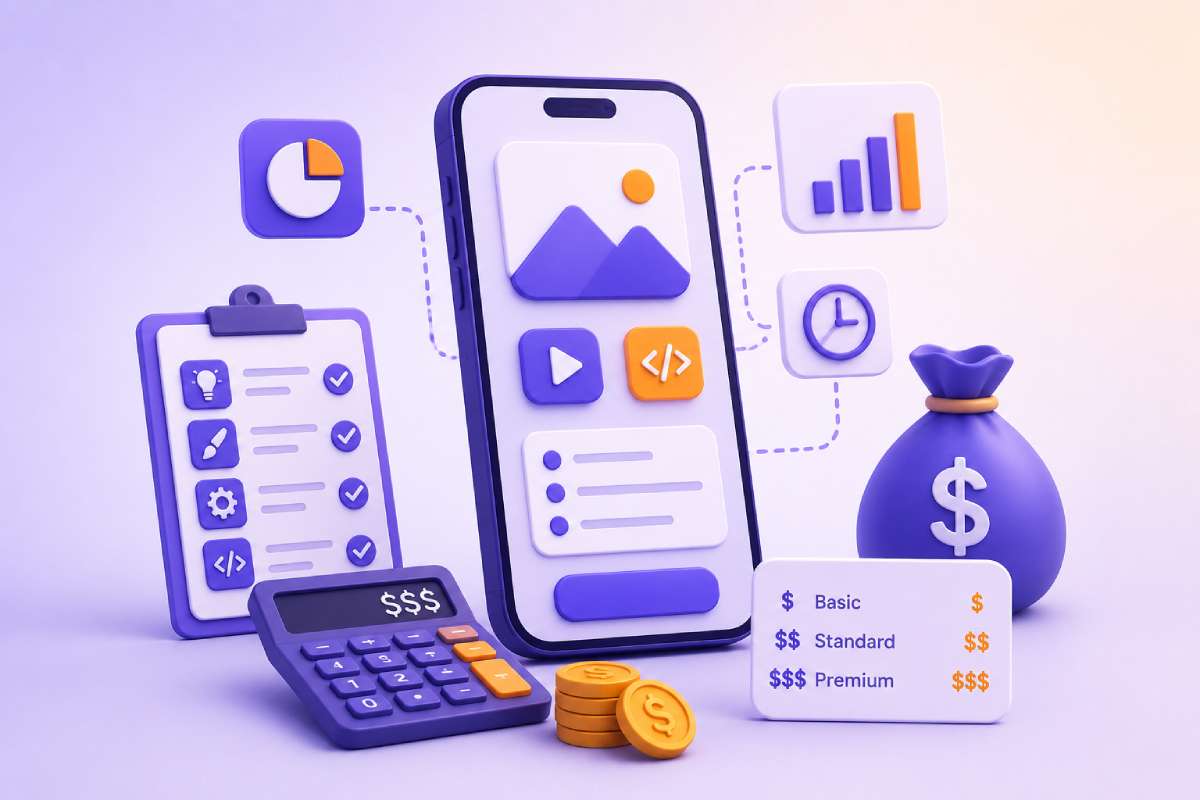
Ask three agencies how much your app will cost and you might hear thirty thousand, a hundred thousand, and three hundred thousand. The frustrating part is that all three can be right. App pricing is not a fixed number on a menu. It is the sum of dozens of decisions about what you build, who builds it, and what you remember to budget for before you start.
That is exactly why a single figure is impossible to give honestly. What is possible, and far more useful, is to understand the real ranges, the factors that push a project up or down within them, the hidden costs that quietly wreck budgets, and how to plan so you spend wisely. This guide walks through all of it. By the end, you will be able to read any quote you receive with a clear eye and budget for your mobile app development cost with confidence rather than guesswork.
A quick note on the numbers throughout: these are market ranges drawn from across the industry, meant to give you a realistic frame of reference. Your actual figure comes from your specific scope, which is a conversation, not a calculator.
It is also worth keeping the bigger picture in view. A well-built app is rarely an expense for its own sake. It can deepen customer relationships, open new revenue through in-app purchases and subscriptions, and put your business directly on the devices where people spend most of their time. The goal of budgeting well is not simply to spend less, but to spend in a way that earns a return.
The Short Answer: Typical Cost Ranges
Let us start with the number you came for. Across the market, building a mobile app generally ranges from around 400,000 or more for a complex, enterprise-grade platform. Most small-to-mid business apps land somewhere in the middle of that span.
The wide gap makes more sense once you break it into the three complexity tiers the industry tends to use.
|
Complexity |
What it includes |
Typical range |
|
Simple app |
Login, user profile, basic UI, limited features, minimal backend |
50,000 |
|
Medium app |
Custom UI, API integrations, payments, user accounts, moderate backend |
150,000 |
|
Complex app |
Real-time data, AI features, high security, multiple integrations, large user base |
400,000+ |
Think of it like building a home. A small studio costs a fraction of a custom house with multiple floors and smart systems throughout. Your app's "architectural complexity" sets the final price tag in much the same way. Everything that follows in this guide explains what moves your project within these ranges, so you can place your own idea on the scale with reasonable accuracy.
It is also worth knowing that these ranges assume custom development by a professional team, which is the route most businesses take for a product they intend to grow. There are cheaper alternatives. No-code and low-code platforms can produce a basic app for a few hundred dollars a month, and they suit simple, internal, or short-lived projects well. The trade-off is limited flexibility and performance, and costs that creep upward as your needs grow more complex. For a serious, scalable product, custom development remains the standard, which is the world the figures above describe.
How App Cost Is Actually Calculated
Underneath all the ranges sits a simple formula. The cost of an app is essentially the number of development hours multiplied by the team's hourly rate.
That sounds obvious, but it explains almost everything about pricing. The hours scale directly with complexity. A simple app might take a few hundred hours to build, a medium app commonly runs past 800 hours, and a complex app can require 1,500 hours or more. Multiply those hours by a rate that might be 150 in another, and you can see how two apps with similar goals end up with wildly different invoices.
This mental model is worth holding onto. When you receive a quote, you are really being told an estimate of hours and a rate. If a price seems surprisingly low or high, the answer almost always lies in one of those two numbers. Understanding this lets you ask sharper questions and compare proposals fairly rather than reacting to the headline figure alone.
It also helps to know that those hours are not all spent by developers. A typical app project involves a team of specialists: business analysts who shape the requirements, UI/UX designers who craft the experience, frontend and backend developers who build it, QA engineers who test it, and a project manager who keeps everything on track. Each role contributes hours to the total, which is part of why professional app development costs more than a single freelancer coding in isolation, and also why it tends to produce a more reliable result.
The Key Factors That Determine Mobile App Development Cost
This is the heart of the matter. Several factors combine to shape your final budget, and understanding each one helps you make smart trade-offs.
- App complexity and number of features. This is the single biggest driver. Every screen, button, and piece of logic adds hours. A straightforward content app is far cheaper than a feature-rich platform with custom workflows.
- Platform choice. Building for iOS only, Android only, or both changes the scope considerably. Covering both platforms with separate native apps roughly doubles the development work.
- Native vs cross-platform approach. Cross-platform frameworks like Flutter and React Native let you serve both platforms from one codebase, commonly cutting costs by 30 to 50 percent compared with two native builds. Native delivers maximum performance but costs more.
- Design complexity. The number of screens, the level of custom animation, and the polish of the interface all affect price. A simple, clean design costs less than a heavily branded, custom-illustrated experience.
- Backend, APIs, and infrastructure. The server-side logic, databases, and cloud setup that power your app often take the largest share of development effort, especially for data-heavy products.
- Third-party integrations. Payment gateways, maps, messaging, analytics, and similar services each need setup, testing, and ongoing maintenance, which adds to the total.
- Security and compliance. Apps handling sensitive data or operating in regulated sectors need stronger security and compliance work, which raises cost but is non-negotiable.
- App category. Your industry shapes user volume, feature needs, and security requirements, all of which move the figure.
If you want a realistic sense of how these factors apply to your idea, our mobile app development services team can map your feature list to a sensible scope and budget.
Cost Breakdown by App Type and Industry
Many people search for cost by the kind of app they have in mind, since category strongly influences features, user volume, and security needs. Here are illustrative ranges for common types.
|
App type |
What drives the cost |
Typical range |
|
E-commerce / m-commerce |
Product catalogues, secure payments, high traffic |
250,000+ |
|
Social media |
Real-time feeds, messaging, large scale |
300,000+ |
|
On-demand (ride, delivery) |
Live tracking, maps, payments, two-sided platform |
300,000+ |
|
Healthcare / fitness |
Data privacy, compliance, device integrations |
300,000+ |
|
Education / e-learning |
Content delivery, video, progress tracking |
200,000 |
|
Gaming |
Graphics, physics, real-time performance |
400,000+ |
|
Business / productivity |
Workflows, integrations, dashboards |
200,000 |
The pattern is clear. Apps that handle money, sensitive data, real-time interaction, or millions of users sit at the higher end, because each of those needs adds engineering, security, and testing work. Simpler, single-purpose apps stay lower. Your category is one of the first things any experienced team will ask about, precisely because it sets so many of the other variables.
Cost Breakdown by Development Stage
It also helps to see where the money actually goes across the project lifecycle. App development is far more than coding, and each stage takes a slice of the budget.
- Discovery and planning (around 10 percent). Market research, requirements, and a clear project roadmap. Skipping this stage is where many budgets quietly go wrong later.
- UI/UX design (around 15 percent). Wireframes, user flows, and the visual interface. Strong UI/UX and product design pays for itself in user retention and fewer expensive changes down the line.
- Development (the largest share). Frontend and backend engineering, where most of the hours and cost concentrate. Backend work in particular tends to take the biggest portion, because of the complexity of APIs, databases, and the systems that hold everything together.
- Testing and QA. Catching bugs and ensuring the app works reliably across devices before launch.
- Deployment and launch (around 5 percent). App store submission, configuration, and going live.
Understanding this split is useful when you read a proposal. If one stage looks oddly thin, for example almost no budget for design or testing, that is worth questioning, since shortcuts there usually resurface as costs after launch.
How Team Choice and Location Affect Cost
Who builds your app, and where they are based, is one of the largest levers on the final figure.
You generally have three routes. Freelancers are the most affordable and flexible, but coordination and consistency can be a challenge on larger projects. In-house teams give you the tightest control and communication, but salaries, benefits, and management make them the most expensive option to sustain. Development agencies sit in between, bringing a full, coordinated team and proven process, which suits most serious app projects.
Location matters just as much as the route. As a general market pattern, developers in North America and Western Europe charge the highest rates, Eastern Europe sits in the middle, and South Asia tends to be the most affordable. The same app can cost two to three times more depending purely on where the team is based.
The important caveat is that the hourly rate is not the whole story. Communication, experience, code quality, and reliability all shape the true cost, since cheap work that needs rebuilding is the most expensive work of all. With offices in both Ireland and the United States, our team is structured to pair strong communication and quality with sensible value, which is the balance most businesses are actually looking for.
The Hidden and Ongoing Costs People Forget
The build cost is only part of the picture. The expenses that surprise first-time founders are the ones that arrive after the quote, so plan for them early.
- Maintenance and updates. Commonly 15 to 20 percent of the original build cost every year, covering bug fixes, improvements, and keeping pace with new OS versions.
- Hosting and cloud infrastructure. Your app's data and traffic run on servers that carry an ongoing monthly cost, which grows with your user base.
- Third-party service fees. Many integrations, from payment processors to mapping and messaging services, charge recurring fees based on usage.
- App store fees. Apple and Google charge to publish and maintain a developer presence, and both take a cut of in-app revenue.
- Security patches and OS updates. Every time the platforms update, your app needs attention to stay compatible and secure.
- Marketing and user acquisition. This is the most underestimated cost of all. An app nobody knows about will not succeed, and marketing budgets often rival or exceed the build cost itself. Many experienced teams suggest planning a marketing budget that is a sizeable multiple of your initial development spend, especially in a crowded app store where discovery is the real battle.
Accounting for these from the start is the difference between a budget that holds and one that quietly doubles mid-project.
How to Reduce Mobile App Development Cost Without Cutting Quality
Spending less does not have to mean building something worse. These proven strategies keep quality high while controlling the figure.
- Start with an MVP. Build the core features that prove your idea first, launch, and learn from real users before investing in everything else. This approach commonly cuts initial cost by 30 to 50 percent and reduces the risk of paying for features nobody wants.
- Choose cross-platform. Covering iOS and Android from a single codebase is one of the most effective ways to lower both build and maintenance costs.
- Reuse what already exists. Established frameworks, libraries, and third-party services mean you are not paying to reinvent solved problems.
- Define scope clearly before you build. Vague requirements lead to rework, and rework means paying to build the same thing twice. Locking down the feature list upfront is one of the biggest money-savers there is.
- Prioritise and phase features. Rank features by impact, ship the essentials, and add the rest in later phases as budget allows.
- Plan a modular, scalable architecture. Building with growth in mind lets you add features later without expensive rebuilds.
A team that genuinely cares about your budget will suggest these moves rather than upselling. That is the approach behind our mobile app development services and broader custom software and app development work, where the goal is the right build for your goals, not the biggest invoice. For some products, a web app or progressive web app is also a lighter, lower-cost route worth weighing.
How to Budget and Get an Accurate Estimate
Reading about ranges is helpful, but a real estimate comes from a real conversation about scope. To quote your project accurately, a good team needs a few things from you: a clear feature list even if rough, the platforms you want to target, your design expectations, the integrations you need, and your ideal timeline.
Two budgeting habits will serve you well. First, build in a contingency buffer of around 10 to 20 percent for the surprises that every project encounters. Second, budget for maintenance from day one rather than treating launch as the finish line, since the app's life really begins there.
Be wary of any number delivered instantly without questions. A figure plucked from a calculator is a marketing hook, not a commitment. The most accurate estimates come from a team that asks about your goals, your users, and your scope before quoting. When you are ready, you can get a tailored estimate for your app based on what you actually want to build.
Conclusion
There is no single price for a mobile app, and anyone who gives you one without understanding your project is guessing. But the absence of a fixed number is not a problem once you understand what drives the figure. The complexity, the platform, the team, the stages, and the hidden costs together shape your budget, and knowing how each works lets you plan with confidence and sidestep the overruns that sink so many projects.
The smartest spend is always the one aligned to your goals: define your scope, start lean with an MVP, and build for the future. If you would like a clear, honest estimate for your specific idea, get a tailored estimate for your app and we will help you turn it into a realistic plan and budget.
Frequently Asked Questions
Related Blog

Healthcare Software Development: What Compliance Actually Requires
A founder says, "We just need to make it HIPAA compliant", as if compliance were a plugin you install before launch. Then the first…
The Software Development RFP Template That Gets Useful Proposals (Free Download)
A good software development RFP contains nine things: company and project background, a problem statement separated from any assumed solution, clear scope boundaries, real…
0 Comments
Please log in to post a comment