Native vs Cross-Platform: Which Is Right for Your App?
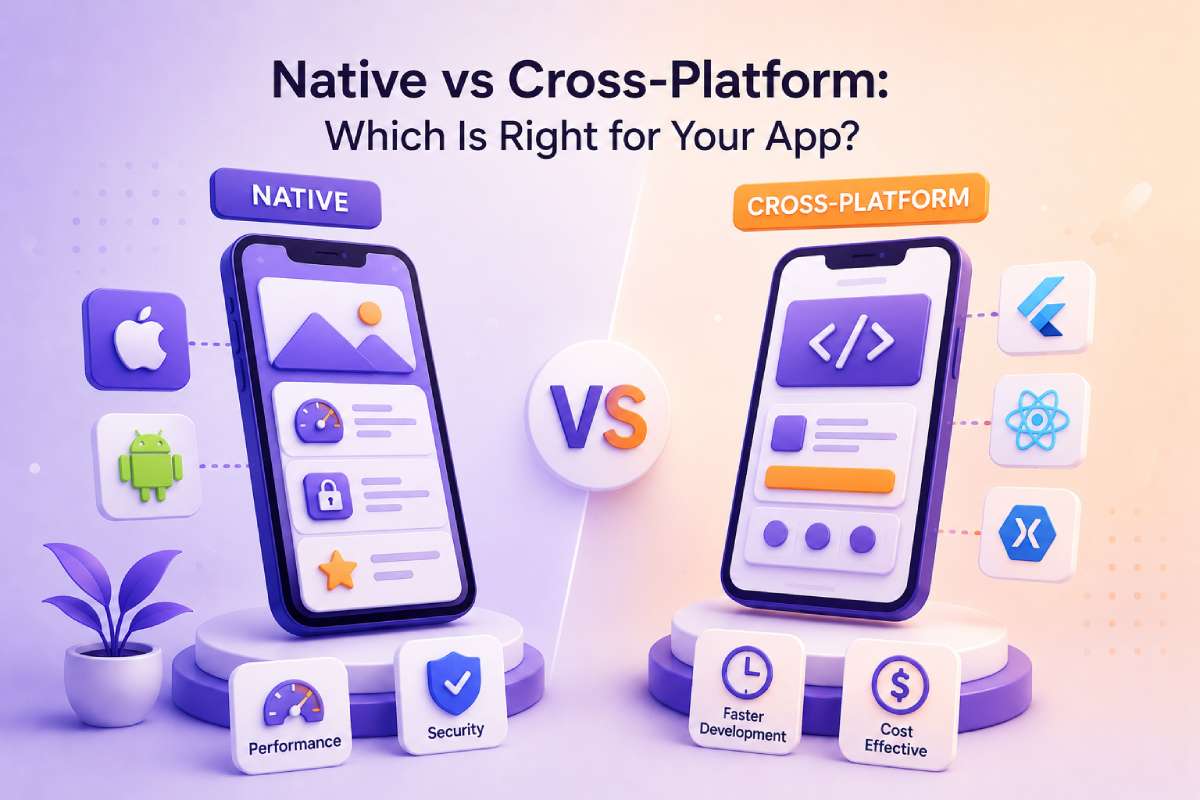
Your app idea has been greenlit. Your team is in place and your schedule has been agreed. Then comes the critical fork in the road that dictates every other path: Should your app be native or cross-platform? This decision might sound technical, but it is as much about product and business as anything, with implications that could stretch on financially for years. It’s going to influence your budget, your release date, how your app actually runs and how readily it will be for you to scale at a later stage.
The truth is the choice isn’t as clear-cut as it used to be, given how far the performance gulf between the two options has narrowed thanks to modern cross-platform frameworks. This is no longer just a straight "native is better, period." Instead, you need to determine the solution best suited to your app's specific requirements and ambitions. I will walk you through the native vs cross-platform app development across performance, cost, user experience, timeline, UX, security and practical fit.
The Two Approaches Explained
Before comparing them, it helps to be clear on what each approach actually means.
Native app development in Native App Development It's about creating the app for one specific operating system at once, based on the programming language and tool specifically designed for that platform. IOS-apps developers are coding with Swift or Objective-C, while Android app-developers go for Kotlin or Java. As a native application communicates the platform language, they usually feel like they belong to the operating system and perform the fastest. In return, creating native applications for both iOS and Android signify developing two different apps and two different sources.
Cross-platform app development goes a different direction. And so, you just get to code once with a shared codebase which runs across several platforms due to the help of frameworks such as Flutter, React Native or Kotlin Multiplatform. It's the "write once, run anywhere" idea. You’ll usually find teams sharing between 60 percent and 95 percent of their codebase across across iOS and android (the real money/time saver!).
And then there’s the third option you’ll encounter: hybrid. Hybrid development essentially wraps web technologies into a native package. It’s not exactly the same, but it’s related- we’ll be back in a minute to see precisely how.
Native App Development: Pros and Cons
Native development is the long-standing gold standard for quality, and for good reasons. It also carries real costs. Here is the balanced view.
The advantages:
- Top performance. Since they are built directly to a single platform, native applications are extremely quick, slick, and responsive under load. Advanced, data-intensive apps perform markedly better.
- Full access to device features. Unlike other app development frameworks, native apps can take advantage of the device’s unique capabilities such as sensors, GPS, camera, NFC, and biometrics without a bridge between your code and the device’s hardware.
- The best user experience. They use each operating system’s specific UI standards and guidelines, giving them the familiar feel people expect on that operating system.
- Stronger security. Native applications have the ability to leverage specific platform security services, encryption capabilities, and anti-fraud techniques which are crucial for some of today’s highly sensitive and private data-handling apps.
- Early access to new features. Native development is able to incorporate new capabilities introduced with a new version of the operating system from day one, whereas other platforms wait for this functionality to be incorporated into a development framework.
- Ideal for advanced experiences. Whether its advanced graphics rendering, or you’re looking to leverage the latest in AR, VR, on-device machine learning, direct access to the platform is ideal.
The drawbacks:
- Higher cost. You are effectively building two apps, which usually means two teams, two codebases, and double the effort.
- Longer time to market. Two parallel development tracks take more time to reach launch.
- No code reuse. Work done for iOS cannot be reused for Android, and vice versa.
- Heavier maintenance. Every update, bug fix, and new feature has to be implemented and tested twice.
Many well-known apps that depend on speed and polish, including the likes of mapping and streaming services, lean on native development for exactly these reasons.
Cross-Platform App Development: Pros and Cons
Cross-platform development has matured fast, and for a large share of projects it is now the practical default. Like any approach, it comes with trade-offs.
The advantages:
- One codebase for both platforms. You build once and deploy to iOS and Android, which is the core of every other benefit here.
- Lower cost. A single team and a shared codebase commonly cut development costs by around 30 to 40 percent compared with building two native apps.
- Faster time to market. Reusing code and shipping to both platforms at once gets your product in front of users sooner.
- Easier maintenance. Updates and fixes apply across platforms from one place, rather than being duplicated.
- Consistent experience. A shared codebase makes it simpler to keep the look and behavior uniform across devices.
- Wider reach with less effort. You cover both major platforms without doubling your team.
The drawbacks:
- Performance can trail native on certain platforms in particularly challenging scenarios but for common applications, it is increasingly imperceptible.
- Platform-specific features can need extra work. require some additional work, accessing some native APIs can require a third-party library or additional work to support on each platform.
- Framework dependency. You’re locked into your roadmap (the framework’s roadmap): Whenever the framework changes or has new release, it affects your own product’s future planning.
- Possible delays with brand-new OS features, since you’re relying on your framework to adopt the new operating system features before you’re able to, there can be a small lag in the adoption process.
Head-to-Head Comparison
Here is how the two approaches stack up across the factors that usually decide the question.
| Factor | Native | Cross-Platform |
| Performance | Highest, ideal for demanding apps | Near-native for most apps, slight edge cases |
| Development cost | Higher (two codebases) | Lower (one shared codebase) |
| Time to market | Slower | Faster |
| User experience | Most polished and platform-consistent | Very good, slightly less platform-specific |
| Device feature access | Full and immediate | Strong, occasional extra effort |
| Security | Strongest, platform-native controls | Solid, depends on framework |
| Code reusability | None across platforms | 60 to 95 percent shared |
| Maintenance | Heavier, duplicated per platform | Lighter, centralized |
The pattern is clear. Native wins where raw performance, deep hardware access, and security are non-negotiable. Cross-platform wins where speed of delivery, budget efficiency, and reaching both platforms quickly matter most. For a large majority of business apps, the cross-platform performance gap is now imperceptible to end users, which is why so many products start there.
A Note on Hybrid Development
Quick, and a brief bit of clarification. Hybrid and cross-platform aren’t the same thing. A hybrid app is simply a web application (coded using HTML, CSS, and JavaScript) nested in a tiny, almost weightless native shell so that it can take advantage of a handful of the device features. It’s inexpensive and fast to develop because hybrid apps rely heavily on existing web technologies, making it a decent choice for quick, rudimentary internal tools, prototypes, or minimum viable products.
The tradeoff for low-cost development is in both performance and user experience, which don’t typically reach native and modern cross-platform levels. If your project is closer to a content-driven product or a web-first experience, our web app development team can help you weigh whether a hybrid or web-based route makes sense before you commit.
How Much Does Each Cost to Build?
Let’s go to the main one where people usually decide what to go for. Cost. A native app will almost always cost more than a cross-platform one in initial development because you're building two distinct apps.
But that’s a simplification, with multiple factors influencing costs for both: Codebase number, team structure & specialization, feature complexity, backend infrastructure, testing, maintenance.
Let’s focus on maintenance costs as that’s where many miss an important piece. In general maintenance for apps is 15-20% of the development cost and it has to be taken into account for two native apps which is double compared to cross-platform. Cross-platform will mostly cost you less for development and also for long-term maintenance which is a big appeal for startups and growing products. Developing one codebase where each feature is tested once and then deployed on both platforms, will save your company a lot over time.
Don’t misunderstand: developing native applications for more expensive price doesn't mean a waste, you'll get performance and a better native look & feel, which for some products might lead to more sales and better reviews and justify their high development costs.
It’s not about how much it costs, it’s about how much value it brings. Of course, there are hidden costs: cross-platform could bring you a situation where some functionalities like real-time animations or videos will not be as performant and you would need to write a piece of code specifically in the native part, which again adds to cost & complexity. Also, with native, maintaining 2 separate apps in terms of OS updates and bug fixes will cost double as well.
All numbers may vary based on complexity and location, treat the quoted figures as just a hint.
Which Industries and App Types Suit Each Approach?
The best approach often comes down to what kind of app you are building.
Native tends to be the stronger choice for:
- High-end gaming, where 3D rendering and steady frame rates demand direct GPU access
- AR and VR experiences and apps with complex graphics or animations
- On-device machine learning and performance-critical AI features
- Security-sensitive apps such as banking, fintech, and clinical-grade healthcare
Cross-platform tends to suit:
- MVPs and startups working to a tight budget and timeline
- Content, e-commerce, social, and lifestyle apps
- Internal business tools and apps with moderate performance needs
- Any product that needs to reach both iOS and Android quickly
Another trend that it pays to know is that many products get built as cross-platform to test a product’s viability and get to users quickly, and are later natively optimized only where it’s truly required. The industry in question is a factor too: A fintech or a regulated healthcare product likely needs custom and compliant software and app development to cater for its bespoke needs from the off. If you can’t yet work out where your app might sit then that’s exactly the type of questions our Android and iOS app development service will guide you through. For product apps and those that function on desktop as well as mobile, cross-platform is also a key approach for desktop app development on Windows, macOS and Linux.
How to Choose the Right Approach for Your App
There is no universal winner, so the smart move is to work through a few honest questions about your own product. To see how the technical trade-offs play out in practice, a developer's view of the trade-offs is a useful reference alongside the questions below.
What is your primary goal? If it is maximum performance and a truly native feel, lean native. If it is rapid deployment and cost efficiency across both platforms, consider cross-platform.
What is your budget and timeline? A generous budget and a flexible schedule make native feasible. A tighter budget and a need to launch quickly point toward cross-platform.
How complex are your features? Apps that rely heavily on device hardware, intensive graphics, or real-time processing favor native. Apps with standard features are well served by cross-platform.
Who is your audience? Consider which platforms your users actually favor, and whether you need both from day one.
How important is long-term scalability? Think past launch to maintenance, updates, and growth, since the architecture you choose now will shape those costs for years.
When you line up your answers, the right path usually becomes clear. The goal is to choose the approach that best balances user needs with your business constraints, not to chase the option that sounds most impressive.
Can You Switch Later, and Should You Start with One?
One worry often expressed is whether the first decision is forever. It isn't. But switching isn't without cost. You can and many do make a transition from cross-platform to native, or into native from cross-platform adding only some native components.
But this transition comes with some overhead in time, effort and expense, since building native implies building and maintaining a version for each platform you support. That’s why your initial choice still matters and deserves careful consideration. In many cases, the most pragmatic choice is to begin with a cross-platform approach to launch and validate the product, then gradually focus resources on building native versions of whatever part(s) of your product that proves to be critically performance-bound. Picking a starting point isn’t choosing a destiny; it is picking a base upon which to build and refine as you learn what is most important about your product and to your users.
Conclusion
One size does not fit all: neither native nor cross-platform is inherently superior. It depends on your specific needs for performance, your project's budgetary and timeline constraints, and the ultimately objectives. As a general guideline native is generally better suited for performance intensive applications with many features or highly sensitive information, while cross-platform is more often suitable for applications that need to be developed and deployed faster and more cost efficient with broad device availability. It always comes down to the most effective approach for your individual product requirements and business objectives, not what looks better theoretically.
If you need assistance in choosing the best approach for your individual needs and product, please contact our team and we’ll be happy to walk through the considerations for you to make.
Frequently Asked Questions
Related Blog

Healthcare Software Development: What Compliance Actually Requires
A founder says, "We just need to make it HIPAA compliant", as if compliance were a plugin you install before launch. Then the first…

The Software Development RFP Template That Gets Useful Proposals (Free Download)
A good software development RFP contains nine things: company and project background, a problem statement separated from any assumed solution, clear scope boundaries, real…
0 Comments
Please log in to post a comment