What Goes Into Building a SaaS Platform from Scratch
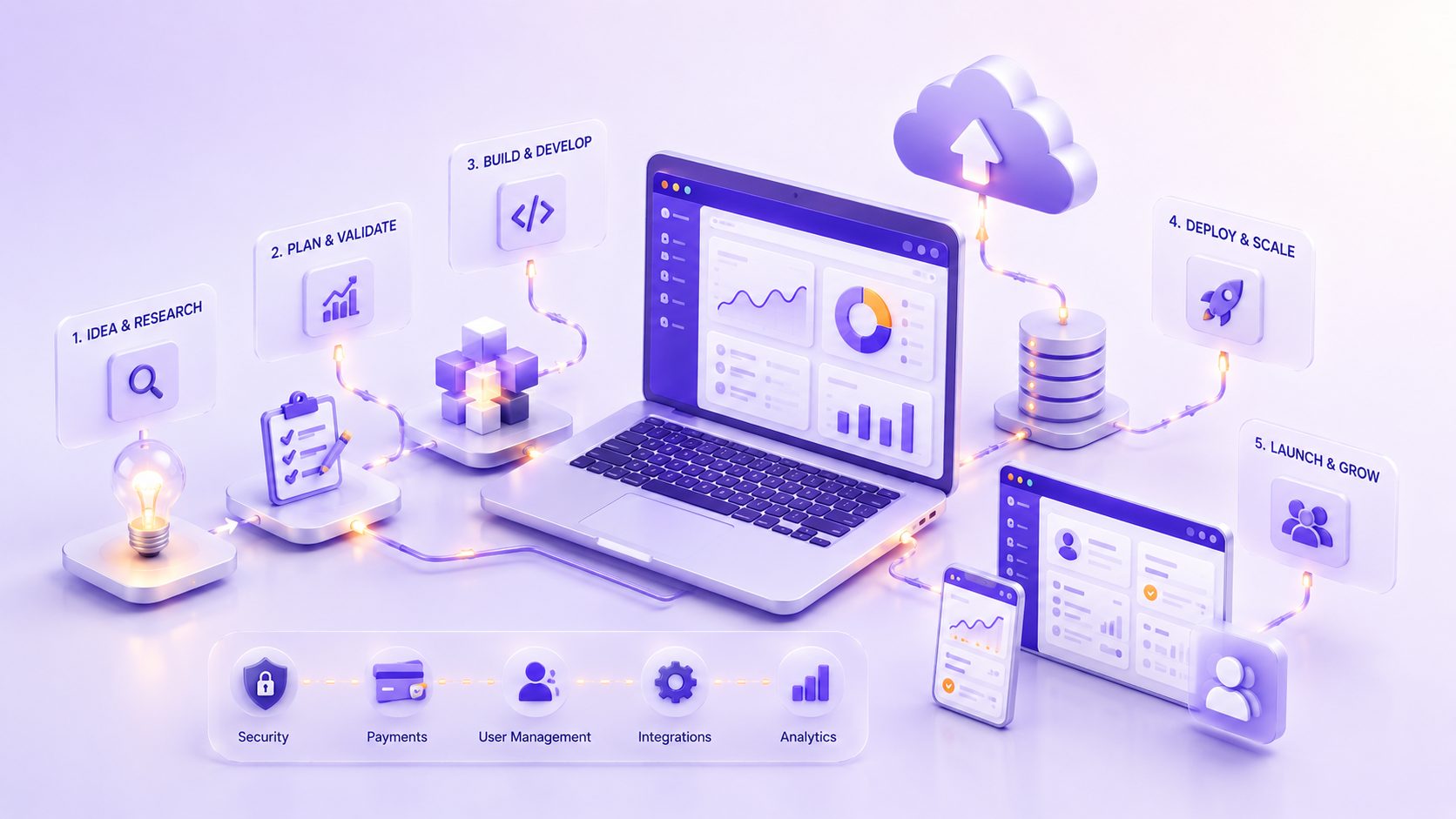
SaaS is one of the most attractive business models around. Recurring revenue that arrives every month, global reach from day one, and the ability to serve a single freelancer or a thousand-person enterprise from the same codebase. It is easy to see why so many founders and businesses want to build one. What is less obvious, until you are in it, is how much more goes into a SaaS platform than simply writing code.
A successful SaaS product is not something you build once and sell. It is an ongoing service you run for every customer at the same time, which means planning, architecture, security, and continuous improvement all matter as much as the initial build. Skip the groundwork and you end up with a product nobody needs or one that breaks the moment users arrive.
This guide walks through what actually goes into building a SaaS platform from scratch, step by step, from validating the idea to launching and scaling. Whether you are a founder scoping your first product or a business adding a software arm, you will come away knowing exactly what the journey involves and where the real work lies.
What "SaaS" Actually Means, and Why It's Different to Build
Before the how, a quick word on the what, because it shapes everything that follows.
Software as a Service means software delivered over the internet on a subscription basis. Instead of installing a program and managing it themselves, users simply log in through a browser and start working. The provider handles the hosting, the updates, the security, and the uptime. Google Workspace, Slack, and Salesforce are all familiar examples: you sign up, pay monthly or annually, and everything runs in the cloud. You can learn more about how the SaaS model works from the cloud providers who power most of it.
The key mental shift is this. With traditional software, you ship a product once and the customer owns that version. With SaaS, you are running a live service for every customer simultaneously, updating and maintaining it continuously. That difference is why SaaS is built differently.
Underpinning most modern SaaS is an idea called multi-tenancy, where a single instance of your application serves many customers at once, with each customer's data kept separate and secure. This is what lets one platform scale from ten users to ten thousand without rebuilding it for each new client. We will come back to it, but keep it in mind as the architectural backbone of the whole model.
Step 1: Validate the Idea Before You Build Anything
Here is the step almost every founder is tempted to skip, and the one that matters most. Before a single line of code, you need to know that people actually want what you are about to build.
The numbers are sobering. A widely cited analysis of the top reasons startups fail found that "no market need" was the single biggest cause, behind a large share of failures. In other words, most SaaS products die not because the code was bad, but because they solved a problem nobody was willing to pay to fix.
Validation is how you avoid that fate. It means proving your concept solves a real problem for a real audience before you invest serious time and money. A few essentials:
Research the market and your competitors. List the existing tools in your niche and study them closely. The gold is often in a "boring" market where people already pay for solutions and openly complain about them.
Identify a specific audience and their pain points. Vague products for everyone appeal to no one. Define precisely who you serve and what frustrates them.
Look for recurring, frequent problems. A pain point people hit weekly justifies a subscription far better than one they face once a year.
Test demand cheaply. Talk to potential users, run surveys, or put up a simple landing page to gauge real interest before building. The goal is to confirm that people will pay, not just that the idea sounds clever in your head.
Get this right and everything downstream becomes easier, because you are building something the market has already told you it wants.
Step 2: Define Your MVP and Core Features
With a validated idea, the temptation is to build everything you have imagined. Resist it. The smart path is a minimum viable product, the smallest version of your platform that solves one core problem really well.
An MVP is not a cut-rate product. It is a focused one. It lets you launch sooner, spend less, and learn from real users before committing to a larger build. The discipline here is prioritisation: rank every feature by how directly it supports your users' core problem, and defer the rest.
The enemy of a good MVP is scope creep, the slow pile-up of "just one more feature" that quietly wrecks budgets and timelines. Every feature you add means more design, more development, more testing, and more cost. Restraint is genuinely a strength.
That said, nearly every SaaS platform needs a core set of features regardless of its niche:
- User authentication and accounts, so people can sign up, log in, and manage profiles securely
- A subscription and billing system to handle recurring payments, commonly through a service like Stripe
- An admin dashboard for you to manage users, monitor activity, and control the platform
- The core product functionality that actually solves your users' problem, your reason for existing
- Basic analytics so both you and your users can see what is happening
Build these well, keep everything else on the roadmap for later, and you have a lean product you can actually ship. If you would rather have an experienced team scope and build this for you, that is exactly what custom software and app development is for.
Step 3: Choose the Right Tech Stack
Your tech stack is the set of tools and frameworks you build on, and it is one of the most consequential early decisions you will make. Choose poorly and you may face a full rebuild in a couple of years. Choose well and your platform scales smoothly from MVP to millions of users.
A SaaS stack spans three layers. Here are commonly used, current options for each, though the right choice always depends on your situation:
| Layer | What it does | Common choices |
| Frontend | The user interface people see and use | React, Next.js, Vue |
| Backend | The logic, data handling, and server-side work | Node.js, Python, Laravel |
| Database | Where your data is stored and retrieved | PostgreSQL, MongoDB |
| Auth and billing | Login and subscription payments | Auth0 or Clerk, Stripe |
| Infrastructure | Hosting and scaling | AWS, Google Cloud, Azure |
Rather than chasing whatever is newest, weigh a few practical factors. Choose technologies your team already knows, since familiarity speeds up development and cuts costs. Prioritise strong documentation and active community support, which make problems far easier to solve. And think about scale from the start: consider where your platform will be in one, three, and five years, and pick tools that will grow with you rather than forcing a rebuild.
Because a SaaS platform is a web application at its heart, this is really a question of solid web app development, where the stack is chosen to balance speed today with scalability tomorrow.
Step 4: Design the Architecture
If the tech stack is what you build with, the architecture is how you arrange it, and it determines whether your platform holds up as it grows.
The foundation of modern SaaS is multi-tenant architecture. Instead of running a separate copy of your software for every customer, one shared instance serves them all, with strict data isolation keeping each customer's information private and secure. This is dramatically more efficient and cost-effective to maintain and scale, which is why it has become the standard for nearly all modern SaaS applications.
You will also face a structural choice between a monolith and microservices. A monolith is a single, unified application, simpler to build and perfectly fine for many early products. Microservices split the system into smaller, independent services that can be developed, deployed, and scaled separately, which suits larger, more complex platforms. Starting simpler and evolving is often the wiser path.
Scalability deserves deliberate thought. Your architecture should handle growth both vertically (more power for heavier tasks) and horizontally (more capacity for more users), ideally scaling automatically as demand spikes.
Finally, security cannot be an afterthought. Bake in strong authentication and authorization, data encryption, regular backups, and tightly controlled data access from the beginning. Because your customers trust you with their data, especially for anything involving payments or sensitive information, security is a core feature, not a finishing touch.
Step 5: Design the User Experience
A SaaS product lives or dies on usability. Unlike software someone has already bought and installed, a subscriber can cancel the moment your platform frustrates them. Good design is therefore one of your strongest retention tools.
Focus on a few things. Make navigation intuitive so users never feel lost. Invest heavily in a smooth onboarding flow, since self-service onboarding is what powers product-led growth, letting users reach value without needing a sales call. Keep dashboards clean and focused on what matters. And use a consistent design system so the whole product feels coherent.
Strong design does more than look good. It reduces churn, lowers your support burden, and turns first-time users into long-term subscribers, which makes it an investment rather than a cost. This is where thoughtful UI/UX and product design pays for itself many times over.
Step 6: Build, Test, and Deploy
Now the platform actually gets built, and the way you approach this stage matters as much as the code itself.
Work iteratively. Rather than building the entire product in one long stretch and hoping it works, build in small increments and test continuously as you go. This catches problems early, when they are cheap to fix, instead of at the end when they are expensive. A beta program, where a small group of real users tries the product before a wide launch, is invaluable for surfacing issues and gathering honest feedback.
Testing should cover several angles: functional testing to confirm features work, security testing to protect user data, performance testing to ensure the platform holds up under load, and usability testing to check the experience actually makes sense to users.
To ship all of this smoothly, modern SaaS teams rely on CI/CD, or continuous integration and delivery, which automates testing and deployment so updates roll out to every customer at once with minimal manual effort and fewer errors.
It is worth knowing who does this work, since it also explains the cost. A typical SaaS build involves frontend and backend developers, a QA engineer, a DevOps engineer, a designer, and a project manager keeping everything aligned. And remember: launching is a milestone, not the finish line. The product keeps evolving from here.
Step 7: Choose a Pricing and Monetization Model
How you charge is a business decision as important as any technical one. The core principle is simple: price to the value your product delivers, not just the cost of building it.
Here are the main SaaS pricing models:
- Flat-rate: one price for one product. Simple to understand and sell, but less flexible.
- Tiered: several packages at different price points, the most common model, letting you serve different customer segments from the same product.
- Per-user (per-seat): you charge based on the number of users, which scales naturally with a customer's team size.
- Usage-based: customers pay according to how much they use, popular for platforms with variable consumption.
- Freemium: a free basic tier that encourages sign-ups, with paid upgrades for more.
A free trial or freemium tier can lower the barrier to that first sign-up and let the product sell itself. Whatever you choose, keep two metrics in view: customer acquisition cost (CAC), what it costs to win a customer, and lifetime value (LTV), what that customer is worth over time. A healthy SaaS business needs LTV to comfortably exceed CAC, otherwise every new customer loses you money.
Step 8: Launch and Grow
Here is a hard truth many first-time founders learn late: building it does not mean they will come. Marketing and distribution matter every bit as much as the product itself.
A strong launch leans on the audience you have already been building. Bring in your beta users, tap into relevant communities, publish helpful content, and consider a launch on a platform like Product Hunt or targeted ads aimed at your specific audience. Product-led growth, where the product is so useful that users naturally invite others, is one of the most powerful engines a SaaS can have.
Once live, let the metrics guide you. Watch churn (how many customers leave), retention (how many stay), monthly and annual recurring revenue (MRR and ARR), and the CAC and LTV figures that reveal whether the business is healthy. These numbers tell you what is working and what needs attention.
Above all, keep iterating. The most successful SaaS products are not the ones that launch fastest, but the ones people keep coming back to, refined continuously based on real user feedback. Growth here also depends on being found, which is where ongoing SEO and digital marketing turns a good product into one your target customers actually discover.
Remember too that SaaS is a long game. It commonly takes two to four years to reach meaningful revenue, so patience and persistence are part of the job description.
How Much It Costs and How Long It Takes
Two questions sit on every founder's mind, so let us address them directly, with the important caveat that these are industry ranges, not fixed prices. Your real figure comes from a scoped conversation about your specific product.
On timeline, a well-scoped MVP commonly takes three to six months to build. A more feature-rich, scalable platform can take a year or more. The single biggest cause of delay is scope creep, which is why a disciplined MVP matters so much.
On cost, the market range is wide. A lean MVP often falls in the tens of thousands, while a complex, enterprise-grade platform can run to several hundred thousand or more. The main drivers are feature complexity, the size and location of your development team, your chosen tech stack, and the integrations you need.
Do not forget the ongoing costs that catch people out: cloud hosting, third-party service subscriptions (ironically, running a SaaS means paying for other SaaS tools), continuous maintenance to patch and update, and marketing to keep acquiring customers. Budgeting for these from the start keeps your plan realistic.
If you would like a grounded estimate for your specific idea rather than a generic range, talk to our team about your SaaS idea and we will help you scope it properly.
Conclusion
Building a SaaS platform from scratch is a full journey, not a single task. You validate the idea so you build something people want, scope a lean MVP so you launch without waste, choose a scalable tech stack and design solid architecture so the platform holds up as it grows, build and test iteratively, price for the value you deliver, and then grow through marketing and relentless iteration.
The businesses that win at SaaS are rarely the ones that launched fastest or packed in the most features. They are the ones that built something focused and genuinely useful, then kept improving it until customers could not imagine going without it. That is the real work, and it is well worth doing.
If you have a SaaS idea and want a partner to help turn it into a real, scalable product, talk to our team about your SaaS idea and we will help you plan the path from concept to launch.
Frequently Asked Questions
External references used in this article: - How the SaaS model works (AWS) - Starting a SaaS business and pricing it (Stripe) - The top reasons startups fail (CB Insights)
Related Blog

Healthcare Software Development: What Compliance Actually Requires
A founder says, "We just need to make it HIPAA compliant", as if compliance were a plugin you install before launch. Then the first…
The Software Development RFP Template That Gets Useful Proposals (Free Download)
A good software development RFP contains nine things: company and project background, a problem statement separated from any assumed solution, clear scope boundaries, real…
0 Comments
Please log in to post a comment