What an MVP Should (and Should Not) Mean
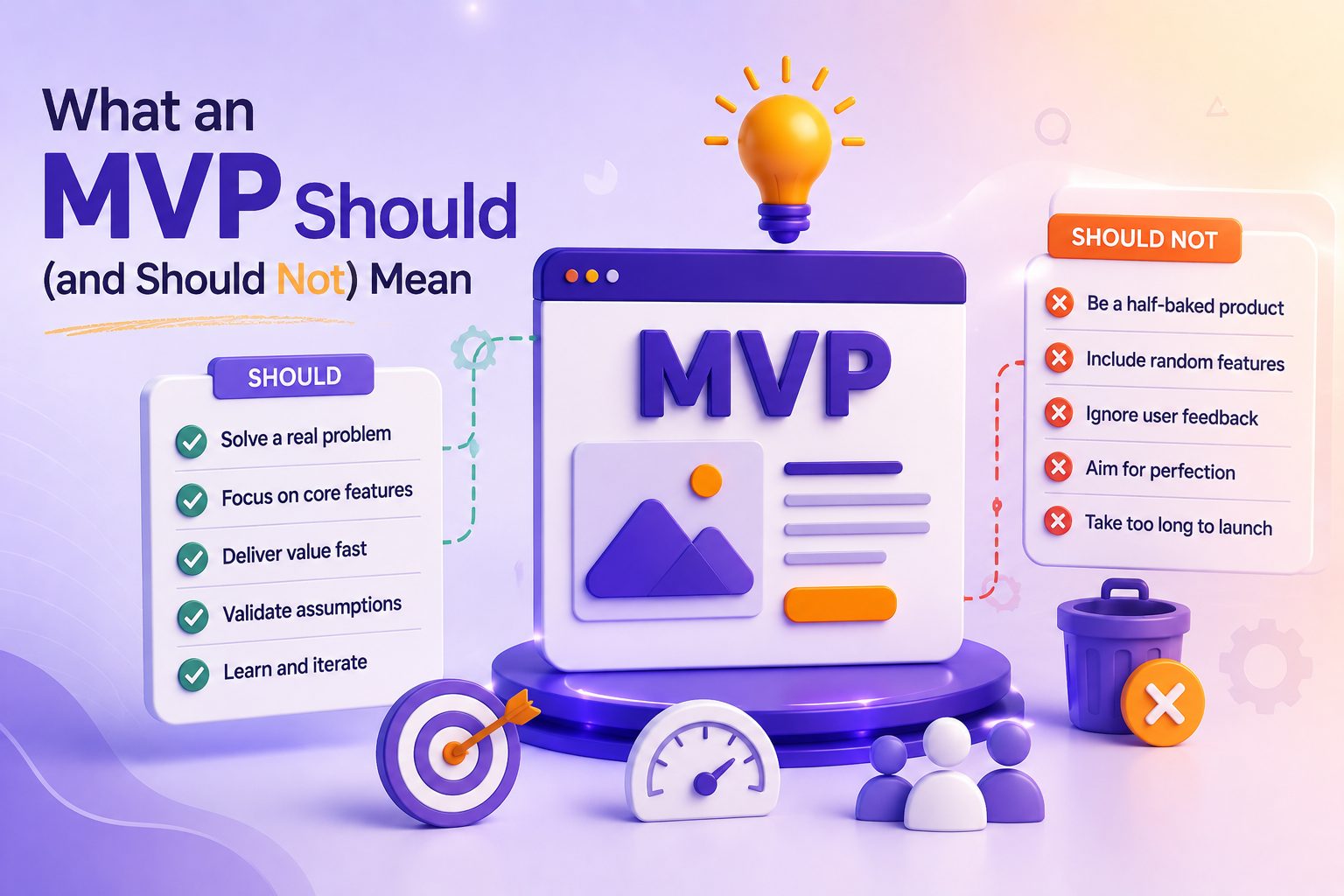
"MVP" is arguably the most commonly heard and least commonly understood word in all of product development. You hear it everywhere - in every pitch meeting, planning session, and conversation with founders. "Build an MVP", they say. But the problem is that roughly half of the people who utter these words are thinking something like "a quickly put together cheap/broken version", and that’s the opposite of what a Minimum Viable Product should really be.
The consequences of misunderstanding an MVP are enormous. Build one that is too sparse and the MVP provides no useful information; build one that’s too complex or has the wrong focus and your budget disappears before you know it. Build one that correctly implements the MVP process and you’ll have one of the most intelligent and cost-effective product development tools at your disposal for learning what customers actually want.
This guide covers both halves of the coin: what an MVP should be and why, and what an MVP shouldn’t be, and how a mistaken assumption could be leading to a costly failure. Get the difference between these two extremes right and you'll have the power of the MVP without all of the costly confusion.
What a Minimum Viable Product Actually Is
So, let's take a step back to begin with a good definition because, let's face it, this term has a history. It was born in the mind of Frank Robinson and later gained mainstream acceptance thanks to Steve Blank and Eric Ries via the methodology that revolutionized how modern products are built, Lean Startup. Here is the quoted definition by Ries that we suggest you commit to memory: An MVP is the version of a new product that allows a team to collect the maximum amount of validated learning about customers with the least amount of effort.
You can read more from Eric Ries on what an MVP really is in his own words
Take notice of the underlying premise. The MVP is not about creating a small, scaled-down product; it is primarily about learning. Its objective is to validate a business hypothesis using real users and to measure their behavior – rather than relying on their expressed intent – and real behavior wins time and time again. And importantly, the word ‘MVP’ carries a message within.
In juxtaposing “minimum” and “maximum” the definition highlights that this is not a one-size-fits-all rule; there isn’t a defined list of required features, or an acceptable length of time, that would label something an MVP.
It is a judgement based on what’s “minimum” and “maximum learning” required to build a viable business around the product. That judgement really is the whole game.
What an MVP Should NOT Mean
Here's how the vast majority of MVPs fail, often in two very opposite ways. The first is underbuilt, or "not viable enough." Many teams overfocus on "minimum", forgetting the "viable".
Failure mode one: too minimal to be viable. They build something so fragile, bug-ridden, or unfinished it's useless for testing a real hypothesis about an idea.
When users reject it, teams don't learn anything of value. All they learn is that people hate a bad experience, something we probably all suspected. The "V" is not negotiable. An MVP needs to allow users to accomplish a meaningful task, even if it's just the one they have for this particular first version, and extract real value from that accomplishment.
A useful mental image for this comes from the often-cited skateboarding-to-car analogy.
If your destination is a car, you don't start by shipping only a wheel, then only a chassis, then only an engine; instead, you ship a skateboard, then a bike, then a scooter, then a motorcycle. At each stage, what you've shipped is usable and adds value to the user. The second is overbuilt and static, or "build it and forget it".
Failure mode two: build it, then never change it. On the other side of the spectrum, a team will build their MVP, collect feedback, and then let it languish unchanged, regardless of what users are saying. That entirely defeats the purpose of an MVP, which is specifically designed to kick off a build-measure-learn cycle. When you treat an MVP as a static product, you miss the chance to radically adapt, pivot, or even scrap the idea based on what you learn from it.
It’s also important to state, MVP does not necessarily equate to cheap or rushed, and the approach isn’t suited to every project.
If there’s a high degree of certainty around the product and a relatively low amount of to-be-learned, the process overhead may not be justified. It is fundamentally a learning tool and deserves to be so.
Why MVP Development Matters
When you cut through the myths, the real benefits shine through. Building an MVP decreases financial risk as you prove your concept before committing substantial funds to a fully developed product. You minimize wasted resources because you avoid building a feature set that nobody wants – the biggest cause of product budget blow-out.
It accelerates your path to market where you gain customer feedback (and potentially revenue) as soon as possible, rather than slogging through years in the dark.
An MVP also facilitates data-driven decisions making; instead of relying on guesswork you’re basing decisions on real-world usage and can iterate and adapt if necessary. Plus, you increase your chances of securing investment by presenting concrete proof of market validation as opposed to a presentation filled with projections. Ultimately, an MVP is about building something real because real people need it, not because you think they do. Which, let’s be frank, is a sobering reality considering the number one reason for startups failing is building products that lack a real market need.
An MVP is your insurance policy against this eventual failure, forcing you to face the question ‘does anyone want this?’ before you place all your chips on the table. It is at the core of good custom app or software development.
How to Build an MVP, Step by Step
Turning the concept into a real product follows a clear path. Here is the process, step by step.
-
Identify the problem and audience. Start with the specific problem you are solving and exactly who has it. Build customer personas so you stay focused on real people rather than a vague "everyone".
-
Research the market and competitors. Study the existing solutions and, crucially, the complaints people have about them. Unmet needs and common frustrations are where your opportunity lives.
-
Define the core value and prioritize features. Separate the genuine must-haves from the nice-to-haves. A simple needs-versus-wish list split, or a prioritization method like MoSCoW, keeps you honest. This is your best defense against scope creep, the slow accumulation of "just one more feature" that kills timelines and budgets.
-
Choose one platform to start. Supporting iOS, Android, and web all at once spreads thin resources even thinner. Pick a single platform that fits your audience and prove your value there first. A successful product on one platform is strong evidence it will work on others, and you can expand with more confidence and capital later. Whether that first platform is mobile app development or web app development, one focused build beats three half-built ones.
-
Prototype or wireframe first. Map out the user flows and interface cheaply before you write production code. This is where UI/UX and product design catches problems while they are still easy and inexpensive to fix.
-
Build the MVP. Develop the core features to a genuinely usable, viable standard, including proper front-end and back-end work and real quality assurance. Remember the "V": this has to actually work.
-
Launch to early adopters. Release to a focused group of early users who are more forgiving, more engaged, and more likely to give you honest, useful feedback.
-
Measure, learn, and iterate. Gather real behavioral data and feedback, then refine, pivot, or proceed. This build-measure-learn cycle is the engine of the whole approach, and it does not stop after launch.
MVP vs Prototype vs Proof of Concept
These three terms get used interchangeably, but they are not the same thing, and confusing them leads to building the wrong artifact at the wrong time. Each answers a different question.
|
Approach |
Answers the question |
What it is |
|
Proof of Concept (POC) |
"Can this be built?" |
A small, often internal test of technical feasibility. Not for end users. |
|
Prototype |
"How will it look and flow?" |
A simulation of the design and user experience, usually front-end only. Not a working product. |
|
MVP |
"Should this be built, and will people use it?" |
A working product with core features, released to real users to test market demand. |
The usual progression is from POC through prototype through MVP-each focused on lowering risk in a different domain: technical risk, design risk, and market risk. But you won’t always need all three. A simple product could start right at the prototype stage and dispense with the POC.
A technically challenging product will need them all.
Beware of this subtle pitfall: While an MVP’s goal is to learn, the goal of a Minimum Marketable Product is to earn. Companies are occasionally tempted to build the latter and call it the former, and then they can’t ask, “Is this the right thing to be building?” until it’s too late. Keep the learning goal front and centre, and your MVP will serve its purpose.
Real-World MVP Examples That Worked
The biggest testament to the validity of this approach is to look at just how many now-monstrous companies started off deliberately in the tiniest of first versions.
Amazon started as the most stripped-down version of an online bookstore out of Jeff Bezos’s garage. Books were the MVP. Then and only then did they move, category by category, to become the colossus they are today.
Airbnb started by air-mattressing their own apartment and putting a rudimentary website online to validate a single proposition: Would people pay to sleep in the home of a stranger? They sold beds to strangers within hours.
Dropbox didn’t even launch the product at first. They put a short explainer video online showing how their file syncing product would work to see if it had traction before investing tons of time in engineering.
Uber was known as UberCab when it first launched and was nothing more than an iPhone-only SMS-based service in a single city to figure out if anyone even cared to have a car hailing service at their fingertips.
All these giants, and countless more, started lean. All these giants focused intently on their most valuable user. And each of these giants learned to build based on the experiences of their users, not on what they assumed their users would like.
Common MVP Mistakes to Avoid
Many even aware of the technique still find themselves making the same few blunders. Avoid them. Over-featurizing-the oldest chestnut-is what converts a lean, efficient test into a cost-y, resource-hogging exercise.
However, there’s an equal chance the team errs in the other direction: so, over-optimizing for speed, the resulting prototype is more of a caricature of the product, completely invalidating the experiment.
Not getting user feedback from actual users obviates the exercise. Likewise, collecting data but failing to act on it; picking the wrong key performance indicators that can have the team optimistically heading in the wrong direction; and finally, maybe the worst offense, considering the MVP a victory, the culmination of effort, rather than the beginning. Avoid those, and keep the magic working.
Turning Your MVP Into a Real Product
The MVP story doesn’t end here. It is the basis for everything to come. Once your MVP has the thumbs up from real users, the effort turns into building the validated idea up.
You prioritize subsequent features by user needs and feedback, polish what your users clearly adore, and harden the product against scale and expansion.
You work patiently from minimum viable product to minimum valuable product and beyond, adding the necessary functionality, and the sheen, that will turn those early adopters into devoted paying customers. In short, the MVP was always intended to be the first chapter in a much longer book that continues to evolve according to your users' feedback. If you already have a product validated by actual customers and you are looking for someone to grow with you into the next stage of your product's life cycle, let our team take a look at your current product.
Conclusion
So, what does minimum viable product mean?
It's the simplest version of your product that you can possibly get away with and still offer the prospect of a learning journey. And what should it not mean? A hacky, incomplete or abandoned build to minimize investment and accelerate market capture. The trick to it all is to keep minimum and viable in sync, then relentlessly learn from it. Used wisely, minimum viable product development is an extremely smart approach to building something people want, saving your time and money in the process of building the wrong thing. Instead of hypothesis, it uses data, instead of ego, it learns. If you want to take the idea of a minimum viable product from the abstract to a functioning first step, get in touch and let our team assist you.
Frequently Asked Questions
External references used in this article: - Eric Ries on what an MVP really is (Lean Startup) - The origin and definition of the MVP (Wikipedia) - How an MVP fits into agile development (Agile Alliance)
Related Blog

Healthcare Software Development: What Compliance Actually Requires
A founder says, "We just need to make it HIPAA compliant", as if compliance were a plugin you install before launch. Then the first…
The Software Development RFP Template That Gets Useful Proposals (Free Download)
A good software development RFP contains nine things: company and project background, a problem statement separated from any assumed solution, clear scope boundaries, real…
0 Comments
Please log in to post a comment