When Does AI Actually Make Sense for Your Business?
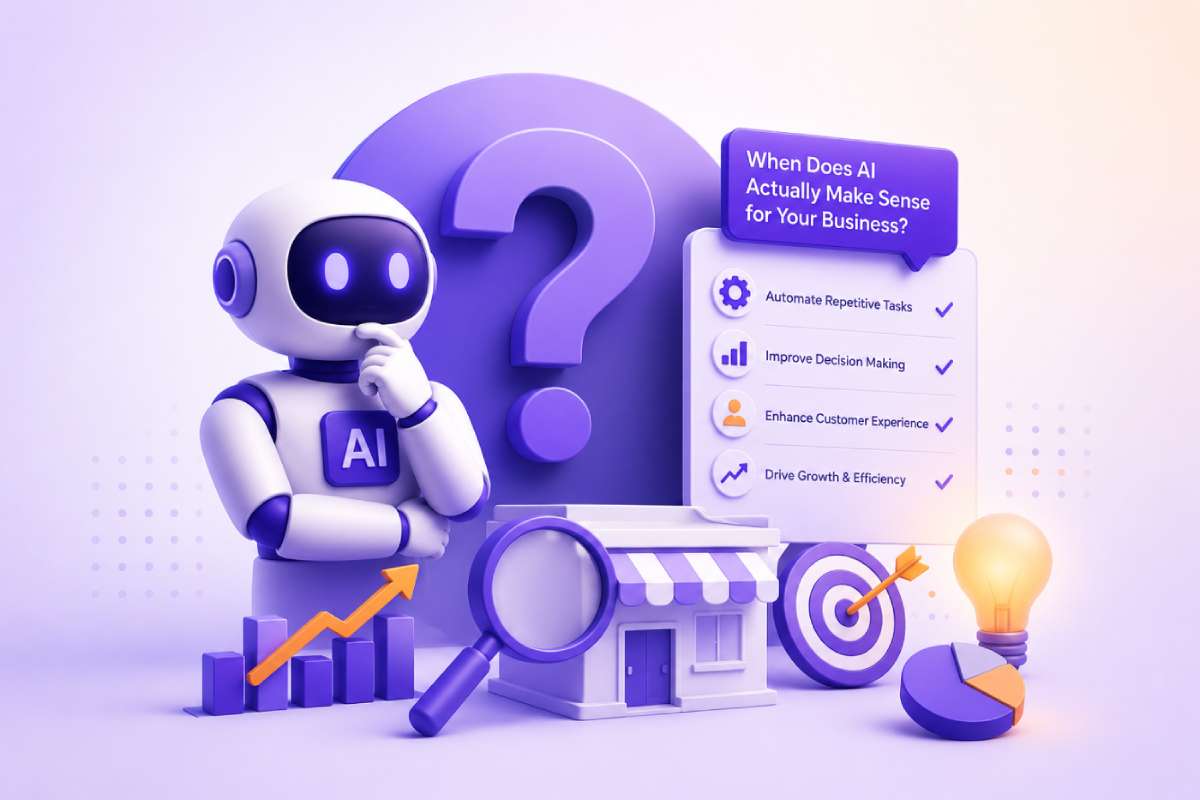
Everyone seems to agree that you should be using AI. Scroll through any software vendor's website and you will see "AI-powered" stamped on every feature. Your inbox is full of tools promising to transform how you work. The pressure is real, and so is the noise. What almost nobody tells you is the part that actually matters, which is when AI is the right tool for the job and when it quietly drains your budget without giving much back.
This guide is built to answer that question. Knowing when to use AI in business is less about chasing the latest model and more about matching the technology to a real problem you can describe and measure. By the end, you will have a clear, practical framework for deciding where AI earns its place, where it does not belong yet, and how to take a sensible first step.
The Honest Answer: AI Is a Tool, Not a Strategy
Let us start with the principle that everything else rests on. AI works best as a complement to human judgment, not a replacement for thinking. It is very good at handling repetitive work, spotting patterns in large amounts of data, and producing first drafts at speed. It is not good at setting your direction, understanding your customers the way you do, or making the calls that depend on taste and relationships.
That means the real question was never whether to use AI. The question is where it creates genuine leverage in your business. The most common and most expensive mistake is to start with the tool and then go looking for a problem to point it at. The better path runs the other way. You begin with a business problem worth solving, then ask whether AI is the right way to solve it. Sometimes the answer is yes, and the gains are substantial. Sometimes a simpler solution does the job, and that is a perfectly good outcome too.
The Clear Signs Your Business Is Ready for AI
Some situations practically wave a flag that says AI could help here. If you recognise several of the following in your own operations, you are likely looking at a strong candidate.
You have repetitive, high-volume tasks. Think data entry, invoice matching, report generation, or sorting and routing incoming requests. When work is rules-based and happens at scale, AI and automation can handle it faster and with fewer errors than a person doing it by hand.
You are sitting on data you barely use. Sales records, customer interactions, support tickets, and operational logs often pile up without ever informing a decision. AI is built to find the patterns and trends hiding in large datasets that would take a human team far too long to surface.
Your team spends hours on work that is easy to describe but slow to do. If you can explain a task clearly in a sentence or two, yet it eats real time to complete, that gap is exactly where AI tends to deliver its best return.
Customer demand is outpacing your capacity to respond. When questions come in faster than your team can answer them, AI-powered chatbots and assistants can handle the common requests around the clock and pass the complex ones to a human.
You can define the problem and measure success. This one matters more than any other. If you know precisely what you want and can tell whether the result is good, you have the foundation a successful AI project needs.
When AI Does Not Make Sense Yet
This is the part most articles skip, and it is the part that protects your budget and your credibility. AI is not the right answer for every situation, and recognising the misfits early saves a great deal of wasted effort.
Hold off on AI when your data is messy, incomplete, or scattered across systems that do not talk to each other. AI is only as good as the information it learns from. Feed it poor data and you get confident, fast, and wrong.
Step back when the task depends on strategy, taste, or human relationships. Negotiating a sensitive deal, setting your brand direction, or coaching a struggling team member are not jobs to hand to an algorithm.
Be cautious when you cannot measure whether it worked. If there is no clear success metric, you will never know if the investment paid off, and the project will quietly lose support.
Walk away when you are adopting AI only to check the "we use AI" box. Impressive demos and executive enthusiasm are not a use case. Real value comes from solving a defined problem, not from being able to say you have AI.
Finally, do the maths on net time saved. If a tool produces a draft in seconds but you spend longer cleaning it up than you would have spent doing the work yourself, it is costing you, not helping you.
High-Value Use Cases by Business Function
When the conditions are right, AI delivers across nearly every part of an organisation. Here is where it tends to earn its keep, function by function.
Customer service. AI chatbots and virtual assistants answer common questions, track orders, and reset passwords without delay, running 24/7. They route the genuinely complex issues to human agents, which keeps service fast without sacrificing quality.
Marketing and sales. AI analyses customer behaviour to power personalised recommendations and targeted campaigns, scores leads so your sales team focuses on the best prospects, and drafts content that a human then refines. Used this way, it lifts engagement and conversion rather than replacing the marketer's judgment. If marketing is where you want to start, our digital marketing and SEO services build on exactly this kind of data-led approach.
Operations and automation. Robotic process automation uses software bots to move data between applications, process documents, and complete predictable tasks across your systems. This is where many businesses see the quickest, cleanest wins.
Data and decision-making. AI turns raw data into forecasts and insights, supporting demand planning, predictive analytics, and faster reporting. Retailers use it to optimise inventory, while leaders use it to spot trends earlier than competitors.
Finance. Machine learning models flag suspicious transactions in near real time, detect anomalies, and speed up reconciliation, which protects margins and reduces fraud risk.
Human resources. AI supports candidate screening, recommends tailored training, and makes internal knowledge easy to search, freeing HR teams to focus on the human side of their work.
Cybersecurity. AI monitors network traffic and detects threats before they escalate, processing far more data than a security team could review manually.
If several of these map to your needs, it may be worth building something tailored rather than stitching together generic tools. That is the core of our AI solutions that solve real problems.
A Simple Framework to Decide If AI Fits a Specific Task
Frameworks beat hunches. Before you commit to any AI project, run the specific task through these five questions. They work whether you are evaluating a vendor's product or an idea of your own.
- Is the task repetitive or rules-based, or does it need genuine judgment? The more predictable the work, the better the fit.
- Do you have enough clean, relevant data? AI needs quality information to produce quality results. If your data house is not in order, fix that first.
- Can you measure the outcome? You need a clear way to judge whether the result is good, otherwise you are flying blind.
- Does it save net time after review and correction? Count the editing and oversight time, not just the time to generate the first output.
- Could you get the same result from a tool you already pay for? Many general assistants now do basic tasks out of the box, so be wary of paying a premium for something you already have.
When most of your answers point in the same direction, you have your answer. A task that is repetitive, well-supplied with data, measurable, genuinely time-saving, and not already covered elsewhere is an excellent candidate. A task that fails several of these tests is one to leave alone for now.
Small Business vs Enterprise: Does Size Change the Answer?
The scale of your business changes the how, not the whether. The decision framework above holds true at any size.
For a small business, AI is a way to compete above your weight. Affordable and low-cost tools can automate routine work, handle customer service, and scale your output without scaling your headcount. The smart move is to start with one specific task that frees up real time, then build from there.
For an enterprise, the calculus involves more moving parts. You need a solid data foundation, a governance model that covers privacy and compliance, and clear alignment between AI investments and the returns you expect. Larger organisations also have to think about how a new tool fits into existing systems and workflows. The ambition is bigger, but the starting question is identical, which is whether AI solves a real, measurable problem better than the alternatives.
What to Get Right Before You Adopt AI
A successful AI project depends less on the tool and more on the groundwork. Treat this as a readiness checklist rather than a list of obstacles.
Sort out your data. Remove duplicates and errors, then connect your data sources so the AI works from one accurate, up-to-date picture.
Define the use case and the metric. Know exactly what problem you are solving and how you will measure whether you solved it.
Build the skills. Make sure your team can use and oversee the tool. A little training goes a long way, and AI literacy across the business reduces friction.
Put governance in place. Decide how you will protect sensitive data, meet your compliance obligations, and keep a human reviewing important outputs.
Start with a pilot. Prove the concept on a small, low-risk use case before any full rollout. A short pilot tells you the truth faster than any sales pitch.
If you are weighing whether to build a tailored system or adopt an off-the-shelf one, our custom software and app development team can help you make that call with your specific systems in mind. For a wider view of where AI fits into your roadmap, IT consulting and digital strategy support is often the sensible first conversation.
Common Mistakes Businesses Make With AI
Even well-intentioned teams fall into a few familiar traps. Knowing them in advance is half the battle.
The first is being dazzled by an impressive demo and mistaking it for a useful feature. The second is skipping human review and trusting AI output blindly, which is how errors and embarrassing mistakes slip through. The third is feeding sensitive or proprietary data into public tools, which creates real security and privacy risks. The fourth is ignoring change management, then wondering why nobody on the team actually uses the new tool. The last and most common is expecting AI to fix a problem you never clearly defined in the first place.
How to Take the First Step
You do not need a grand AI strategy to begin. You need one good use case.
Pick a single task that is repetitive, well-defined, and low-risk, the kind of work that drains time without needing much judgment. Run a short pilot, ideally over a few weeks, with a clear metric in place so you know whether it is working. Measure the result honestly. If it saves time and improves the outcome, scale it deliberately and look for the next candidate. If it falls short, you have learned something cheaply and can shift your focus elsewhere.
This phased approach builds trust and momentum without betting the business on an unproven idea. Many successful AI journeys started with one small, boring task that suddenly took a fraction of the time it used to.
Conclusion
AI makes sense for your business when it solves a real, measurable problem that you can clearly define, when you have the clean data to support it, and when it saves more time than it costs to oversee. It does not make sense when it is adopted for its own sake, when the work needs human judgment, or when you cannot tell whether it worked.
Hold onto the core idea. AI is a tool, not a strategy. The businesses that get real value from it are the ones asking where it genuinely helps, rather than racing to say they use it. Get that question right and the technology becomes a quiet, powerful advantage. If you would like a clear-eyed view of where AI fits in your business, talk to our team about your project and we will help you find the use cases worth pursuing.
Frequently Asked Questions
Related Blog
AI Agents for Business Operations: The Hype vs What Actually Ships in 2026
An AI agent is a system that uses a language model to decide, on its own, which tools to use and in what order…
Lost Traffic to AI Overviews? What the Data Says to Do Next
Open Search Console and you might spot a pattern that makes your stomach drop. Impressions are holding steady, maybe even climbing. Your rankings look…
0 Comments
Please log in to post a comment