Shopify vs. Custom Ecommerce: Total Cost of Ownership Over 3 Years
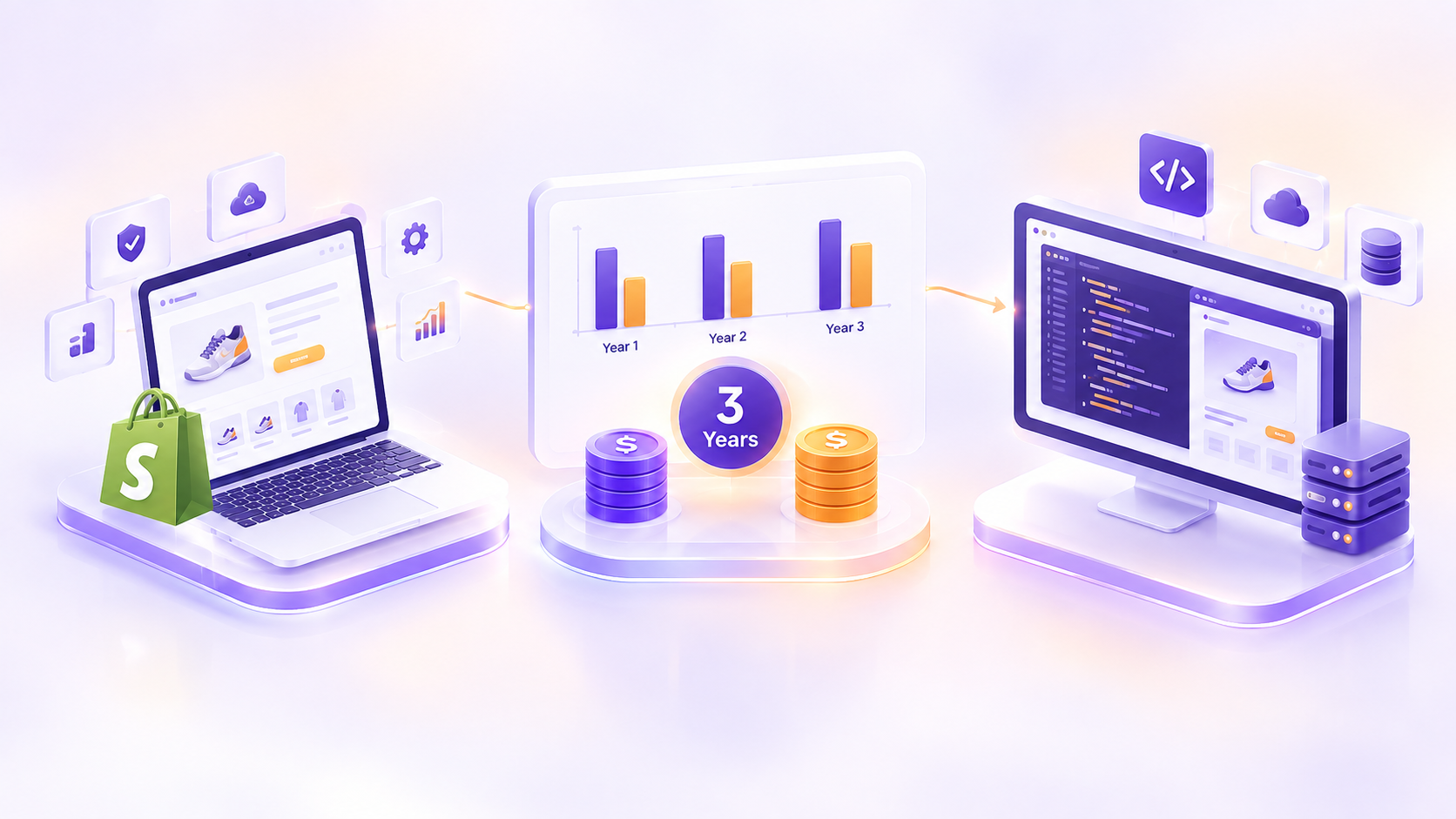
"How much will this actually cost us?" is the question every founder asks when they're choosing between Shopify and a custom build, and it's also the question most comparisons answer badly. Most of them compare a Shopify subscription against a custom development quote, as if those were the same kind of number. They aren't. A monthly subscription and a one-time build cost are two different shapes of spending, and comparing them side by side without a timeframe tells you very little.
The honest way to compare them is total cost of ownership, meaning everything you'll spend over a set period. This post uses three years, since that's long enough to include real maintenance, growth, and the fees that only show up once you're actually selling.
Here's the short version: for most stores, Shopify wins in years one and two on cost alone. Custom development starts to earn its price at scale, at a certain level of complexity, or once transaction volume gets high enough that platform economics work against you. The rest of this post shows the numbers behind that, so you can see where your own business sits.
Shopify vs. custom e-commerce at a glance
| Shopify | Custom Build | |
|---|---|---|
| Upfront cost | Low. A store can go live for a few hundred dollars in setup and theme costs. | High. Even a lean build typically starts in the tens of thousands. |
| Time to launch | Days to a few weeks | Two to six months, often longer |
| Ongoing platform cost | Fixed monthly subscription plus card processing | No subscription, but hosting, security, and updates are your responsibility. |
| Transaction fees | Standard card processing rates, with a lower rate on higher plans | The same card processing rates apply through whatever gateway you choose. |
| Customization ceiling | Wide, through themes and apps, with real limits at the edges | Effectively unlimited, at a development cost |
| Maintenance burden | Handled by Shopify for core platform, updates, and uptime | Falls on you or your development partner |
| Best fit | Most stores under roughly $1 to $2 million in annual revenue, or anyone who needs to launch fast | High-complexity catalogs, unusual workflows, or very high transaction volume where fee economics change |
What Shopify really costs beyond the monthly plan
Shopify's pricing page makes the platform look simple, and for a lot of stores it is. But the sticker price is only one line in the budget.
The core plans
As of 2026, Shopify's core plans are priced as follows when billed annually:
- Basic: $29 per month, with a 2.9% plus $0.30 online card rate
- Grow (Shopify's mid-tier plan, previously called the "Shopify" plan): $79 per month, with a 2.7% plus $0.30 card rate
- Advanced: $299 per month, with a 2.5% plus $0.30 card rate
- Plus: priced from roughly $2,300 per month on a multi-year contract, aimed at high-volume and enterprise merchants
Paying monthly instead of annually adds roughly 25 to 35% to each plan. If you use a payment gateway other than Shopify Payments, an additional transaction fee applies on top of your gateway's own rate, ranging from about 2% on Basic down to under 1% on Advanced. Using Shopify Payments directly avoids that extra fee, which is why most merchants stick with it.
The costs the plan page doesn't show
- Apps. Reviews, subscriptions, upsells, inventory sync, and shipping tools each carry their own monthly fee. A modest app stack commonly runs $50 to $300 a month for a small store and several hundred to a few thousand a month for a larger one running a dozen integrations.
- Themes and design. Free themes work for a basic launch. A premium theme is typically a one-time fee in the low hundreds, and custom design or development work on top of a theme is billed separately, often by a Shopify development partner.
- Card processing. This is usually the largest line item once a store has real revenue, because it scales directly with sales. It's easy to underestimate in a monthly budget and then notice it clearly at the end of the year.
- Development and liquid customization. Anything beyond what a theme and apps can do (custom checkout logic, unusual product configurators, complex B2B pricing) needs a developer familiar with Shopify's platform, billed as a project or a retainer.
None of this makes Shopify expensive. It makes the plan price a starting point rather than the whole answer.
What a custom e-commerce build really costs
A custom build shifts the cost profile from a subscription to a project, plus ongoing infrastructure you now own.
Build, hosting, maintenance, and security
- Initial build. For a genuinely custom storefront (checkout, catalog, cart, and admin tooling built from scratch or on a headless commerce framework), industry ranges commonly run from the tens of thousands for a lean build to several hundred thousand for a complex, high-traffic platform with deep integrations.
- Hosting and infrastructure. Cloud hosting, a CDN, staging environments, and load handling for peak traffic (think Black Friday) typically run from a few hundred to a few thousand dollars a month, depending on traffic and redundancy needs.
- Maintenance. A common industry rule of thumb is 15 to 20% of the original build cost per year for updates, bug fixes, dependency upgrades, and small feature work. On a $150,000 build, that's roughly $22,000 to $30,000 annually before anything new is added.
- Security and compliance. PCI compliance, patching, and monitoring are the platform's jobs on Shopify. On a custom build, they're your job, whether handled in-house or contracted out.
- Card processing. This cost doesn't go away with a custom build. Whatever gateway you use (Stripe, Adyen, Braintree, or similar) charges a comparable percentage-based rate, generally in the same range as Shopify's.
The figures above are illustrative industry ranges, not a quote. If you're comparing this against Raydiant's own project data for a similar build, use that instead, since real project ranges beat public benchmarks every time.
Three-year total cost of ownership: two worked examples
Numbers land better with real scenarios attached. Here are two, using average order values and modest, realistic growth. Treat both as directional rather than exact.
Scenario 1: a store doing roughly $50,000 a year in revenue
Shopify (Basic plan, annual billing, using Shopify Payments):
| Cost | 3-Year Estimate |
|---|---|
| Subscription ($29/mo) | ~$1,050 |
| Apps (~$50/mo average) | ~$1,800 |
| Theme and light design | ~$500 |
| Card processing (2.9% + $0.30, on ~$165,000 cumulative revenue) | ~$6,100 |
| Total | ~$9,450 |
Custom build, for comparison:
| Cost | 3-Year Estimate |
|---|---|
| Initial build (lean scope) | $15,000 to $30,000 |
| Hosting and infrastructure | $1,800 to $5,400 |
| Maintenance (15 to 20% of build, per year) | $6,750 to $18,000 |
| Card processing (same volume, comparable rate) | ~$6,100 |
| Total | ~$30,000 to $60,000 |
At this revenue level, the gap isn't close. A custom build costs roughly three to six times more over three years for a store that doesn't yet need most of what custom development buys. This is why Shopify, or a comparable platform, is the sensible default for most stores starting out.
Scenario 2: a store doing roughly $1 million a year in revenue
Shopify (Advanced plan, annual billing, using Shopify Payments):
| Cost | 3-Year Estimate |
|---|---|
| Subscription ($299/mo) | ~$10,800 |
| Apps and integrations (~$800/mo average) | ~$28,800 |
| Development and customization work | $30,000 to $60,000 |
| Card processing (2.5% + $0.30, on ~$3.45M cumulative revenue with modest growth) | ~$103,000 |
| Total | ~$173,000 to $203,000 |
Custom build, for comparison:
| Cost | 3-Year Estimate |
|---|---|
| Initial build (mid- to high-complexity) | $100,000 to $250,000 |
| Hosting and infrastructure | $36,000 to $108,000 |
| Maintenance (15 to 20% of build, per year) | $78,000 to $105,000 |
| Card processing (same volume, comparable rate) | ~$95,000 to $103,000 |
| Total | ~$309,000 to $566,000 |
Even at $1 million a year, Shopify Advanced tends to come out ahead over three years for most businesses. The gap narrows compared to Scenario 1, and it can flip if the build unlocks something with real financial value, like a checkout experience or workflow Shopify's app ecosystem can't replicate, or if transaction volume is so high that a negotiated flat-rate processing deal beats percentage-based fees by a wide enough margin to offset the build cost.
Beyond cost: five decision factors that matter as much as the number
Cost is the headline, but it isn't the whole decision. These five factors often tip the balance either way.
Customization ceiling
Shopify's app ecosystem covers an enormous range of needs, but every app is still working within Shopify's underlying architecture. Deeply unusual checkout flows, highly specific B2B pricing logic, or a product configurator that doesn't fit standard variant models can hit a ceiling that no app quite clears. A custom build has no such ceiling, at a development cost.
Transaction-fee economics at volume
Percentage-based card fees scale with revenue in a way that fixed platform costs don't. At low volume, that's an advantage of Shopify's model, since you're not paying for capacity you don't use. At very high volume, the same math works against you, which is part of why some large merchants negotiate custom payment processing rates that a percentage-of-sales fee structure can't match.
Data ownership and portability
On Shopify, your store data lives inside Shopify's infrastructure, accessible through their APIs and exportable, but structured the way Shopify structures it. A custom build gives you full control over your data model and where it lives, which matters more for businesses with heavy data science needs, unusual reporting requirements, or strict data residency rules.
Speed to launch
A functioning Shopify store can go live in days to a few weeks. A custom build realistically takes two to six months, often longer with a complex catalog or integrations. If speed to market matters more than architectural control, that's a real point in Shopify's favor, independent of cost.
Integration depth with ERP and logistics
Shopify connects to most common ERP, accounting, and fulfillment systems through apps or Shopify's APIs, which covers the large majority of use cases well. Businesses with a highly specific or legacy ERP setup, or unusual warehouse and logistics workflows, sometimes find a custom ERP integration layer easier to build once than to keep working around inside an app-based model.
The middle paths: Shopify Plus, headless, and hybrid builds
The Shopify-versus-custom framing implies two choices, but most growing merchants actually land somewhere in between.
- Shopify Plus raises the ceiling considerably. It supports custom checkout extensions, higher API limits, and features built for larger merchants, while keeping Shopify's hosting, security, and core platform maintenance. It's worth evaluating well before you'd consider a fully custom build.
- Headless commerce uses Shopify, or another platform, as the backend for products, inventory, and checkout, while a custom frontend gives you full design and experience control. This is a common choice for brands that need a distinctive storefront but don't want to own payment processing, PCI compliance, or backend infrastructure.
- Hybrid builds keep Shopify for checkout and payments, arguably the highest-liability part of an ecommerce stack to build yourself, while custom-building the parts of the experience that create real differentiation, like a product configurator or a loyalty system.
These paths often deliver most of what a fully custom build offers, at meaningfully lower cost and risk.
Which should you choose? A quick scenario guide
- Launching a new store, or doing under roughly $500,000 a year: Shopify, almost without exception. The cost gap is too wide to justify custom development at this stage.
- Growing steadily, $500,000 to $2 million a year, standard retail workflows: Shopify, likely on Advanced or Plus. Consider headless if brand experience is a major differentiator.
- Complex B2B pricing, unusual fulfillment logic, or a product catalog that doesn't fit standard ecommerce models: Start with Shopify Plus and evaluate specific custom extensions before committing to a full custom build.
- Very high transaction volume, or a checkout experience central to your competitive advantage: A custom or hybrid build becomes worth serious evaluation, ideally backed by your own cost model rather than industry averages.
The bottom line
Shopify and custom ecommerce aren't really competing on the same axis. Shopify trades some ceiling on customization for speed, low upfront cost, and someone else handling security and uptime. Custom development trades a much larger upfront and ongoing cost for full control. Over a three-year window, that trade favors Shopify for the large majority of stores, and it only tips toward custom once specific, measurable factors, such as complexity, volume, or a genuine competitive need, justify the difference.
Model your own numbers before deciding either way. If you'd like help running the comparison against your actual catalog, traffic, and growth plans, the team at Raydiant Webs can walk through it with you.
Frequently asked questions
Related Blog

Healthcare Software Development: What Compliance Actually Requires
A founder says, "We just need to make it HIPAA compliant", as if compliance were a plugin you install before launch. Then the first…

The Software Development RFP Template That Gets Useful Proposals (Free Download)
A good software development RFP contains nine things: company and project background, a problem statement separated from any assumed solution, clear scope boundaries, real…
0 Comments
Please log in to post a comment