Bring your operations into one system that fits
What an ERP actually does for you
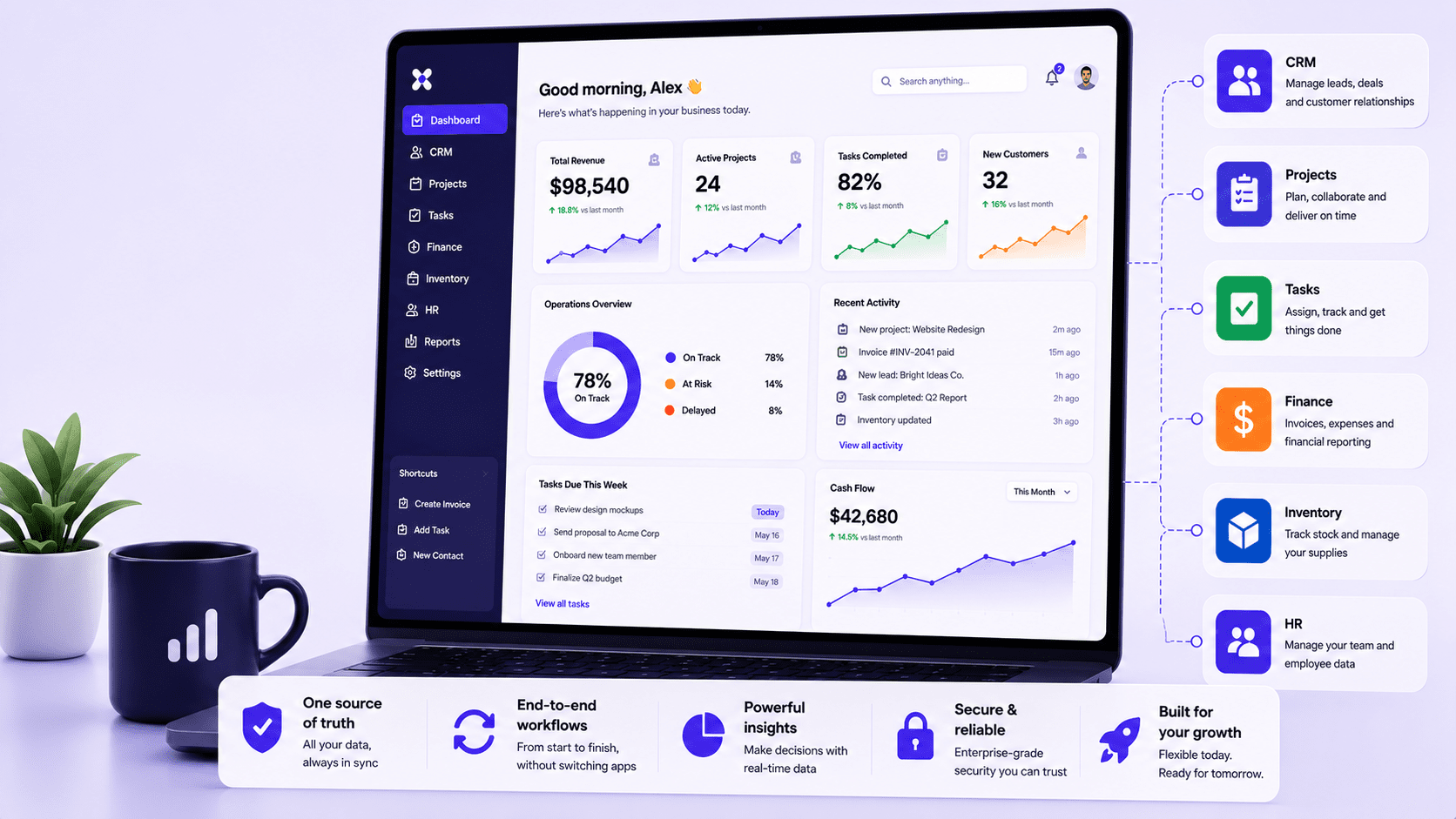
Stripped of the jargon, an ERP does four things.
It gives you one source of truth, so stock levels, order status and financial position are the same number wherever you look.
It removes duplicate entry, so information entered once flows everywhere it is needed instead of being retyped into three systems.
It makes the business visible, so you can see what is happening now rather than reconstructing it from spreadsheets at month end.
It enforces process, so approvals, stock movements and financial controls happen consistently rather than depending on who is on shift. If none of those describe a problem you currently have, you may not need an ERP yet, and we will say so.
What we do
Mapping how you actually operate, then recommending custom or platform with the reasoning and cost comparison.
Building modules around your operations: inventory, purchasing, production, order management, warehouse, finance and reporting.
Configuring and tailoring Odoo, SAP and other platforms to fit your processes rather than the other way around.
Auditing, cleaning, mapping and migrating your existing records with verification against the source.
Connecting the ERP to your website, store, CRM, accounting, logistics providers and any other system you depend on.
Building the parts a platform does not cover, so you keep a mature product without accepting its gaps.
Making sure the people who use it daily are confident with it, which determines whether the project succeeds.
Maintenance, improvements and new requirements as the business changes.
Who needs an ERP
Manufacturers and producers coordinating materials, production and finished stock, where a shortage discovered late costs a great deal.
Wholesalers and distributors managing inventory across locations, suppliers and channels, where stock accuracy is the whole business.
Multi-channel retailers selling through a store, a website and marketplaces, where stock and orders must reconcile across all of them.
Construction and project-based businesses tracking costs, materials and progress across concurrent jobs.
Growing businesses generally, where the coordination that worked at a smaller scale now consumes management time every week and errors are becoming expensive.
The choice, the honest limit, and the data reality
The three things that decide whether an ERP project succeeds.
Custom ERP or an existing platform?
The honest comparison, in the terms that actually matter.
An established platform such as Odoo or SAP is usually right when your processes are reasonably standard for your industry, when you want proven functionality quickly, and when you value a large ecosystem of people who already know the system. Modern platforms are highly configurable and cover most requirements well. The trade-offs are per-user licence fees that grow as you do, constraints on how far the software can bend, and dependence on the vendor's direction.
A custom ERP is usually right when your operations are genuinely distinctive, when the workarounds needed to fit a platform would create more friction than they remove, when licence costs at your headcount become significant, or when your operational process is itself a competitive advantage. You own everything and it fits exactly. The trade-offs are a higher initial cost, a longer build, and full responsibility for its future.
There is also a middle path we use often: implement a platform for the standard parts and build custom modules for the genuinely distinctive ones. For many businesses this is the best value of the three.
When you do not need an ERP
Worth saying, because ERP is oversold to businesses too small to benefit.
If you have one location, straightforward stock and fewer than roughly ten people touching the process, well-configured accounting software plus a decent inventory tool will probably serve you better and cost a fraction. If your current problem is one specific bottleneck rather than general disconnection, a focused custom tool solves it far more cheaply than a full ERP. And if your data is currently chaotic, cleaning it up may reveal that the systems were never the real problem.
We would rather build you a small tool that fixes the actual issue than sell you a platform you will not fully use.
Data migration, treated seriously
This is where ERP projects most often go wrong, so it gets its own section.
Every business believes its data is in better shape than it is. Migration reliably uncovers duplicate customers, products with three different codes, historical records with missing fields, and quantities that have not matched reality for years. Discovering this late is what turns a schedule into a crisis.
We audit data early, before the timeline is fixed, and give you an honest assessment of its condition. We map old fields to new ones explicitly rather than assuming. We migrate in stages with verification at each step, reconciling against the source rather than trusting the import. And we plan for the cutover period when both systems may briefly hold information. It is unglamorous work and it is the difference between a smooth launch and a bad quarter.
How much does an ERP implementation cost?
An ERP implementation starts around €15,000 for Odoo or SAP Business One configured to your processes, including data migration and training.
Platform licence fees are charged per user by the vendor, are not included above, and over five years they frequently exceed the implementation cost. We model them with you from the start rather than letting them arrive later.
- How many users, roles and locations
- Which modules are genuinely in scope
- The volume and condition of data to migrate
- Integrations with the systems you keep
- Training and the change management around it
Custom modules, where a platform cannot bend to a process that is genuinely yours, are quoted separately after discovery. See full pricing.
Ways to work with us
A fixed-price review of your operations, systems and data, with a recommendation on custom versus platform and a five-year cost comparison. The sensible first step.
Configuration, migration, integration and training on an established ERP.
Bespoke system development, phased so value arrives early.
Platform for standard processes, custom modules for the distinctive ones.
Fixing a poorly implemented or under-adopted existing ERP, usually far cheaper than replacing it.
Maintenance, improvements and new requirements over time.
Why Raydiant Webs for ERP
We assess without bias, because we build custom and implement platforms and have no commission riding on either. We are strong on the integration work that decides these projects, with backend depth across Java, .NET, Python and PHP including Oracle-backed systems. Connecting an ERP to your website, store, accounting and logistics is where most implementations struggle, and it is our strongest ground. We also build the surrounding software, so if your ERP needs a customer portal, a mobile app for the warehouse floor or a desktop tool for offline sites, that comes from the same team. And we are honest about scale, including telling smaller businesses when an ERP is premature.
ERP FAQ
It depends on how distinctive your processes are, your user count and the five-year cost including licences. Most businesses are well served by a configured platform, some genuinely need custom, and a hybrid often beats both. Our assessment answers this for your situation.
Odoo and SAP among others, alongside custom development. We recommend based on fit rather than on what we prefer to implement.
Months rather than weeks. Straightforward platform implementations are faster; custom builds and complex integrations take longer. Phasing means working parts arrive earlier rather than everything landing at once.
Less than you fear if it is planned properly. Phased rollout, proper training and a considered cutover keep the business running. Disruption comes from rushed launches and untrained users, both of which are avoidable.
Audited early, cleaned, mapped and migrated in verified stages. We give you an honest assessment of its condition before the timeline is set rather than after.
Yes, and this is often the highest-value part of the project. Integration is where our engineering depth matters most.
Usually not. Poor configuration, missing integration and low adoption are the common causes, and all three are fixable. We audit before recommending replacement, because replacing a system that was merely badly implemented repeats the same expensive mistake.
Discuss an ERP project
Tell us how your operations work today and where the pain is. We will assess honestly and recommend the right path, including when that is smaller than you expected.
- No bias: we build custom and implement platforms
- Data audited early, before the timeline is fixed
- A five-year cost picture, licences included
More enterprise solutions
Tell us how your operations work today and where the pain is.
We will assess honestly and recommend the right path, including when that is smaller than you expected.