Manage customers and sales the way your team actually works
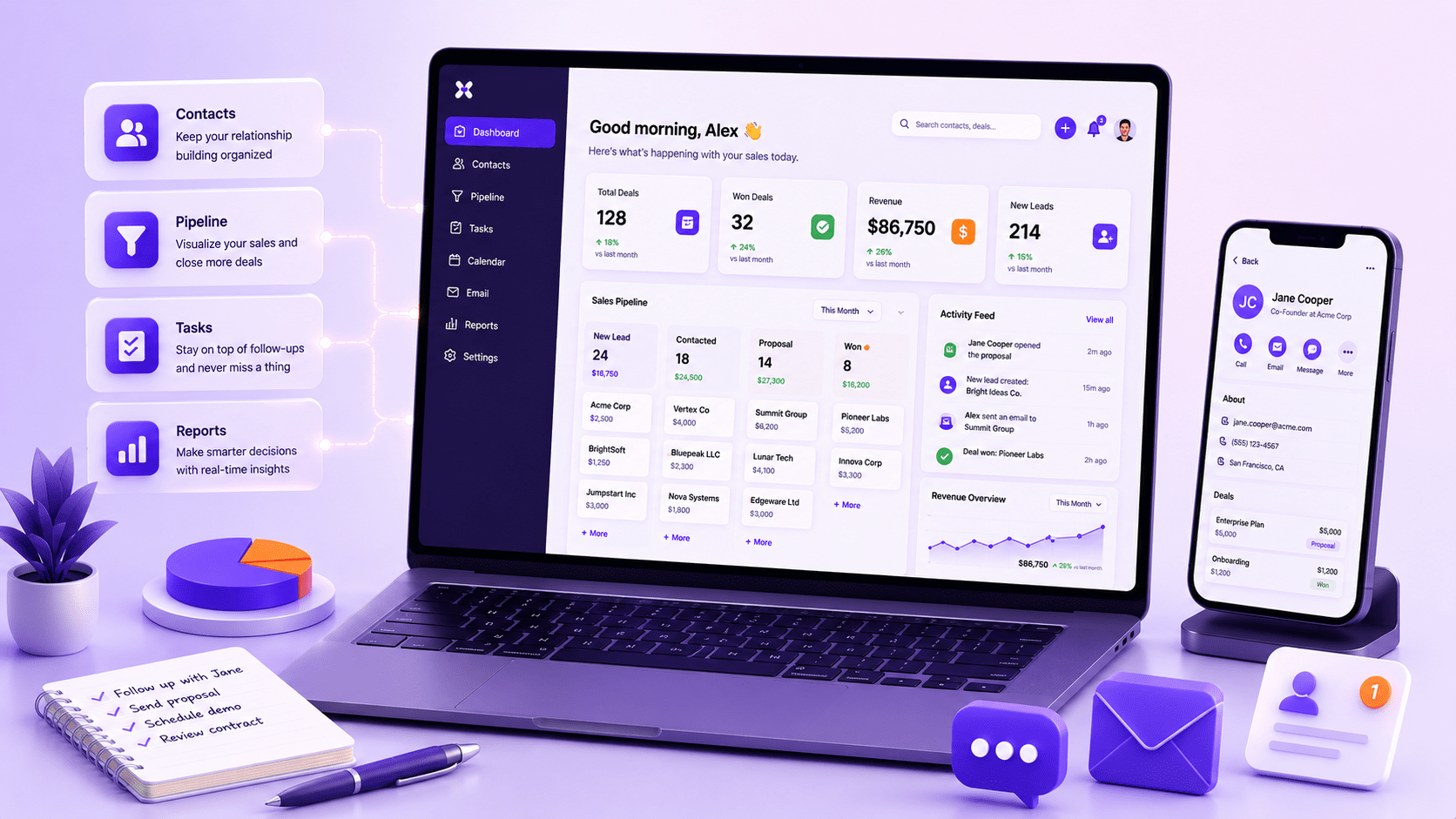
What we do
Understanding how your team actually sells and serves customers, then recommending custom or platform with honest reasoning.
Configuring Salesforce, HubSpot and others around your pipeline, your stages and your terminology rather than the vendor's defaults.
Building bespoke systems when your process does not fit packaged software, or when licence costs at your scale do not justify it.
Moving contacts, companies, deal history and communications from wherever it lives, cleaned and de-duplicated.
Connecting the CRM to your website forms, email, calendar, phone, accounting, ERP and support tools, so it reflects reality automatically.
Removing the admin that makes people resent CRMs: automatic logging, task creation, follow-up reminders and pipeline updates.
Giving managers a genuine picture of pipeline, forecast and activity, built on data that is actually current.
The part most projects skip, and the part that decides whether any of the rest matters.
Who needs a CRM
Sales teams beyond a handful of people, where visibility across the team stops being possible informally.
Businesses with long or multi-stage sales cycles, where a deal touched by several people over months will otherwise lose its history.
Service businesses managing ongoing relationships, where renewal dates, past work and open issues need to be visible to whoever picks up the phone.
Companies losing leads to follow-up failure, which is the single most common and most expensive gap we see.
Businesses whose pipeline lives in one person's head, which is both a forecasting problem and a genuine business risk.
The choice, adoption, and when to wait
Why most CRM projects fail, and how we make sure yours does not.
Custom CRM or an existing platform?
The honest comparison.
An established platform such as HubSpot or Salesforce suits most businesses. The functionality is mature, integrations with common tools already exist, people can be hired who already know it, and the vendor keeps developing it. HubSpot generally suits small and medium businesses wanting quick, usable setup; Salesforce suits larger or more complex operations needing deep customisation. The trade-offs are per-user licence fees that grow with headcount, and a structure your process must broadly fit.
A custom CRM is right when your sales or service process is genuinely unusual, when the platform's structure fights your workflow, when licence costs at your team size become hard to justify, or when the CRM needs to be part of a larger custom system rather than a separate tool. You own it and it fits exactly, at a higher initial cost and with the future on your shoulders.
Most businesses should implement a platform properly rather than build. We will say so when that is the answer, even though the custom project would be worth more to us.
Adoption is the whole game
Everything else is secondary, so this deserves saying plainly.
The most sophisticated CRM in the world is worthless if your team does not update it. And teams do not avoid CRMs out of stubbornness. They avoid them because the system was designed around what management wants to see rather than around how the work actually happens, so using it feels like unpaid administration on top of the real job.
We approach it the other way. We watch how your team actually works before configuring anything. We use your terminology and your real stages, not the platform's defaults. We automate the logging and updating that people find tedious, so the CRM largely maintains itself from email, calendar and forms. We keep required fields to the genuine minimum, because every mandatory box is a reason to skip the record entirely. And we train people on what it does for them, not only on what it does for the business. A simple CRM your team uses every day beats a powerful one that sits empty. That is not a compromise, it is the point.
When you do not need a CRM yet
If you are one or two people with a manageable number of active conversations, a well-kept spreadsheet is genuinely fine and considerably cheaper. If your problem is a shortage of leads rather than a shortage of organisation, a CRM will organise an empty pipeline neatly and change nothing; marketing is your priority instead. And if you already have a CRM that nobody uses, replacing it will not help until you understand why it was abandoned. That is usually a configuration and adoption problem, and fixing it costs a fraction of starting again.
Integration is what makes it stick
A CRM that requires manual entry decays quickly. One that fills itself stays accurate.
We connect the CRM to the places customer information already appears: website enquiry forms so leads arrive automatically with their source recorded, email and calendar so conversations and meetings log themselves, phone systems where call records matter, accounting so invoice and payment status is visible to the people talking to the customer, your ERP so sales and operations see the same reality, and support tools so account managers know about open issues before a call rather than during one. Each integration removes a reason for the data to be wrong. That is what turns a CRM from a reporting chore into something people actually rely on.
How much does a CRM implementation cost?
A CRM implementation starts around €12,000 for Salesforce, HubSpot or a custom build, including data cleaning, integrations and training.
Licence fees are per user per month and sit with the vendor, not with us. We recommend without bias toward the option that pays us more, and most businesses should implement a platform properly rather than build one.
- How complex your pipeline and process really are
- The state of the data being brought across
- Integrations with email, phone and marketing tools
- Automation, scoring and reporting requirements
- Training and the adoption support that follows
Adoption decides whether a CRM pays for itself, so training is part of the project rather than an upsell. See full pricing.
Ways to work with us
A fixed-price review of your sales and service process with a recommendation on platform versus custom and a realistic cost picture.
Configuration, migration, integration and training on Salesforce, HubSpot or another established CRM.
Bespoke development where the platforms genuinely do not fit.
Fixing an existing CRM nobody uses, usually a configuration and training problem rather than a software problem.
Connecting an existing CRM to your other systems, often the highest-value work available if the CRM itself is fine.
Improvements and new requirements as your process evolves.
Why Raydiant Webs for CRM
We recommend without bias, since we both implement platforms and build custom, and nothing rides on which you choose. Integration is our strength, and integration is what makes a CRM survive its first year. Our backend depth across multiple stacks means connecting your CRM to your website, ERP, accounting and phone system is straightforward work for us rather than an outsourced unknown. We also build the systems the CRM connects to, including websites, portals and custom applications, so the whole picture can be designed together. And we treat adoption as part of the job rather than as your problem after handover.
CRM FAQ
For most businesses, a properly configured platform is the right answer, with HubSpot generally suiting small to medium teams and Salesforce suiting larger or more complex operations. Custom makes sense when your process genuinely does not fit or licence costs at your scale do not justify themselves. Our assessment gives you a straight recommendation.
Only if the reasons are addressed. We look at why it was abandoned, which is usually a system built around reporting rather than around the work, too much manual entry, or no real training. Fix those and adoption follows. Replace the software without fixing them and you repeat the outcome.
Yes, and it is usually the most valuable part. Website forms, email, calendar, phone, accounting and ERP integrations are what keep the data accurate without anyone having to be disciplined about it.
We migrate it, cleaned and de-duplicated, from wherever it currently lives, including spreadsheets and old systems. Deal history and communications come across where the source allows.
A straightforward platform implementation is typically weeks. Complex configurations, heavy integration and custom builds take longer. You get a clear timeline after assessment.
Your data is always yours and exportable, on any platform we would recommend. For custom builds you own the system outright as well.
Often, yes, and it is usually the cheaper and better answer. Poor configuration, missing integrations and low adoption are all fixable without replacing anything.
Discuss a CRM project
Tell us how your sales process works and where it breaks down. We will recommend the right path, whether that is a platform, a custom build, or fixing what you already have.
- Configured around how your team actually sells
- Integrated so it fills itself and stays accurate
- Adoption treated as part of the job
More enterprise solutions
Tell us how your sales process works and where it breaks down.
We will recommend the right path, whether that is a platform, a custom build, or fixing what you already have.