Generative Engine Optimization: The Complete 2026 Playbook

Generative Engine Optimization (GEO) is the practice of structuring your content, your entity signals, and your earned media presence so that AI systems like ChatGPT, Perplexity, Claude, and Google's AI Overviews cite your business when they answer a question, rather than optimizing purely for a ranked list of blue links. 2026 is the inflection point because AI-powered answers have moved from a novelty to the default starting point for a meaningful share of real search behavior, and the businesses building GEO fundamentals now are establishing citation patterns that get reinforced every time a model is updated, while the businesses waiting to see how things shake out are falling further behind competitors who are already being cited.
What Is Generative Engine Optimization (GEO)?
GEO is the discipline of making your business, your content, and your expertise easy for a generative AI system to find, trust, and cite when it synthesizes an answer to a user's question. Where traditional SEO optimizes for ranking in a list of links a person then chooses to click, GEO optimizes for being one of the sources an AI model actually pulls from, quotes, or references when it writes its own answer, often without the user ever clicking through to your site at all.
The term was formalized academically in a November 2023 paper by researchers from Princeton, Georgia Tech, IIT Delhi, and the Allen Institute for AI, presented at KDD 2024, which introduced a 10,000-query benchmark and tested nine content optimization strategies against it. That research matters beyond its academic origin because it gave the industry its first rigorous, measurable answer to a question marketers had only been guessing at: which specific changes to content actually move the needle on AI citation, and by how much.
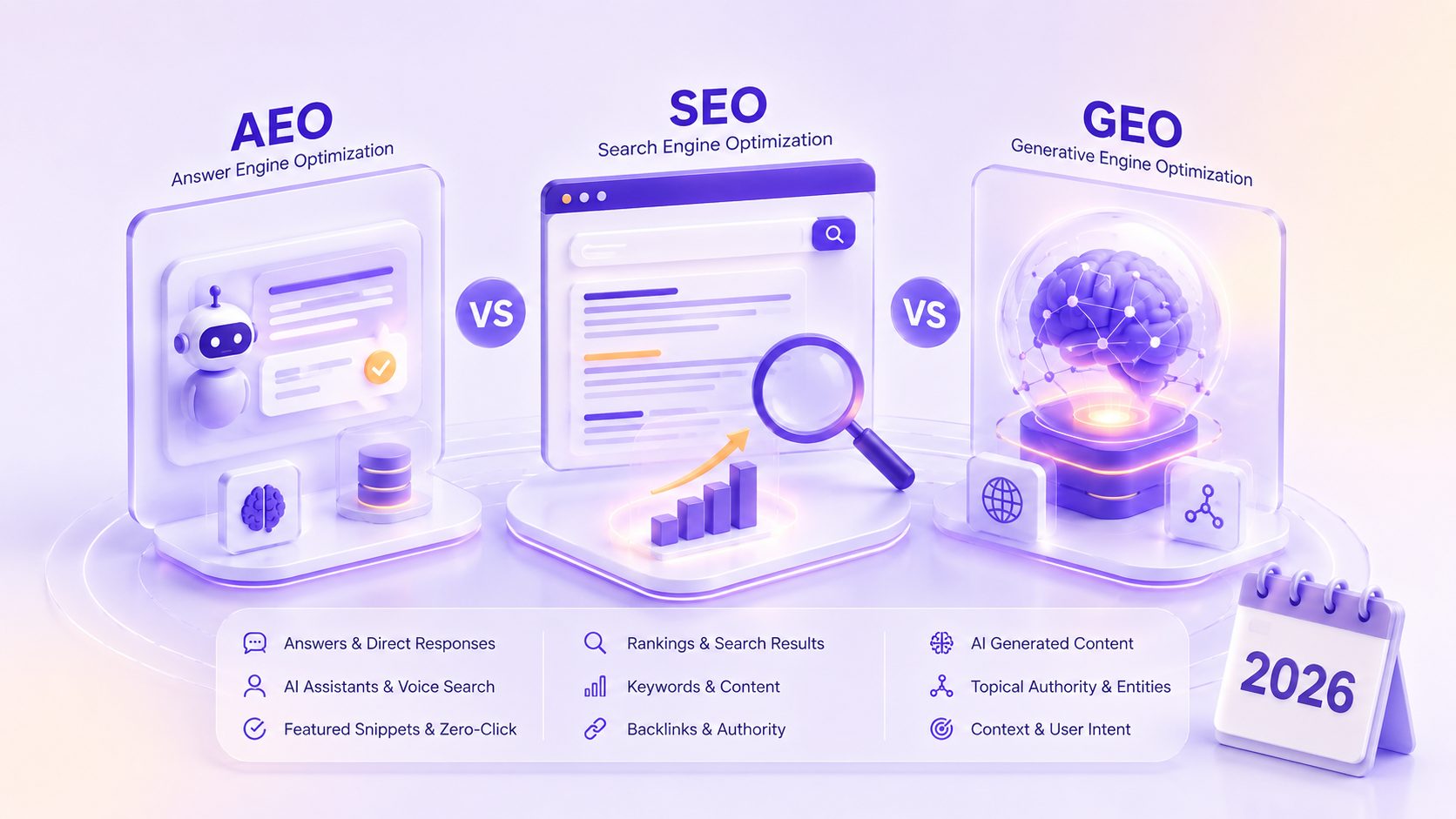
GEO is not a replacement for SEO, and it is not identical to AEO (Answer Engine Optimization), though the three overlap significantly, covered in more detail in the comparison below. Think of GEO as the outermost, most AI-native layer of a discipline that also includes traditional ranking (SEO) and structured, answer-first content (AEO), all aimed at the same underlying goal: being the source that gets found, trusted, and used, whichever interface someone is using to search.
How Do Generative Engines Choose What to Cite?
Generative engines do not work like a traditional search index, and understanding the actual mechanism behind citation is the foundation everything else in this playbook builds on.
Retrieval, Synthesis, and Citation Mechanics
A generative engine typically works in two stages. First, it retrieves a set of candidate sources relevant to the query, drawing on some combination of a search index, its own training data, and, increasingly, real-time web crawling. Second, it synthesizes those sources into a single, coherent answer, selecting which claims to include, which sources to attribute them to, and how to phrase the result. Your content has to survive both stages: it has to be retrieved as a relevant candidate in the first place, and then it has to be judged citable, trustworthy, and clear enough to actually make it into the synthesized answer rather than being read and discarded.
This is meaningfully different from ranking in a traditional search index, where simply appearing on page one guarantees visibility. A page can be retrieved by a generative engine and still never get cited if a competing source states the same fact more clearly, with better supporting evidence, or in a format the model finds easier to extract and attribute confidently.
Training Data vs. Live Retrieval
Generative engines draw on two distinct information sources, and each responds to a different kind of effort. Training data is what the underlying model learned during its build process, frozen at a cutoff date, which is largely outside your ability to influence going forward except through the reputation and presence you build now, ahead of some future model's training window. Live retrieval, increasingly the dominant mechanism for tools like ChatGPT search, Perplexity, and Google's AI Overviews, pulls current web content at the moment a question is asked, which is the layer where fresh, well-structured, well-cited content published or updated today can influence an answer within days, not years.
This distinction is the practical reason GEO work pays off faster than most businesses expect. You are not waiting for the next training run of a frontier model. You are competing for citation in the live retrieval layer, which responds to real, current signals on a rolling basis.
GEO vs SEO vs AEO: Where the Disciplines Meet
The three disciplines overlap substantially but optimize for genuinely different outcomes, and understanding the distinction shapes where you invest effort.
| SEO | AEO | GEO | |
| Optimizes for | Ranking position in search results | Direct answers in featured snippets and AI overviews | Citation and mention inside AI-generated responses |
| Success metric | Rankings, organic traffic | Snippet capture, answer-box appearances | Citation share, AI referral quality |
| Primary mechanism | Backlinks, technical SEO, keyword relevance | Answer-first structure, FAQ schema | Entity consistency, earned media, factual density |
| Content format | Comprehensive, keyword-targeted pages | Direct answers in the first 40–60 words | Statistic-dense, quotable, well-attributed content |
Our full AEO vs SEO vs GEO comparison breaks this down in more depth, including a decision framework for which discipline deserves the most investment based on your specific business. The short version for most businesses: these are not competing budgets; they are a layered strategy. Strong technical SEO and backlink authority still feed a domain's overall credibility, which generative engines weigh alongside GEO-specific signals, and an answer-first, AEO-structured page is also easier for a generative engine to extract and cite cleanly. The businesses seeing the strongest AI visibility right now are rarely running GEO in isolation. They are running all three disciplines as a single, coordinated content strategy.
The GEO Ranking Factors That Matter in 2026
Citations and Statistics (the Princeton Findings)
The KDD 2024 Princeton research remains the most rigorous evidence available on what actually moves AI visibility, and its findings are worth citing precisely rather than approximately. Testing nine optimization strategies against a 10,000-query benchmark, the study found that adding specific, verifiable statistics and citing authoritative sources were consistently the strongest levers, each improving visibility in generative engine responses by up to 40 percent, with adding authoritative quotations also producing a substantial lift. Improving text fluency helped as well, though by a smaller margin. Critically, the study found that keyword stuffing, the traditional SEO tactic of repeating target phrases, actually hurt AI visibility, a genuine inversion of old-school SEO instinct that every content team adapting to GEO needs to unlearn deliberately.
Earned Media and Third-Party Mentions
Content on a business's own site is rarely the primary source a generative engine cites. Independent research tracking millions of AI citations has consistently found that earned media, articles, reviews, and mentions on sites you do not own, make up the large majority of what these models actually reference, with paid content barely registering. This mirrors exactly what our guide on getting recommended by ChatGPT covers in more depth: a business that only exists on its own website is competing for a small slice of what generative engines actually draw from.
Entity and Brand Consistency
Generative engines build an internal picture of a business by cross-referencing its name, services, and locations across every source they encounter. Inconsistent naming, contradictory service descriptions, or mismatched location data across your website, directories, and social profiles makes a model less confident recommending you, and low confidence tends to mean omission rather than a hedge. Fixing this is largely a one-time cleanup exercise with a long-lasting payoff.
Content Structure and Extractability
Content that states its main point clearly and early, uses question-based headings that match how people actually ask AI assistants questions, and structures comparisons and data in tables rather than dense paragraphs is dramatically easier for a generative engine to extract and attribute correctly. This is the AEO layer of the strategy showing up concretely inside GEO: structure is not a stylistic preference; it is a mechanical requirement for citability.
Freshness and Factual Accuracy
Recency carries more weight in AI citation than it traditionally has in SEO ranking. Content published or meaningfully updated recently, and that states specific, current facts rather than vague or dated claims, is easier for a model to lift confidently into an answer. A page that has not been revisited in two years signals staleness to both readers and the retrieval systems increasingly favoring current information.
Multimodal Signals
As generative engines increasingly draw on images, video transcripts, and structured data alongside text, businesses with well-described visual content, properly captioned images, transcribed video, and clean structured data markup are building an additional citation surface that text-only competitors are not. This factor is earlier in its maturity than the others on this list, but it is worth building the underlying discipline (proper alt text, transcripts, schema) now rather than retrofitting it later once it matters more.
The GEO Playbook: A 90-Day Implementation Plan
Days 1–30: Audit and Entity Foundations
Start by running a structured audit of your current AI visibility: a set of prompts across ChatGPT, Perplexity, and Google's AI Overviews covering your core services, comparisons against competitors, and problem-based queries your buyers would realistically ask, logging whether you appear and how accurately you are described. In parallel, fix your entity foundations, correcting any inconsistency in your business name, service descriptions, and location data across your website, Google Business Profile, and every directory listing you control. This phase is unglamorous but foundational, since every later phase's effectiveness depends on a model being able to confidently identify who you are before it will consider citing you.
Days 31–60: Content Restructuring and Schema
With entity foundations in place, restructure your highest-priority existing content to lead with a direct answer in the first 60 words, add question-based subheadings matching real query phrasing, and rework key statistics and claims to be specific and attributable rather than vague. Implement the Article, Organization, LocalBusiness, and FAQPage schema across your site, giving generative engines a machine-readable summary that removes ambiguity from what they would otherwise have to infer. This is also the phase to audit and, where necessary, rebuild any comparison content as genuine tables rather than prose, since tables are disproportionately favored for extraction.
Days 61–90: Digital PR and Citation Building
With your own content and technical foundation solid, shift effort toward the highest-leverage lever in the entire playbook: earned media. Pitch genuinely useful, original data points, project results, or observations to trade publications, local business outlets, and relevant journalists, since a small number of well-placed earned mentions consistently outperforms a much larger volume of owned content in AI citation research. Close this phase by re-running your Day 1 audit prompts to measure real movement, and use that comparison to decide where to double down for the next 90-day cycle.
How to Measure GEO (Metrics and Tools)
Citation Share and Prompt Tracking
The core GEO metric is citation share: across a consistent, representative set of prompts run regularly against ChatGPT, Perplexity, and Google's AI Overviews, what percentage mention your business at all, and how accurately. Building this tracking manually, as described in the audit phase above, is entirely viable for a business just getting started, and a small but growing set of dedicated AI-visibility tracking tools now automate this same process across a larger prompt set on a continuous basis, worth evaluating once manual tracking becomes a genuine bottleneck rather than before.
AI Referral Traffic Quality
Where a business can attribute traffic to AI referral sources in its analytics, the more interesting signal is usually not volume but quality. Multiple independent studies through 2026 have found AI-referred visitors converting meaningfully higher than traditional organic traffic, though the reported multiplier varies considerably by study and industry, from roughly double the conversion rate in more conservative, cross-industry analyses to a much larger multiple in studies focused on high-consideration B2B categories. The consistent thread across nearly all of this research, regardless of the exact multiplier any single study reports, is that AI-referred visitors tend to arrive further along in their decision process, having already had their initial questions answered by the AI's summary before ever reaching your site, which is worth designing your landing experience around rather than treating identically to a colder organic visitor.
GEO for Local and Multi-Market Businesses
For a business operating across multiple locations or markets, entity consistency becomes both more important and more complex. Each location needs its own accurate, consistent LocalBusiness schema and NAP (name, address, phone) data, and generative engines increasingly use exactly this structured local data to answer "near me" and location-specific prompts, meaning a multi-location business with inconsistent data across offices is actively working against itself in a growing category of AI-driven queries. A single domain serving multiple markets, as many growing businesses do, does not need separate GEO strategies for each market so much as it needs geo-specific content (dedicated pages addressing each market's specific queries) layered on top of the same core entity and citation-building work described throughout this playbook. The fundamentals do not change by market; what changes is which specific prompts and local directories matter for each one.
Common GEO Mistakes and Myths
The most common mistake is treating GEO as a purely technical, one-time fix, adding schema markup and calling the work done, while ignoring the earned media dimension that the research consistently identifies as the strongest lever. Schema and content structure matter, but they are necessary, not sufficient.
A related myth is that GEO is simply SEO with new terminology attached. The two disciplines share real infrastructure; a technically sound, crawlable, well-structured site benefits both, but the Princeton research's core finding, that keyword density hurts rather than helps AI visibility, is a direct contradiction of long-standing SEO instinct, and teams that port old SEO habits wholesale into GEO work tend to actively undermine their own results.
A third mistake is expecting citation results within days. Entity and schema fixes can influence how a model describes a business within weeks, since they are low-ambiguity facts models that pick up quickly, but earned media and genuine citation-share improvement typically take two to four months to show clearly, since a mention has to be published, indexed, and then reflected consistently across enough model responses to register as a real pattern rather than a fluke.
Finally, some businesses assume GEO only matters for large, well-known brands. The opposite is often true in the near term: AI search visibility for many specific, long-tail queries is still relatively uncontested territory, and a smaller, focused business investing in genuine entity consistency and earned media coverage can outperform a much larger, better-known competitor who has not yet bothered to fix basic AI visibility fundamentals.
The Bottom Line
Generative Engine Optimization is not a speculative future discipline; it is a measurable, researched practice with a clear evidence base on what actually works: specific statistics, credible citations, earned media presence, and clean entity consistency, delivered through content structured for extraction rather than buried under old-school keyword tactics that now actively work against you. The 90-day playbook above is deliberately sequenced, foundations first, then structure, then the highest-leverage earned media work, because each phase's effectiveness depends on the one before it. If you want a GEO strategy built around your specific business, competitors, and market rather than a generic checklist, our GEO services team can run the audit described above and build your 90-day plan from there.
Frequently Asked Questions
Related Blog

How to Get Your Business Recommended by ChatGPT (and Every Other AI Assistant)
When someone asks ChatGPT for "a good software development agency" or "the best CRM for a small business", the tool does not guess and…
AEO vs SEO vs GEO: What's the Difference in 2026?
Here’s the short answer. SEO will land your page on a search results page. AEO will have your content pulled into a direct answer-whether…
0 Comments
Please log in to post a comment