AI Automation for Small Business: 12 Processes Worth Automating First
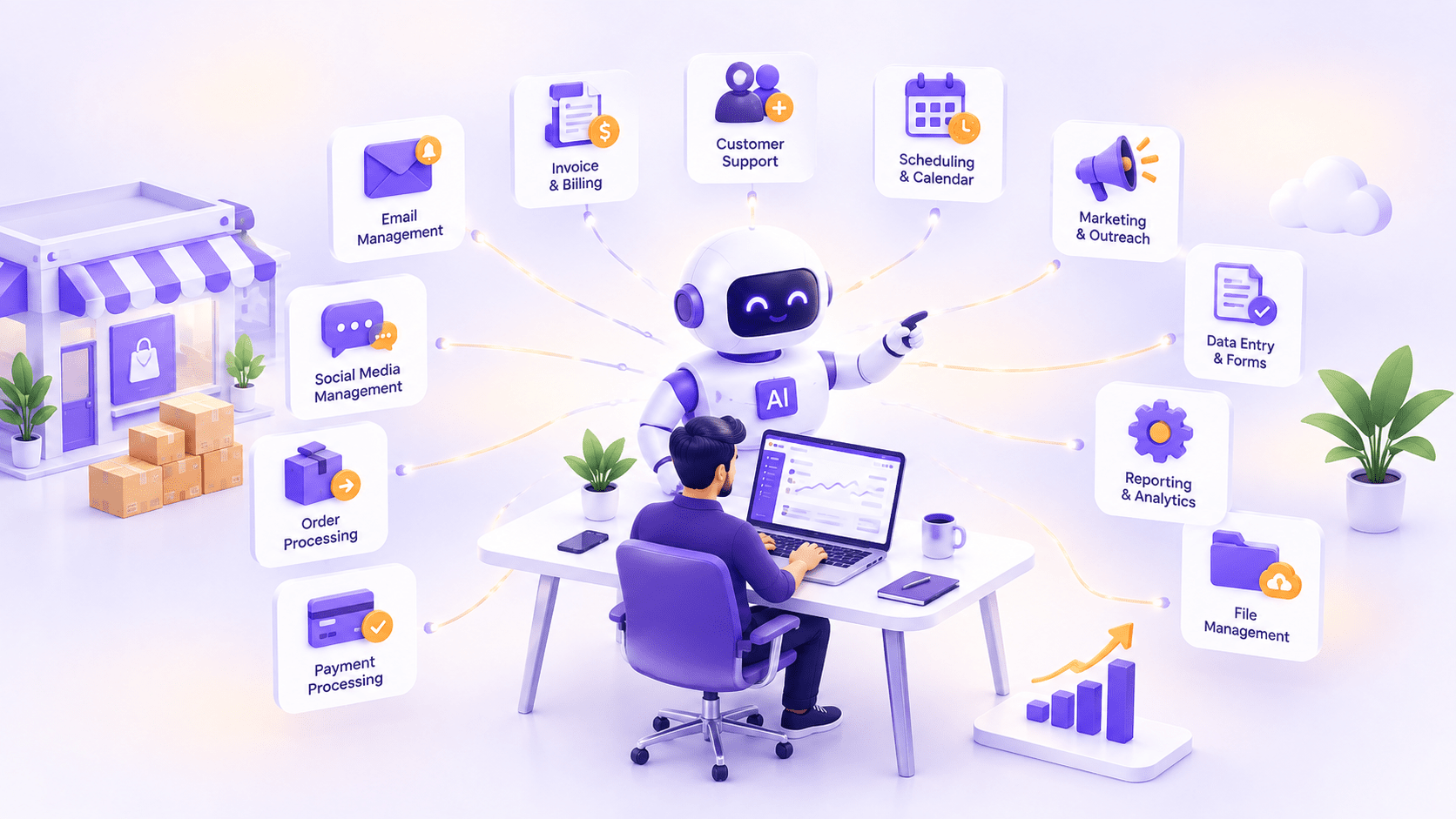
The highest-ROI processes for small business AI automation are usually customer enquiry triage, invoice processing, appointment scheduling, document drafting, lead qualification, and review response, since these tasks are repetitive, high-volume, and don't require nuanced human judgment to do well. Starting here, rather than with more ambitious or unproven use cases, tends to deliver measurable time savings within weeks rather than months.
How to Decide What to Automate First (ROI Framework)
Before picking a process to automate, weigh three things: how often the task happens, how much time it currently consumes, and how tolerant the task is of occasional error. High-frequency, high-time-cost, low-risk tasks are the best starting candidates, since they deliver the fastest payback with the least downside if the automation isn't perfect on day one. Tasks involving nuanced judgment calls, sensitive customer situations, or legal and financial risk are better left partially automated, with a human reviewing the output before it goes out.
The 12 Processes Worth Automating First
1. Customer Enquiry Triage and First Response
AI can read incoming enquiries, categorize them by topic and urgency, and draft an initial response for a human to review or send directly for simple, common questions. This alone often cuts response time from hours to minutes for routine enquiries, freeing staff to focus on complex cases.
2. Invoice Processing and Data Entry
Extracting line items, amounts, and vendor details from invoices and entering them into accounting software is one of the most reliable AI automation wins, since the task is structured and repetitive. Most businesses see this pay for itself quickly given how much manual time invoice entry typically consumes.
3. Appointment Scheduling and Reminders
AI-driven scheduling tools can handle booking, rescheduling, and reminder messages without back-and-forth email threads, reducing no-shows and freeing front-desk or admin time for higher-value work.
4. Document Drafting and Summarization
Drafting first versions of proposals, contracts, or reports, and summarizing long documents into key points, is a strong fit for AI assistance, provided a human still reviews and finalizes anything client-facing or legally binding.
5. Lead Qualification and CRM Updates
AI can score incoming leads based on defined criteria and automatically update CRM records, ensuring sales reps spend time on genuinely promising leads rather than manually sorting through every enquiry that comes in.
6. Review Monitoring and Response Drafting
Monitoring reviews across platforms and drafting thoughtful first-pass responses saves significant time for businesses that get meaningful review volume, while still allowing a human to personalize and approve before anything is posted publicly.
7. Inventory and Reorder Alerts
AI-driven demand forecasting and automated reorder alerts help avoid both stockouts and overstock, particularly useful for businesses with seasonal or variable demand patterns that are hard to track manually.
8. Employee Onboarding Paperwork
Automating the repetitive parts of onboarding, like document collection, account setup requests, and policy acknowledgment tracking, reduces administrative burden and gets new hires productive faster.
9. Reporting and KPI Dashboards
AI tools can pull data from multiple systems and generate regular reports or dashboards automatically, removing the manual, often error-prone process of compiling numbers from spreadsheets each week or month.
10. Email Marketing Personalization
AI can tailor subject lines, content blocks, and send times based on individual recipient behavior at a scale that would be impractical to do manually, typically improving engagement without adding to the marketing team's workload.
11. Meeting Notes and Action Items
Automated transcription and summarization of meetings, with action items pulled out automatically, saves time and improves follow-through compared to relying on someone to remember and write everything up afterward.
12. Basic Bookkeeping Categorization
Categorizing transactions and flagging anomalies for review is a well-suited AI task, since the categories are usually consistent and the volume of transactions makes manual categorization tedious and error-prone.
What This Costs (Tools vs Custom Automation)
Off-the-shelf automation tools and platform-native AI features are the cheapest and fastest way to start, often available for a modest monthly subscription, and are usually the right starting point for most of the processes above. Custom automation becomes worth the investment once your workflows are specific enough that generic tools require excessive workarounds, or once you're automating at a volume where a tailored solution pays for itself through efficiency gains a generic tool can't match.
Common Automation Mistakes Small Businesses Make
The most common mistake is trying to automate too much at once instead of proving value on one or two processes first. A close second is automating a broken process rather than fixing it first, which just makes a bad workflow run faster rather than better. And skipping a human review step on customer-facing automation, particularly early on, risks sending errors out at scale before anyone catches them.
Automation works best when it's targeted at the specific processes eating the most time with the least judgment required, not applied as a blanket strategy across the whole business. If you want help identifying which of these processes would deliver the fastest return for your specific operations, our AI automation team can help you scope a starting point.
FAQs
Related Blog

How Much Does AI Development Cost in 2026? Real Project Ranges
AI development costs in 2026 typically range from around $10,000 for a focused pilot to $500,000 or more for a complex, enterprise-grade system, with…

How to Get Your Business Recommended by ChatGPT (and Every Other AI Assistant)
When someone asks ChatGPT for "a good software development agency" or "the best CRM for a small business", the tool does not guess and…
0 Comments
Please log in to post a comment