Hiring an App Development Company in New Jersey: Local vs Offshore vs Hybrid
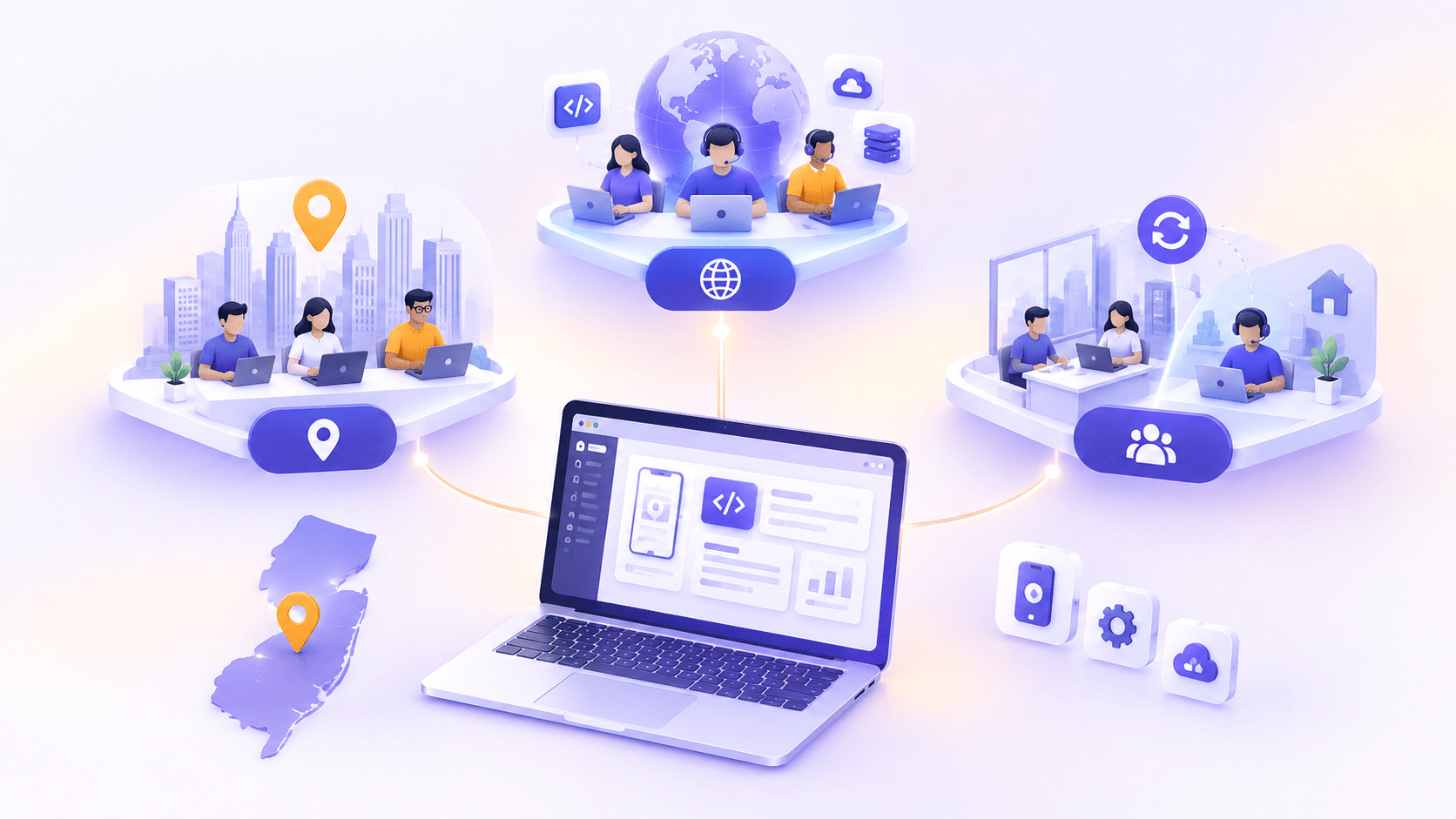
New Jersey businesses hiring an app development company should expect to pay a premium over the national average, driven by the NYC metro talent market, and should pick between three real engagement models: a local NJ agency, an offshore team, or a hybrid of the two. There is no universally right answer among the three. The right choice depends on how much your scope is likely to change, how price-sensitive the project is, and how much you value having someone in the same time zone.
This guide breaks down what app development actually costs in New Jersey right now, walks through the honest trade-offs between the three engagement models, and covers exactly what to verify before signing with any agency, local or otherwise.
What Does App Development Cost in New Jersey?
New Jersey sits inside the broader New York-Newark-Jersey City metro market, one of the highest-cost tech labor markets in the country, and that shows up directly in agency rates. Software developers in New Jersey earn a median of roughly $132,000 to $136,000 per year, according to the Bureau of Labor Statistics, with senior engineers and specialized roles running considerably higher across the wider NYC metro area. That employee-level wage data is the underlying driver of agency pricing in the region, since an agency's rates ultimately have to cover the local cost of employing the people doing the work.
| NJ/NYC Metro | National Average | |
| Blended agency hourly rate | $100–$225/hour | $75–$175/hour |
| MVP / proof of concept | $25,000–$60,000 | $15,000–$50,000 |
| Mid-complexity app | $80,000–$250,000 | $50,000–$180,000 |
This premium buys real proximity, an agency you can visit, a team working your business hours, and staff who already understand the local business landscape, but it is worth going in with the honest expectation that NJ-based development costs more than a national average quote, not less. It is also worth asking any local agency directly whether the team actually delivering your project sits in New Jersey, since some agencies market a local presence while the majority of hands-on development happens elsewhere, which changes what you are actually paying the premium for.
Local NJ Agency vs. Offshore vs. Hybrid: Honest Trade-offs
| Local NJ Agency | Offshore | Hybrid | |
| Typical cost | Highest | Lowest | Middle |
| Communication | Same time zone, in-person available | Time zone gaps, mostly async | Local oversight, distributed build |
| Best for | Evolving scope, close collaboration needs | Well-defined, stable scope | Most growing NJ businesses are balancing cost and control. |
| Main risk | Paying local rates for work that could be delivered elsewhere | Miscommunication, weaker accountability | Coordination overhead between teams |
None of these three models is a permanent commitment either. A business often starts with a local agency while requirements are still forming and stakeholder input matters most, then shifts more of the ongoing build work toward a hybrid or offshore arrangement once the scope has settled and the risk of expensive miscommunication has dropped considerably.
When Local Matters
A local NJ agency earns its premium when your requirements are still evolving, when in-person stakeholder workshops genuinely add value, or when your industry (finance, healthcare, or government-adjacent work) benefits from a team already familiar with the compliance landscape your business operates under. It also matters when the relationship itself needs to be ongoing and close, a long-term product partnership rather than a one-time build.
When Offshore Works
Offshore development can be the right call when your scope is genuinely fixed and well-documented, and cost sensitivity outweighs the value of real-time, same-time-zone collaboration. This works best for projects with a clear specification and less need for iterative back-and-forth during the build, where the main risk to manage is communication clarity rather than evolving requirements.
The Hybrid Model
Local senior oversight paired with a distributed build team is where most growing NJ businesses land in practice. It keeps a single accountable point of contact nearby while accessing a broader talent pool for the actual build, and it is often the most cost-efficient path without fully giving up local accountability. This model also tends to age well as a project matures, letting a business shift more of the build toward the lower-cost distributed team once initial requirements have settled and the risk of costly miscommunication has dropped.
6 Things to Verify Before Signing With Any Agency
Ask who specifically will work on your project, and get a portfolio you can verify against reachable references, not just logos on a website. A confident agency will happily connect you with a past client; a hesitant one is telling you something.
Confirm who actually writes the code versus who handles sales and account management, since the two are not always the same team, and the seniority of the person who scoped your project is not a guarantee of who builds it.
Get IP and code ownership terms in writing before work begins, not after. Confirm explicitly that you own the finished code and any custom components once the project is paid in full.
Ask exactly how and how often you will hear from the team, and whether the people you speak with day to day are actually in your time zone, not just the account manager who sold you the project.
Understand post-launch support terms, response times for critical issues, whether support is included or a separate contract, and what happens if your main point of contact leaves the agency partway through.
And insist on a transparent pricing model, fixed-price, time and materials, or a hybrid, explained clearly enough that you understand exactly what triggers a change order rather than discovering it mid-project.
Questions to Ask in the First Call
Ask directly who will be assigned to your project, by name and seniority. Ask for a reference you can actually call, and follow through on calling them, not just accepting a quote written on the agency's website. Ask what happens, contractually, if the project runs past its original timeline, since the answer reveals how the agency handles risk before it becomes your problem. Ask how they handle a mid-project scope change, since the answer reveals how honestly they scope work from the start and whether their process protects your budget or leaves it exposed to open-ended change orders. A confident, specific answer to each is a good sign; vagueness on any of them is worth taking seriously before you sign anything.
The Bottom Line
New Jersey's app development market costs more than the national average, and that premium is worth paying when your project genuinely benefits from local proximity and evolving-scope collaboration. It is not automatically worth paying for a well-defined build that offshore or hybrid delivery could handle just as well at lower cost. The businesses that get the best value tend to match the engagement model to the project's actual characteristics, not to whichever option feels most reassuring on the surface.
If you want to talk through which model actually fits your specific project, talk to our New Jersey team about scope, timeline, and a realistic budget before you commit to an agency.
Frequently Asked Questions
Related Blog
Laravel vs WordPress: When Your Business Has Outgrown a CMS
WordPress is the right tool for a content site, a blog, a brochure site, or most small business marketing sites where publishing and editing…
How to Choose a Software Development Company in Ireland (and What It Really Costs)
Choosing a software development company in Ireland comes down to three things: verifying they have real people and real references behind the pitch, being…
0 Comments
Please log in to post a comment