Custom CRM vs Salesforce vs HubSpot: An Honest Cost-Benefit Breakdown

Platforms win early, and custom wins at scale or when your workflow genuinely does not fit a template. Salesforce and HubSpot both get you running in weeks with proven functionality and no upfront build cost, which makes sense for a small or newly formed sales team. A custom CRM asks for more money and time upfront, but once you are paying for enough seats over enough years, or once you are bending your actual process to fit a platform's assumptions, the maths and the fit both start to favour building your own.
Custom CRM vs Salesforce vs HubSpot at a Glance
| Salesforce | HubSpot | Custom CRM | |
| Typical price per user/month | $80–$550 (Professional to Agentforce 1) | Free–$150 (Starter to Enterprise) | $0 licensing, one-time build cost instead |
| Typical implementation cost | $15,000–$150,000+ | $3,000–$40,000 | $30,000–$250,000+ |
| Time to launch | 6–16 weeks | 2–8 weeks | 3–9 months |
| Customization | Extensive, but often needs an admin or developer | Moderate, limited outside paid tiers | Unlimited, by design |
| Ongoing cost driver | Per-seat licensing + add-ons | Per-seat + marketing contact tiers | Maintenance (typically 15–20% of build cost/year) |
| Best fit | Complex sales orgs already in the Salesforce ecosystem | Growing SMEs wanting marketing and sales in one tool | Unusual workflows, or cost efficiency at real scale |
This table is a starting point. The real decision comes down to what each option actually costs once you stop reading the list price, and how much your business's process resembles what these platforms were built to assume.
What Salesforce Really Costs (Licences, Add-ons, Admins)
Salesforce's published pricing looks simple and rarely is. As of 2026, Sales Cloud runs from a Starter Suite at around $25 per user per month up through Professional at roughly $80 to $100, Enterprise at approximately $165 to $175 (the tier most mid-market and enterprise deployments actually land on), Unlimited at around $330 to $350, and the AI-forward Agentforce 1 tier at $550 per user per month. Enterprise is where most serious CRM deployments sit, since Professional lacks the API access most integrations need.
The list price is the floor, not the ceiling. Add-on products (CPQ for quoting, advanced analytics, additional Agentforce capacity, premium support) are priced separately and stack on top of the base edition. Most businesses running Salesforce properly also need a dedicated or part-time Salesforce administrator, whether an in-house hire or a contracted consultant, since the platform's flexibility is only realized through configuration most business users cannot do themselves. Budget for that role, plus implementation (typically $15,000 to $150,000 or more depending on complexity), plus the add-ons your sales process will eventually need, not just the per-seat number on the pricing page.
It is also worth watching the gap between list price and negotiated price. Salesforce's published rates are a starting point for negotiation at any meaningful seat count, and the discount available depends on contract length, total annual spend, and how many products you bundle together. A quote that looks identical to the published tier pricing, with no room moved on either side, is often a sign you are talking to the wrong rep or have not yet asked the right questions.
What HubSpot Really Costs (Tiers and the Scaling Trap)
HubSpot's core CRM is genuinely free for unlimited users, which is a real advantage for a very early-stage team. Sales Hub then scales through Starter at roughly $20 per seat per month, Professional at around $90, and Enterprise at approximately $150 per seat per month, each tier unlocking more automation, reporting, and AI features.
The scaling trap sits outside the seat price, in HubSpot's marketing contact tiers. Marketing Hub's Professional and Enterprise plans charge for the size of your marketing contact list in blocks, commonly around $50 per additional 1,000 contacts once you exceed your plan's included allowance, and that number climbs steadily as your list grows regardless of how many seats you actually have. A business that started HubSpot at a comfortable per-seat price can find its bill has crept up substantially within a year or two purely from contact growth, not from adding users. Factor in a mandatory onboarding fee on Professional and Enterprise tiers (commonly a few thousand dollars, paid once) and HubSpot's real first-year cost typically runs 20 to 30 percent above the advertised list price.
This is not necessarily a reason to avoid HubSpot. Plenty of businesses grow their contact list deliberately as part of their marketing strategy and get real value from the automation that comes with it. It is a reason to model your contact growth honestly before signing, rather than budgeting purely from the seat count, since the two numbers can diverge quickly for a business running active inbound marketing alongside its sales motion.
What a Custom CRM Really Costs (Build + Run)
A custom CRM has no per-seat licence fee, which is the headline appeal, but it is not free. Build costs for a genuinely custom CRM (not a heavily modified off-the-shelf tool) typically run from around $30,000 for a lean, single-team build up to $250,000 or more for a system covering multiple departments, complex pipeline logic, and deep integrations with your existing stack. Based on our own project work, the businesses that get the best value from a custom build are the ones whose sales or account management process genuinely does not map onto Salesforce's or HubSpot's assumptions, rather than businesses building a custom CRM purely to avoid a subscription fee.
Ongoing costs after launch typically run 15 to 20 percent of the original build cost per year for maintenance, security patching, and incremental feature work, plus hosting, which is modest for a CRM-sized application compared to a consumer-facing product. The trade-off is time. A custom build realistically takes three to nine months to reach a usable first version, against weeks for either platform, so it suits a business that can operate on its current tools a little longer in exchange for a better long-term fit.
Where a custom build tends to pay off fastest is in the features platforms treat as edge cases. A commission structure that does not map to a standard pipeline, an approval chain involving three departments, or a client-facing portal built directly into the same system your team uses internally, these are the kinds of requirements that turn into expensive, fragile workarounds on Salesforce or HubSpot but are simply part of the specification on a custom build from day one.
5-Year Total Cost of Ownership: A Worked Example
Actual costs vary by team structure, sales complexity, and how much of each platform's automation you actually use, so treat the figures below as an illustrative model rather than a quote. This scenario assumes a growing SME with 25 sales and account management seats, comparing Salesforce Enterprise, HubSpot Sales Hub Professional, and a mid-range custom build.
| Cost Component | Salesforce (Enterprise) | HubSpot (Professional) | Custom CRM |
| Licensing (5 years, 25 users) | ~$262,500 | ~$135,000 | $0 |
| Implementation | ~$40,000 | ~$15,000 | ~$80,000 (build) |
| Admin, support, or contact overages (5 years) | ~$125,000 | ~$50,000 | ~$97,000 (maintenance + hosting) |
| Estimated 5-year total | ~$427,500 | ~$200,000 | ~$177,000 |
At 25 seats, the custom build already edges out both platforms on pure five-year cost, largely because the build cost is fixed while Salesforce and HubSpot's costs scale with headcount. The story looks different for a smaller team just getting started. At 5 to 8 seats, HubSpot's free or Starter tier and Salesforce's lower tiers cost very little in absolute terms, and a custom build's fixed cost has far fewer seats to amortize across, which is exactly why platforms tend to win in a business's earlier years and the calculus shifts as headcount and tenure grow.
Worth noting too: this table compares direct platform and build costs only. It does not price in the workflow friction discussed below, the cost of forcing a genuinely unusual process into a platform's template, which is real but harder to put a single number on. A business with a standard sales motion can generally trust the table above as a fair comparison. A business with an unusual one should weigh the qualitative factors just as heavily as the dollar figures.
Beyond Cost: 5 Decision Factors
Workflow Fit vs Process Compromise
Salesforce and HubSpot both encode assumptions about how a sales process works. Most businesses' processes fit those assumptions well enough, which is exactly why the platforms are so widely used. The businesses that struggle are the ones with a genuinely unusual sales motion, a complex multi-party approval chain, or an industry-specific workflow, where every platform customization becomes a workaround rather than a natural fit. If you are constantly building elaborate automations to force a platform to do something a custom system would do natively, that friction is a real, ongoing cost even when it does not show up on an invoice.
A useful test: ask your sales team to describe your actual process, start to finish, without reference to any specific software. If that description maps cleanly onto a standard pipeline with stages, owners, and predictable handoffs, a platform will likely serve you well. If the description involves several conditional branches, exceptions, or approvals that vary by deal type, that is the kind of complexity platforms handle through configuration compromises rather than a natural fit.
Data Ownership and Portability
With Salesforce or HubSpot, your data lives in their infrastructure under their export and API terms. Both offer reasonable data export tools, but you are working within their schema and their rules, and migrating away later is a genuine project, not a formality. A custom CRM gives you full ownership of the database and schema from day one, which matters more to some businesses (regulated industries, businesses planning an eventual acquisition or system consolidation) than others.
This factor tends to matter most at the extremes. An early-stage business rarely has the operational maturity to benefit meaningfully from full data ownership, while a business with strict compliance obligations, or one preparing for due diligence ahead of a sale, often finds that owning the underlying data outright removes a category of risk and negotiation friction that a platform-hosted system simply cannot.
Integration Requirements
Salesforce has the deepest and most mature integration ecosystem of the three, which matters if your stack includes several enterprise tools that already have polished Salesforce connectors. HubSpot's integrations are strong for marketing and lighter sales stacks but thinner for complex enterprise systems. A custom CRM can integrate with anything, but every integration is itself a build task rather than a pre-built connector, which shifts cost from a subscription to a development budget.
Map your must-have integrations before comparing platforms, not after. An accounting system, a support desk, and an ERP with existing, well-supported Salesforce or HubSpot connectors can tip the decision toward whichever platform already has that groundwork done, since rebuilding a mature integration from scratch is rarely where a custom build's advantages show up most clearly.
Team Adoption and Training
Both Salesforce and HubSpot benefit from a large pool of people who already know how to use them, which shortens hiring and onboarding time for new sales hires. A custom CRM has no such pool. Every new hire learns your specific system from scratch, which is a real, ongoing cost that is easy to underweight when comparing build quotes against subscription prices.
This cost shrinks over time as your own documentation and internal training process matures, but it never fully disappears the way it effectively does with a platform where a new hire may already have prior experience on day one. Businesses that hire sales staff frequently should weight this factor more heavily than businesses with low sales team turnover.
Scaling Economics: Per-Seat vs Owned
This is the mechanism behind the TCO table above. Platform costs scale roughly linearly with headcount, every new seat costs the same as the last one, while a custom CRM's cost is front-loaded into the build and scales far more slowly afterward, mostly through maintenance rather than per-user fees. That makes platforms economically efficient for a small or uncertain-size team and makes custom increasingly efficient as headcount grows and stabilizes.
The practical implication is that this decision is not permanent. A business can reasonably start on a platform while headcount and process are still settling, then commission a custom build once both have stabilized enough to justify the upfront investment with real confidence in the return.
Which Option Fits Which Business? (Scenario Guide)
Choose Salesforce if you have a complex, multi-stage sales process, need deep integration with an existing enterprise stack, or are already operating within the Salesforce ecosystem through other products. It is the most expensive option per seat, but it is also the most proven at genuine enterprise scale, and switching away from it later is disruptive enough that many businesses simply grow into more of what it offers rather than out of it.
Choose HubSpot if you want sales and marketing functionality in one platform, your team is small to mid-sized, and you value a shorter implementation timeline over maximum customization. Keep a close eye on marketing contact growth specifically, since that is where a HubSpot bill tends to creep up faster than the seat count suggests it should.
Choose a custom CRM if your sales or account management process is genuinely unusual, you are operating at a scale where per-seat licensing has become one of your largest software costs, or long-term data ownership and total control matter more to your business than speed to launch. It asks for more patience and more capital upfront, and pays that back for the businesses whose workflow was never going to fit a template comfortably.
There is also a fourth path worth naming, even though it does not get its own heading above: many growing businesses run a hybrid approach, using a platform like HubSpot for marketing and lighter sales automation while a custom system handles the specific operational workflow that platform was never going to manage well. This is often a more realistic middle ground than an all-or-nothing choice, and it is worth raising with any implementation partner as an explicit option rather than assuming the decision has to be one system or the other.
The Bottom Line
There is no universally cheaper or better option among these three. Salesforce and HubSpot both remove the cost and risk of a custom build in exchange for an ongoing per-seat fee that compounds as you grow, while a custom CRM trades a larger upfront investment for a system built around your actual process rather than a template you adapt to. The right call depends on your team's size, how unusual your workflow genuinely is, and how far out you are planning. If you want an honest read on which model fits your specific sales process, our custom CRM development and implementation team can walk through your actual workflow rather than a generic comparison and tell you plainly if a platform would serve you just as well.
Frequently Asked Questions
Related Blog
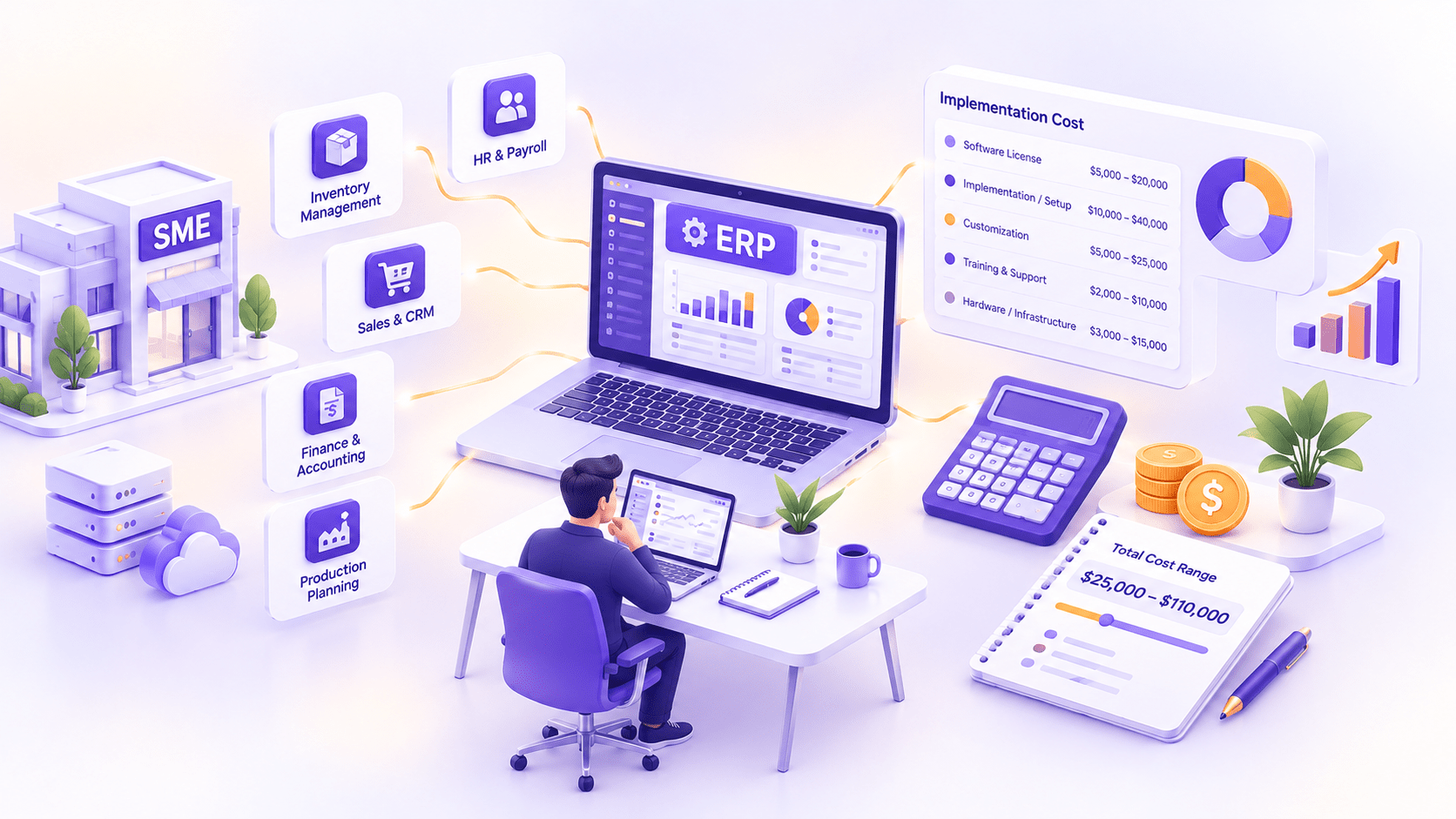
ERP Implementation Cost: A Realistic Budget Guide for SMEs
SME ERP implementations typically run from €25,000 to €250,000 all-in, depending on the platform, company size, and how much customization the project requires. The…
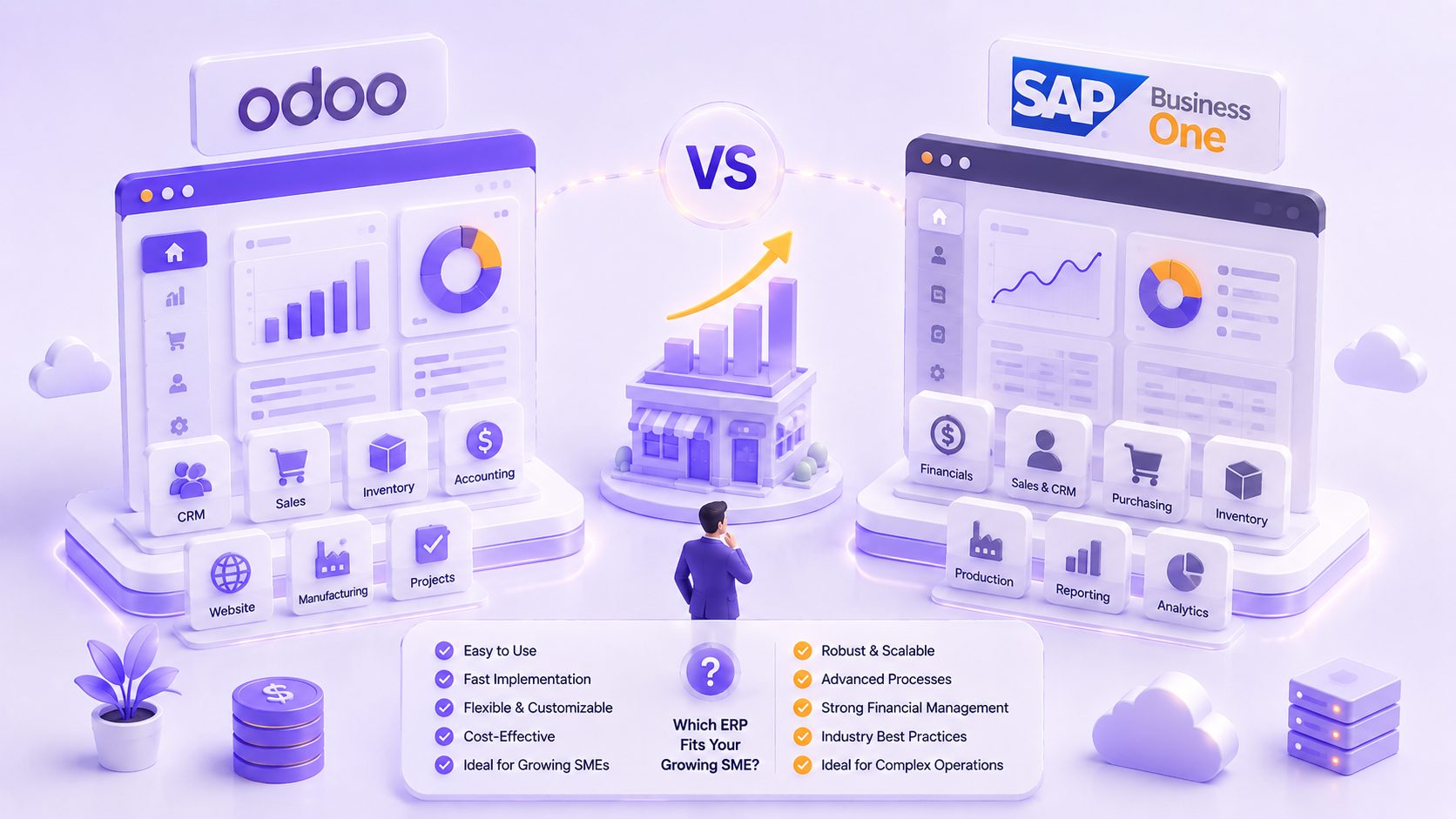
Odoo vs SAP Business One: Which ERP Fits a Growing SME?
Short answer: If you prioritize flexibility, lower licensing costs, and are willing to let an implementation partner take on a heavier share of configuration…
0 Comments
Please log in to post a comment