Odoo vs SAP Business One: Which ERP Fits a Growing SME?
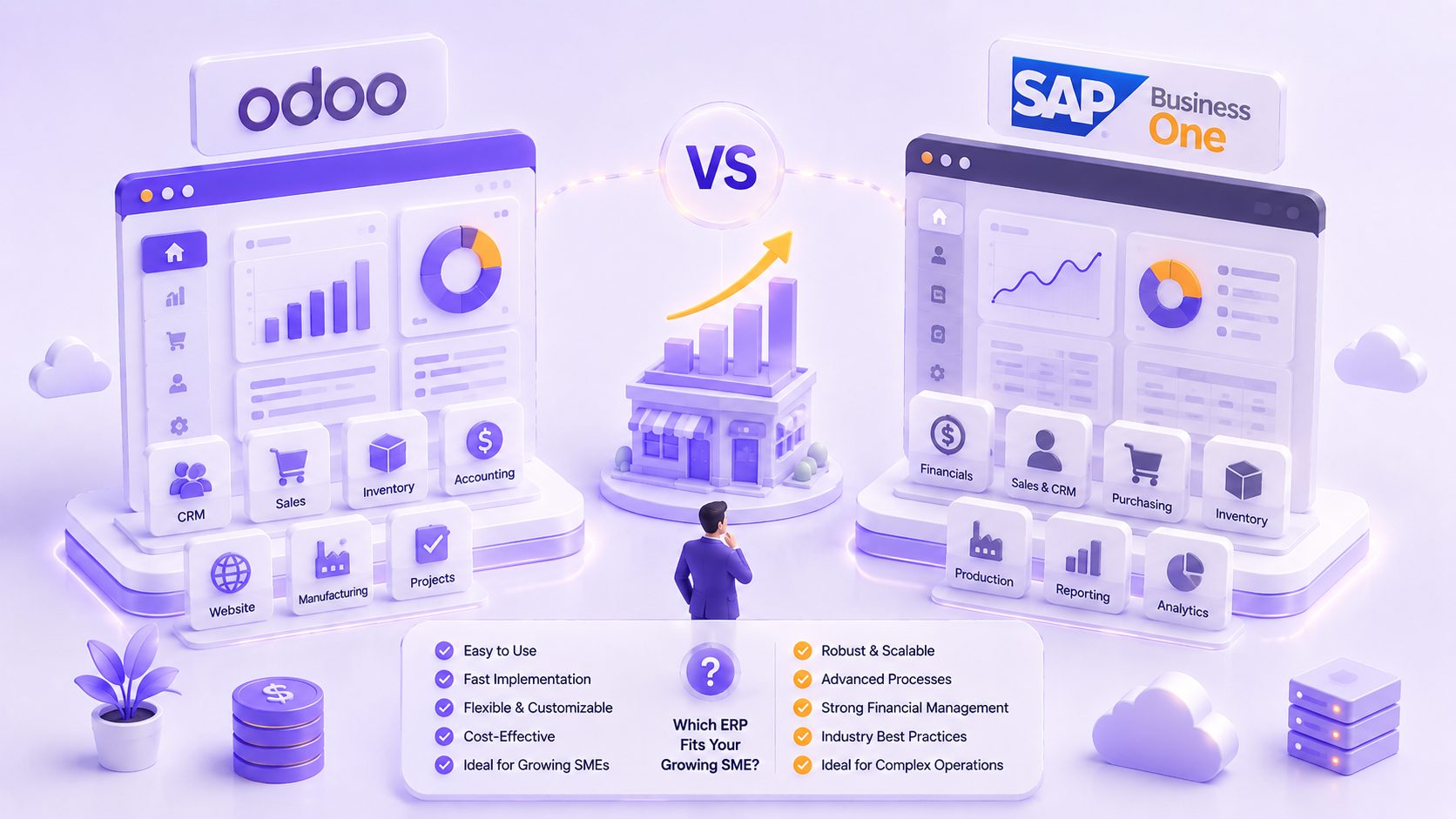
Short answer: If you prioritize flexibility, lower licensing costs, and are willing to let an implementation partner take on a heavier share of configuration work, select Odoo. If you prefer a more standardized, “out-of-the-box” process and envision yourself growing into the SAP universe, select SAP Business One. One isn’t “better” than the other: Both are solutions for differing objectives, and making the wrong choice in your unique scenario will come at high financial costs. Let’s compare more thoroughly.
Odoo vs SAP Business One at a Glance
Aside from vendor marketing, verified user reviews for both software suites largely reflect the same division: “Odoo” reviewers highlight ease of use, flexibility, and affordability, while complaining about sporadic support inconsistency across various partners; meanwhile, SAP Business One reviewers praise stability and complexity but dislike pricing and setup time.
| Odoo | SAP Business One | |
| License model | Open-source core + paid apps/user | Proprietary, per-user + database |
| Typical licensing cost | €20–€35/user/month | €100–€150/user/month |
| Implementation cost | €15,000–€80,000 | €50,000–€200,000+ |
| Implementation time | 3–6 months | 6–12 months |
| Customization approach | Open-source modules, extensive partner ecosystem | Add-ons via SAP-certified partners, closed core |
| Best fit | SMEs prioritizing cost and configurability | SMEs planning to scale into the SAP ecosystem |
What Is Odoo? Strengths and Limits
Odoo is a flexible, open-source, modular ERP that supports accounting, inventory, CRM, and manufacturing-all in one go (it is sold as a bundle of apps you can toggle on rather than a single behemoth ERP system). Its biggest advantage is the versatility-whether the base system is open-source and the partner market is sprawling the possibilities it’s possible-any given workflow process can be designed and stretched to meet business operations without having to build a completely custom approach, and, businesses most time begin with 2 or 3 Odoo applications (accounting & inventory, for instance, and continue adding other modules when appropriate rather than buying the whole software from the beginning. Odoo's downside, however, tends to stem from the other side-the flexibility can make the implementation partners and the business make a series of decisions, as an overblown Odoo could end up having multiple scopes, a limit rigid systems don’t generally share. Odoo projects, in particular, the well-managed system endures over the long haul, whereas the other gets bloated due to each division wanting customization till Odoo is out of the hands of some personnel (aside from the first Odoo consultants, of course), making the entire business process too tough for a regular user to follow the program. Nevertheless, that does not happen because of Odoo, but due to the inability to govern any mission at length.
What Is SAP Business One? Strengths and Limits
Business One is actually SAP’s take on a small-to-mid-market ERP system, and it's more standardized and opinionated in its built-in processes out of the box. That’s where its real sweet spot is. Standardized finance, inventory, and reporting, and if you’re dealing with finance, inventory, or report processes, this will have it down based on decades worth of SAP ERP deployments in the field, so that if you’re facing an edge case, you can bet someone has created a fix to that edge case along with other SAP customers. Plus, it'll integrate nicely with the wider SAP system and all its various cloud-based offerings, like Analytics cloud or even if you want to grow into full-fledged S4/HANA for larger, enterprise sized businesses. The trade-off is cost and inflexibility: customization is available only via certified partner plugins rather than simply opening up the source for developers to modify on top. Also, the per-user licensing tends to climb a little steeper than Odoo, and while it's not a completely open system means it is a little less flexible for certain businesses on the periphery that may want the simplest of tweaks and not rely on a third party to get anything done.
Head-to-Head: 6 Decision Criteria
The numbers in the table are of course the headlines. Below, with those numbers and data are derived, and these are six criterion which most SMEs will find the choice will fall upon, depending on their needs rather than a comparison with each other.
Licensing and pricing
Odoo runs about 20-35 per user/month (for the core apps). You can check current Odoo per-user pricing, although it changes depending on bundle. A 25-user installation of SAP Business One typically costs 100-150 per user/month when database license and standard modules are factored in. That difference equates to about 2,000-3,500/month difference for a 25-user company - it's real money over the long term (multi-year) but doesn't tell the entire story when implementation costs are included.
Implementation cost and time
SME Odoo implementation costs SMEs spend 15k - 80k over 3 - 6 months implementing Odoo solutions. A SAP Business One implementation costs between 50k - 200k over a similar, but much longer time of 6-12 months. The methodology with its more step-by-step partner element and level of integration required are the reasons behind this greater investment and longer time.
Customization and open-source vs. closed ecosystem
The advantage of Odoo’s open-source core is that a developer can really hack at anything and get at most things working whether for good or bad - Odoo is extremely hackable, and it is extremely easy to customize into oblivion and struggle to upgrade. This is limited in SAP Business One’s case via its marketplace of certified third-party add-ons - a bit limiting in that the scope for customizing is much more confined, but again that keeps it manageable through version upgrades which ad-hoc Odoo customization does not always.
Functional depth by department
All have a good grasp on Finance, Inventory, and CRM. Where SAP Business One has strength is in the manufacturing module, and financial consolidation for firms requiring more advanced production or multi-entity accounting. Odoo's advantage is in its breadth, its app marketplace has the entire range from e-commerce to HR, to marketing automation within one integrated system, which is crucial if you want an all-in-one system over a best-of-breed solution.
Usability and learning curve
Generally, Odoo is perceived to be a much more modern and immediately understandable tool for non-technical teams and beginners, where as SAP Business Ones interface, though efficient, is somewhat more laden than its enterprise counterparts - more robust upon gaining proficiency but with an elevated initial learning cliff for the business users.
Scalability and upgrade path
There's a clearer upward trajectory for SAP Business One if you can foresee a future requirement for full SAP S/4HANA or enterprise SAP modules-the ecosystem is geared up for that. Odoo scales well within its own ecosystem but there is not a similar "upgrade to enterprise SAP" path; past a certain point, you're likely to see a genuinely separate ERP migration rather than a pure upgrade of the existing one.
Total Cost of Ownership Over 5 Years
Here's a rough idea of the two compared for a typical 25-user SME over a 5-year span (including license fees, implementation and typical recurring support charges):
| Odoo (25 users) | SAP Business One (25 users) | |
| Implementation (Year 1) | €35,000 | €110,000 |
| Licensing (Years 1–5) | €45,000 (€30/user/mo) | €180,000 (€120/user/mo) |
| Support & maintenance (Years 1–5) | €25,000 | €60,000 |
| Estimated 5-year total | ≈ €105,000 | ≈ €350,000 |
This example of one setup-figures quoted change with module selection, data migration effort, and what your implementation partner will charge you; it's what remains consistent across setups that is of most value-the curve of the delta between what two similar options deliver: the value-of-money of Odoo benefits increase year on year with an licensing gap being reissued every 12 months and what the higher upfront cost in SAP B1 reflects is an bet against the cost of yet another ERP migration in the next 5 to 10 years.
Which Should a Growing SME Choose?
Choose Odoo if…
Standardization is less important than cost effectiveness; your process is unusual enough that you would rather configure a solution to fit that process than to try and change your process to a standard template; you're willing to work with an implementation partner who you are intending to reuse in the long run as a configuration helper rather than as a once-off supplier of an application module or license.
Choose SAP Business One if…
You anticipate you’ll be in the broader SAP ecosystem for a number of years, you’d just as soon “pay more now to buy your processes” instead of build them or: you’re in manufacturing or multi-entity finance, and SAP’s functional depth is an honest plus, not just the “Big Iron Brand Surcharge.”
Conclusion
Both are legitimate ERP options for an SME as it continues to expand, where the choice rarely hangs on “which one is better” but “which one best reflects how your business plans to operate over the next five years”. Should you need us to demonstrate the alignment between your own workflow and either of the two candidates before making your decision, our ERP implementation (SAP, Odoo) services department will do that for you as part of every one of our ERP scoping services. If cost planning is currently a concern, our more granular analysis of the costs associated with ERP implementation provides in-depth insights into the data supplied above. Alternatively, if neither system accurately reflects your workflow, it is even possible to explore custom-built ERP solutions.
FAQs
Related Blog
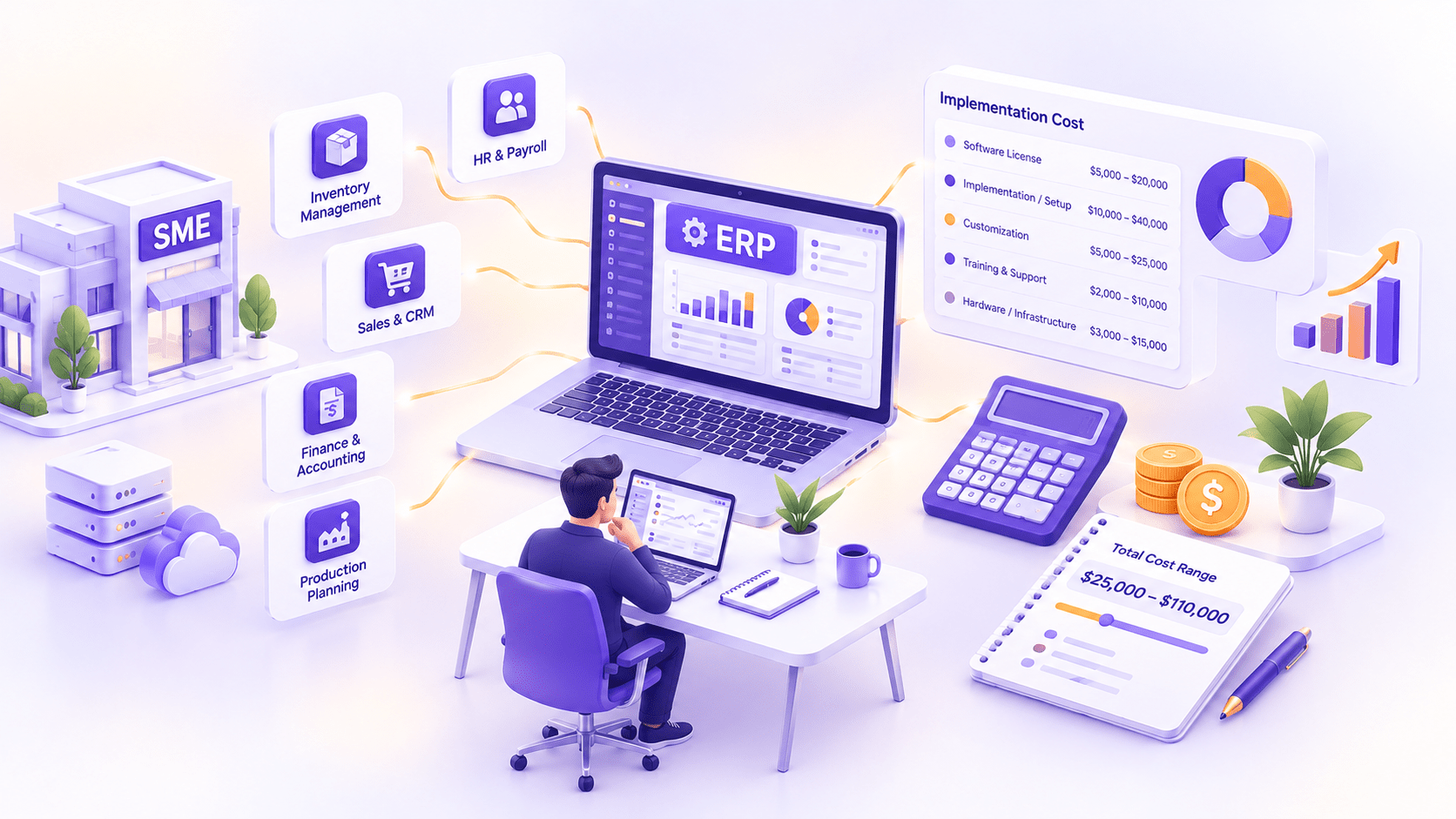
ERP Implementation Cost: A Realistic Budget Guide for SMEs
SME ERP implementations typically run $25,000 to $250,000 all-in, covering software, implementation partner fees, data migration, and training, with most growing businesses landing between…

Custom CRM vs Salesforce vs HubSpot: An Honest Cost-Benefit Breakdown
Platforms win early, and custom wins at scale or when your workflow genuinely does not fit a template. Salesforce and HubSpot both get you…
0 Comments
Please log in to post a comment