Custom ERP Development: When Off-the-Shelf Stops Fitting
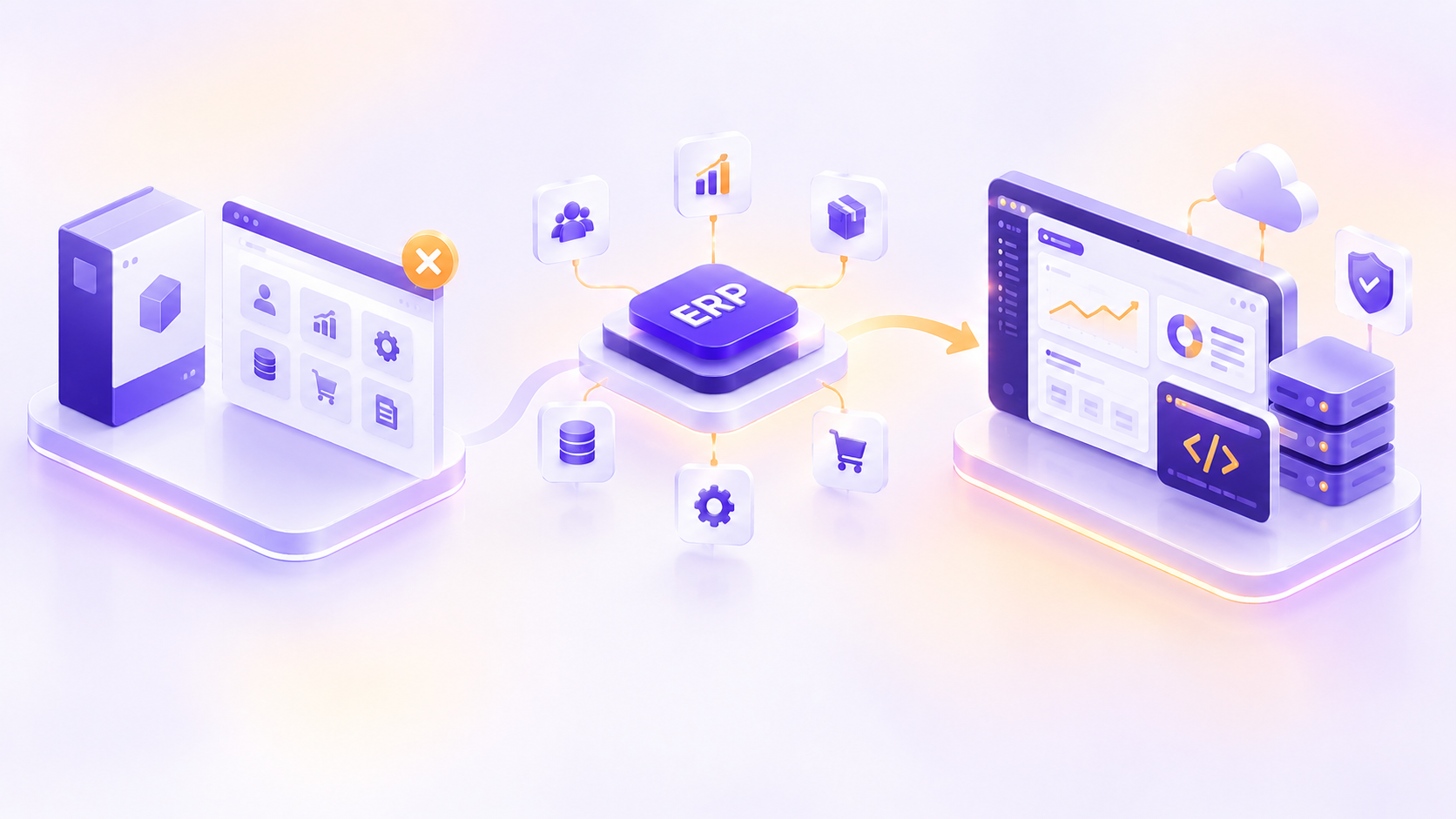
Most businesses should not build a custom ERP system. That's not a hedge; it's the honest starting point. Configured platforms like Odoo and SAP Business One exist because most companies run recognizable versions of finance, inventory, and operations, and a well-implemented platform gets them running in months rather than years, at a fraction of the cost.
But "most businesses" isn't "every business". Some operations genuinely don't fit any off-the-shelf model, no matter how much configuration or customization you throw at it. When that's true, forcing the fit costs more than building the right thing from the start.
This post covers how to tell the difference, what a custom build costs against a configured platform like Odoo or SAP Business One, and how to keep a custom ERP project from becoming one of the industry's well-documented cautionary tales.
What is custom ERP development?
Custom ERP development means building an enterprise resource planning system from the ground up, or on a framework, rather than configuring a commercial product like Odoo, SAP, NetSuite, or Microsoft Dynamics. Instead of adapting your processes to fit a vendor's data model and workflow assumptions, you build the data model and workflows around your actual operations.
That doesn't necessarily mean writing everything from scratch. Many "custom" ERP builds combine off-the-shelf components (a database, an authentication layer, and a reporting engine) with custom-built business logic where it actually matters. The defining feature isn't zero third-party code. It's that the system's core processes are designed around your business rather than around a vendor's product roadmap.
This is also different from customizing a platform you've already implemented. Adding a few custom fields and workflows to Odoo is configuration. Rebuilding Odoo's inventory logic from scratch because your warehouse operations don't fit its model is custom development, and at that point you should ask whether you're still using Odoo or just paying for it.
Six signs off-the-shelf ERP no longer fit
None of these signs alone should send you toward a custom build. Together, or at enough severity, they're worth taking seriously.
Your processes are being forced to match the software.
Every ERP platform encodes assumptions about how work happens. When those assumptions match your business, configuration is fast and painless. When they don't, you end up with staff working around the system instead of through it, maintaining spreadsheets alongside the "system of record" because the software can't represent how the work actually happens. If your team has quietly built a shadow process in Excel because the ERP can't handle it, that's the clearest version of this sign.
Customization costs are starting to rival a build.
Heavily customized implementations of platforms like SAP or Dynamics can run into hundreds of thousands of dollars in configuration and custom code, on top of licensing. At some point, the math shifts: if you're paying build-level money to bend a platform into shape, you should ask whether you'd get more for the same spend by building the thing you actually need. There's no fixed threshold here, but if custom development work is already the majority of your implementation budget, it's worth the comparison.
Per-seat licensing is punishing you at scale.
Platforms like SAP Business One and Dynamics charge per user, which is fine at 15 seats and can become a real cost problem at 150. A business with a large frontline or seasonal workforce that all needs some level of system access can find per-seat licensing scales worse than the cost of owning the software outright. This is one of the more purely financial triggers on this list and one of the easier ones to model with real numbers.
You've hit an unbridgeable integration gap.
Most modern ERP platforms integrate reasonably well with common tools. The trouble shows up with legacy systems that have no modern API, highly specific hardware (custom manufacturing equipment, proprietary scanners, or regulated lab instruments), or a data architecture that simply doesn't map to how a commercial ERP expects to structure information. If you've spent real money on middleware and custom connectors and you're still fighting the integration, that's a sign the platform's architecture, not just its configuration, is the problem.
The workflow is a genuine competitive advantage.
Some operational processes are commodity. Others are the reason a business wins. If a specific pricing engine, a proprietary allocation logic, or an unusual fulfillment sequence is part of what makes your business better than competitors, running it inside a shared platform (even a heavily customized one) means every future platform upgrade is a risk to the thing that differentiates you. Gartner's research on enterprise application strategy frames this well: the Buy, Build, and Blend framework generally points toward buying commodity capability and building where the capability is genuinely differentiating.
The vendor's roadmap is diverging from your needs
Platforms evolve according to their own commercial priorities, not yours. If a vendor is visibly investing in a market segment or feature set that has little to do with your business, while the capabilities you actually need stay stagnant release after release, that's a slow-motion version of vendor lock-in working against you rather than for you.
Custom ERP vs. configured platform vs. hybrid
| Configured Platform (Odoo, SAP B1) | Hybrid (Platform + Custom Modules) | Fully Custom Build | |
|---|---|---|---|
| Time for the first version | 3 to 6 months | 4 to 9 months | 9 to 18 months, often longer |
| Typical cost profile | Lowest upfront, ongoing licensing | Moderate upfront licensing plus dev cost | Highest upfront, no licensing |
| Fit for unusual processes | Limited by platform design | Good for isolated gaps | Unlimited, at a development cost |
| Upgrade path | Vendor-managed can be disruptive to customizations. | Vendor-managed core and custom modules need separate maintenance | Entirely your responsibility |
| Best fit | Standard finance, inventory, and operations workflows | A platform that's 80% right with a few genuine gaps | Operations with no reasonable off-the-shelf match |
For most growing SMEs, the honest starting point is a configured platform, with our ERP implementation cost guide covering what that typically runs. The hybrid path, extending a platform like Odoo with custom modules built on its own development framework, covers a large share of the businesses that think they need a full custom build but don't. Fully custom is the right call only once the signs above are genuinely present, not just uncomfortable.
What custom ERP development costs
Because a custom build has no licensing floor and no standard configuration path, cost bands are wider than for a platform implementation. As a general guide:
- Focused single-module builds (a custom inventory or scheduling system integrated with existing finance software): roughly $40,000 to $120,000
- Mid-complexity custom ERP covering two to three core functions (finance, inventory, and order management, for example): roughly $120,000 to $350,000
- Full custom ERP across finance, inventory, procurement, and operations, with proper reporting and role-based access: $350,000 and up, with genuinely complex, multi-entity, or multi-region builds running well past $1 million
These bands cover the build phase, not the total cost of ownership. Add ongoing hosting and infrastructure, and budget for maintenance at roughly 15 to 20% of the build cost per year, consistent with the maintenance-cost pattern discussed in our legacy software modernization guide. Unlike a licensed platform, there's no recurring per-seat fee, which is exactly the tradeoff that makes custom development pay off at high user counts and painful at low ones.
If you're evaluating a custom build against continuing with a configured platform, run both sides through the same multi-year lens rather than comparing a one-time build quote to a monthly subscription. A configured platform's licensing adds up over years the same way a custom build's maintenance does.
Timeline and phasing: how a custom ERP actually gets built
A realistic custom ERP project moves through distinct phases, and skipping or rushing the early ones is where most timeline and budget overruns start.
- Discovery and process mapping (4 to 8 weeks). Documenting how work actually happens today, not how a process diagram says it should happen. This phase alone often surfaces workarounds nobody had mentioned.
- Architecture and data model design (3 to 6 weeks). Deciding how core entities (orders, inventory, customers, and financial records) relate to each other. Mistakes here are expensive to fix later, so this phase deserves real scrutiny before development starts.
- Core module development (3 to 9 months, depending on scope). Usually built and tested module by module rather than as one monolithic release, so the business gets working software incrementally instead of waiting for a single big-bang launch.
- Integration and data migration (4 to 10 weeks). Connecting to existing systems and migrating historical data, which is consistently underestimated in both time and complexity.
- User acceptance testing and training (4 to 8 weeks). Real staff, using real workflows, before go-live, not after.
- Phased rollout (varies). Department by department or site by site is generally lower-risk than switching everything over on one date.
A single-module custom build can realistically launch inside 6 months. A full multi-function custom ERP more commonly runs 9 to 18 months, and treating that shorter estimate as a promise is one of the more common ways these projects go over budget.
Risks of custom ERP and how to manage them
Custom ERP development carries real risk, and the industry data on ERP projects generally is a useful reality check before committing. Panorama Consulting's 2026 ERP Report found that more than a quarter of organizations exceeded their project budgets, with additional technology needs and late-discovered process misfits cited as leading causes. That data covers ERP projects broadly, including platform implementations, but the underlying failure patterns apply just as much, if not more, to custom builds, since there's no vendor default to fall back on when something is missed.
The main risks worth planning for:
- Scope creep. Without a vendor's fixed feature set as a boundary", while we're building it, let's also add" is a constant temptation. Lock scope for each phase and treat additions as a new phase, not a mid-build addition.
- Key-person dependency. A custom system is only as maintainable as the team that understands it. Documentation and code ownership matter more here than on a platform implementation, where a whole ecosystem of consultants can pick up the work.
- Underestimated maintenance. Platform vendors absorb security patching, compliance updates, and infrastructure scaling as part of the license. On a custom build, all of that is now your responsibility, whether in-house or contracted.
- No vendor safety net. If a configured platform has a bug, a vendor with thousands of other customers has an incentive to fix it. A custom system's bugs are entirely yours to resolve, on your own timeline and budget.
None of these risks are reasons to avoid custom development outright. They're reasons to go in with a realistic budget, a phased plan, and a partner who will tell you honestly when a platform would actually serve you better, which is worth demanding regardless of who builds it.
The bottom line
Custom ERP development is the right call for a genuine minority of businesses, and it's usually obvious in hindsight which side of that line a company was on. The signs are concrete: processes being forced to match software rather than the other way around, customization costs approaching build costs, per-seat licensing punishing you at scale, integration gaps that middleware can't close, a workflow that's a real competitive advantage, or a vendor roadmap heading somewhere you're not.
If none of those apply strongly to your business, a configured platform, possibly with targeted custom extensions, will very likely serve you better and cost less. If several of them do apply, a custom build stops being a risk and starts being the sensible option.
Not sure which side of that line your business is on? The team at Raydiant Webs can walk through your actual processes with you and give you a straight answer, whether that answer is custom development or a platform you haven't fully explored yet.
Frequently asked questions
Related Blog
Healthcare Software Development: What Compliance Actually Requires
A founder says, "We just need to make it HIPAA compliant", as if compliance were a plugin you install before launch. Then the first…
The Software Development RFP Template That Gets Useful Proposals (Free Download)
A good software development RFP contains nine things: company and project background, a problem statement separated from any assumed solution, clear scope boundaries, real…
0 Comments
Please log in to post a comment