Fintech Software Development: Regulation, Security and Build Choices
In most software, a bug is an annoyance. In fintech, a bug can mean money leaving an account that should not have, a breach of sensitive financial data, or a regulator asking hard questions about how you handle people's money. That is the difference that defines this whole field. Building financial software is not just harder than ordinary development, it is a different discipline, one where regulation and security are not features you add near the end but the foundation you build on from the first day.
That is why so many fintech projects struggle. Teams treat compliance as paperwork to sort out later and security as a checklist for launch week, and both assumptions are expensive mistakes. Get them wrong and no amount of slick design will save the product.
This guide focuses on the three things that actually decide whether a fintech build succeeds: getting regulation right, getting security right, and choosing the right way to build. We will cover the types of fintech software, the features every product needs, the regulatory landscape, the security it demands, and the build and cost choices in front of you. One honest note before we start: the regulatory content here is general guidance, not legal advice, so always consult a compliance specialist for your specific product and jurisdiction.
What Fintech Software Development Actually Involves
Fintech software is any application that delivers financial services. That covers a huge range, including payments, digital banking, lending, investing, and insurance, but the common thread is always the same: it handles money and highly sensitive personal data, usually at scale and often in real time.
That common thread is exactly what sets fintech apart from ordinary software development. A few things are non-negotiable in a way they simply are not elsewhere. The product must comply with strict financial regulation. Security cannot be an afterthought, because the stakes are real money and real identities. Transactions involve actual funds, so errors have direct financial consequences. And downtime is not just inconvenient, it can breach obligations and destroy trust in minutes.
Put simply, fintech carries a level of responsibility that most software never touches. The rest of this guide works through what that responsibility means in practice: the types of products you might build, the features they all need, the two hard constraints of regulation and security, and the choices that shape how you actually build. Keep the core idea in mind throughout, because it explains almost every decision that follows. In fintech, trust is the product, and regulation and security are how you earn it.
Types of Fintech Software
"Fintech" spans a wide range of products, and knowing which one you are building shapes everything from the regulations that apply to the features you need.
Digital banking. Neobanks and banking apps that let people manage accounts, cards, and money entirely through software, with no branch required.
Payment processing. Payment gateways, digital wallets, remittance tools, and buy-now-pay-later services that move money between parties.
Lending and credit. Loan platforms, credit scoring systems, and BNPL products that assess risk and lend money, increasingly using AI for credit decisions.
WealthTech. Robo-advisors, investment apps, and trading platforms that help people grow and manage their money.
InsurTech. Digital insurance products and claims automation that modernise a traditionally slow industry.
RegTech. Software that automates compliance itself, handling KYC, AML monitoring, and regulatory reporting for other financial businesses.
Embedded finance and Banking as a Service. Financial features, like payments or lending, built directly into non-financial apps through ready-made infrastructure.
Crypto and blockchain. Exchanges, wallets, and decentralised finance platforms built on blockchain technology.
Most real products combine several of these. A digital banking app, for example, might include payments, lending, and embedded investment features all at once, which is part of what makes fintech builds complex.
Must-Have Features of Fintech Software
Whatever you build, a fintech product needs a baseline set of features that are simply expected. These are not nice-to-haves, they are the price of entry.
Security and identity. Multi-factor authentication, biometric login, and automated KYC and identity verification to confirm users are who they claim to be.
Transactions. Real-time transaction processing and multi-currency support, so money moves instantly and across markets.
Intelligence. AI-powered fraud detection, risk scoring, and clear financial analytics that both protect users and help them understand their money.
Compliance. Built-in AML monitoring, tamper-evident audit trails, and regulatory reporting, so the product meets its obligations automatically rather than manually.
Integration. A solid API layer connecting to payment networks, banks, credit bureaus, and data aggregators like Plaid, because no fintech product is an island.
Each of these carries weight and cost, which is one reason fintech builds run more expensive than ordinary software. Building them properly is the heart of serious custom software and app development in the financial space, where the features have to be secure and compliant, not just functional.
The Regulatory Landscape8
Here is the first of the two constraints that define fintech. Financial software is heavily regulated, and which rules apply depends entirely on where you operate and what you do. This section is a map, not legal advice, so treat it as a starting point for a conversation with a compliance specialist.
Data protection. Wherever you handle personal data, privacy law applies. GDPR governs it in the EU, CCPA and related laws in US states, and the DPDP Act in India, among others. These shape how you collect, store, and use customer information.
Payment and card data. If you touch card payments, the PCI DSS standard sets strict requirements for how card data is handled and secured. It is effectively mandatory for payment products.
Identity and anti-crime. KYC (Know Your Customer) and AML (Anti-Money Laundering) rules apply almost everywhere, requiring you to verify users and monitor for suspicious activity. In the US, the Bank Secrecy Act underpins much of this.
Regional financial regulation. Beyond the basics, regional frameworks add their own demands. The EU has PSD2, DORA, and MiCA for crypto. The UK has the FCA's rules. India has RBI guidelines. The US layers federal and state-level licensing on top of each other.
Open banking. Frameworks that let customers share financial data securely between providers are now live across Europe, the UK, and beyond, and they shape how modern fintech connects.
There is also the question of licensing, which catches out founders who assume a good product is enough. Depending on what you do, moving money, lending, or holding customer funds, you may need a specific license or must partner with a regulated institution that already holds one. This is often the single biggest determinant of how you structure the business, and it is a decision to make before you write any code, not after. Many fintech startups launch by partnering with a licensed bank rather than becoming regulated themselves, precisely because the licensing path is slow and expensive.
Two things matter most here. First, compliance has to be designed in from day one, because retrofitting it into a finished product is painful and often means rebuilding. Second, it is expensive: compliance and security together commonly consume 30 to 40 percent of a fintech budget. That is not waste, it is the cost of being allowed to operate. For an authoritative reference on just one piece of this, the PCI DSS payment security standards show the level of detail involved, and planning for all of it is where IT consulting and digital strategy earns its place early in a project.
Security: Non-Negotiable in Fintech
The second defining constraint is security, and in fintech the bar is as high as it gets. A security failure here is not a bad week, it can be the end of the business through fines, lawsuits, and a total loss of the trust that financial products depend on.
A serious fintech product builds in a layered set of protections:
- Strong authentication, including multi-factor authentication, biometrics, and passkeys, so access is tightly controlled.
- End-to-end encryption, protecting data both in transit and at rest, so intercepted data is useless.
- Zero-trust architecture, where nothing inside the system is automatically trusted and every request is verified.
- AI-powered fraud detection and real-time monitoring, catching suspicious activity as it happens.
- Tamper-evident audit logging, creating a reliable record for both security and compliance.
- Penetration testing and vulnerability assessment before every major release, finding weaknesses before attackers do.
- Secure APIs and tokenization, so sensitive data is never exposed unnecessarily.
- Incident response planning and automated failover, so the system stays resilient when something goes wrong.
The critical point is that security is designed into the architecture from the very beginning, not bolted on before launch. A product built with security as an afterthought has gaps that no amount of late patching fully closes. In fintech, both your customers and your regulators treat security as a core feature, and rightly so. It is the thing that makes everything else trustworthy. Beyond the protection of personal data covered by rules like how GDPR governs personal data, this is about protecting the money itself.
Build Choices: How Should You Develop It?
The third pillar is how you actually build, and fintech presents some specific choices.
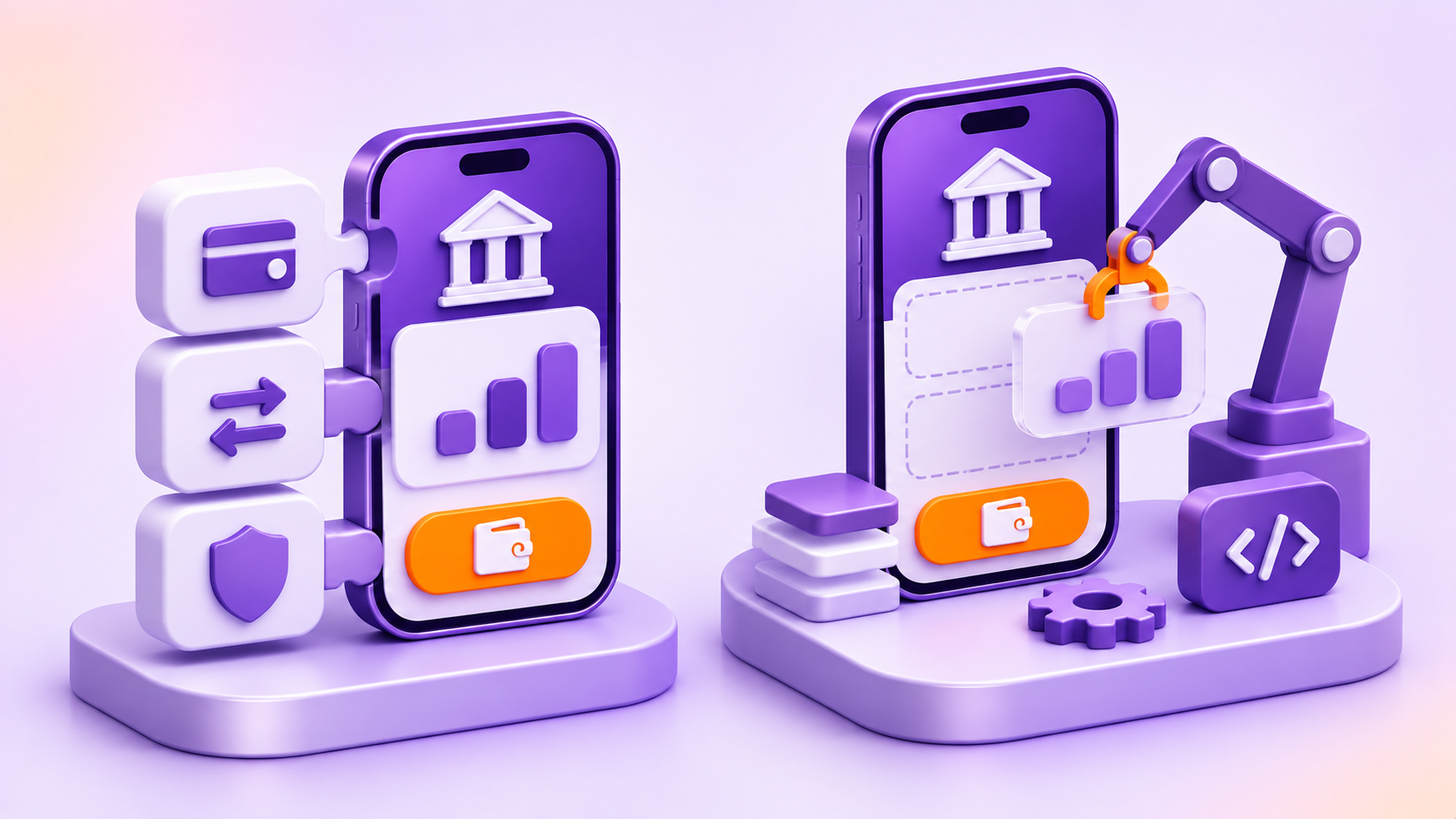
In-house, outsource, or specialist partner. Building in-house gives control but requires hiring rare talent, since fintech needs people who understand both regulation and security deeply. Outsourcing to a specialist partner who already has that expertise is often faster and less risky than assembling it yourself from scratch.
Custom build versus Banking as a Service. You can build everything from the ground up for maximum control, or use Banking as a Service and embedded-finance platforms that provide ready-made, partly pre-compliant components. For many products, especially early-stage ones, BaaS dramatically cuts both time to market and compliance burden, because you inherit infrastructure that already meets many requirements. A full custom build makes more sense once you reach scale and need control that off-the-shelf infrastructure cannot give.
Native versus cross-platform for the app itself. Cross-platform frameworks cover iOS and Android from one codebase and lower cost, while native delivers maximum performance for the most demanding apps. Our comparison of native versus cross-platform development walks through which fits a given product.
Cloud-native and microservices architecture is the modern default for fintech, because it scales, isolates failures, and handles real-time load far better than a single monolithic system. When one service handles payments and another handles identity, a problem in one does not take down the whole platform, which matters enormously when money is moving through the system.
A practical way to think about these choices together is to separate what differentiates your product from what does not. The parts that make your product unique, your user experience, your specific financial logic, are worth building and owning. The parts that are the same for everyone, like core compliance checks, identity verification, and payment rails, are often better handled by proven infrastructure and specialist providers. Building everything from scratch, including the plumbing that dozens of mature services already do well, is how early fintech budgets get burned on solved problems instead of on the product itself.
Matching these choices to your stage and goals is a strategic decision, and it is where experienced mobile app development and software partners add the most value, by steering you toward the route that fits rather than the most expensive one.
The Fintech Development Process
The way a fintech product is built differs from ordinary software in one crucial respect: compliance and security run through every phase, not just one. The process generally looks like this.
It starts with discovery and requirements, defining exactly what you are building and for whom. Then comes compliance and regulatory planning, early rather than late, so the rules shape the design from the outset. Architecture and security design follow, building the secure, scalable foundation. UI/UX design makes the product usable and trustworthy, which matters enormously when people are handling their money.
Development and integration proceed in agile sprints, connecting the many third-party services a fintech product relies on. Security testing and compliance review then verify that the product is both safe and lawful before it ships. Deployment sets up the production infrastructure, and finally post-launch monitoring and continuous compliance keep the product secure and up to date as regulations and threats evolve.
The theme throughout is that security and compliance are not a single stage you pass through and forget. They are woven into discovery, design, development, testing, and the entire life of the product after launch. A team that treats them as a one-time checkpoint has misunderstood the job.
What Fintech Software Costs and How Long It Takes
Fintech builds cost more than comparable non-regulated software, and now you know why: compliance and security alone eat 30 to 40 percent of the budget. Here are the market ranges by scope, as general figures rather than fixed quotes.
| Tier | Timeline | Typical Cost |
|---|---|---|
| MVP / regulated pilot | 2 to 4 months | $50,000 to $120,000 |
| Mid-scale platform | 5 to 9 months | $120,000 to $250,000 |
| Enterprise platform | 9 to 14 months | $300,000+ |
Beyond scope, the main cost drivers are the regulatory and security requirements, the number of third-party integrations, the complexity of the product, and the location and seniority of your development team. Integrations in particular add up, since connecting to payment networks, KYC providers, and banking APIs each takes real work.
Do not forget the ongoing costs either. Annual maintenance commonly runs 15 to 20 percent of the build cost, and fintech carries an extra continuing burden: compliance does not stand still, so keeping up with changing regulations is a permanent line item. For the deeper mechanics of how app budgets are built, our guide on how much it costs to build a mobile app breaks the drivers down, and the same principles apply here with compliance layered on top.
If you want a grounded estimate for your specific product rather than a broad range, talk to us about your fintech project and we will scope it properly.
Conclusion
Fintech software lives or dies on three things: getting regulation right, getting security right, and choosing the right way to build. These are not add-ons or afterthoughts. They are the foundation, and they are why fintech is a specialist discipline rather than ordinary app work. A beautiful product that fails compliance or suffers a breach is not a product at all, it is a liability.
The businesses that succeed in fintech treat compliance and security as design principles from day one, and they choose a build path that matches their stage, whether that is launching fast on Banking as a Service or building custom for scale. Get those foundations right and everything else becomes possible.
If you are planning a financial product and want a partner who treats regulation and security as the starting point rather than the finish line, talk to us about your fintech project and we will help you build it on solid ground.
0 Comments
Please log in to post a comment